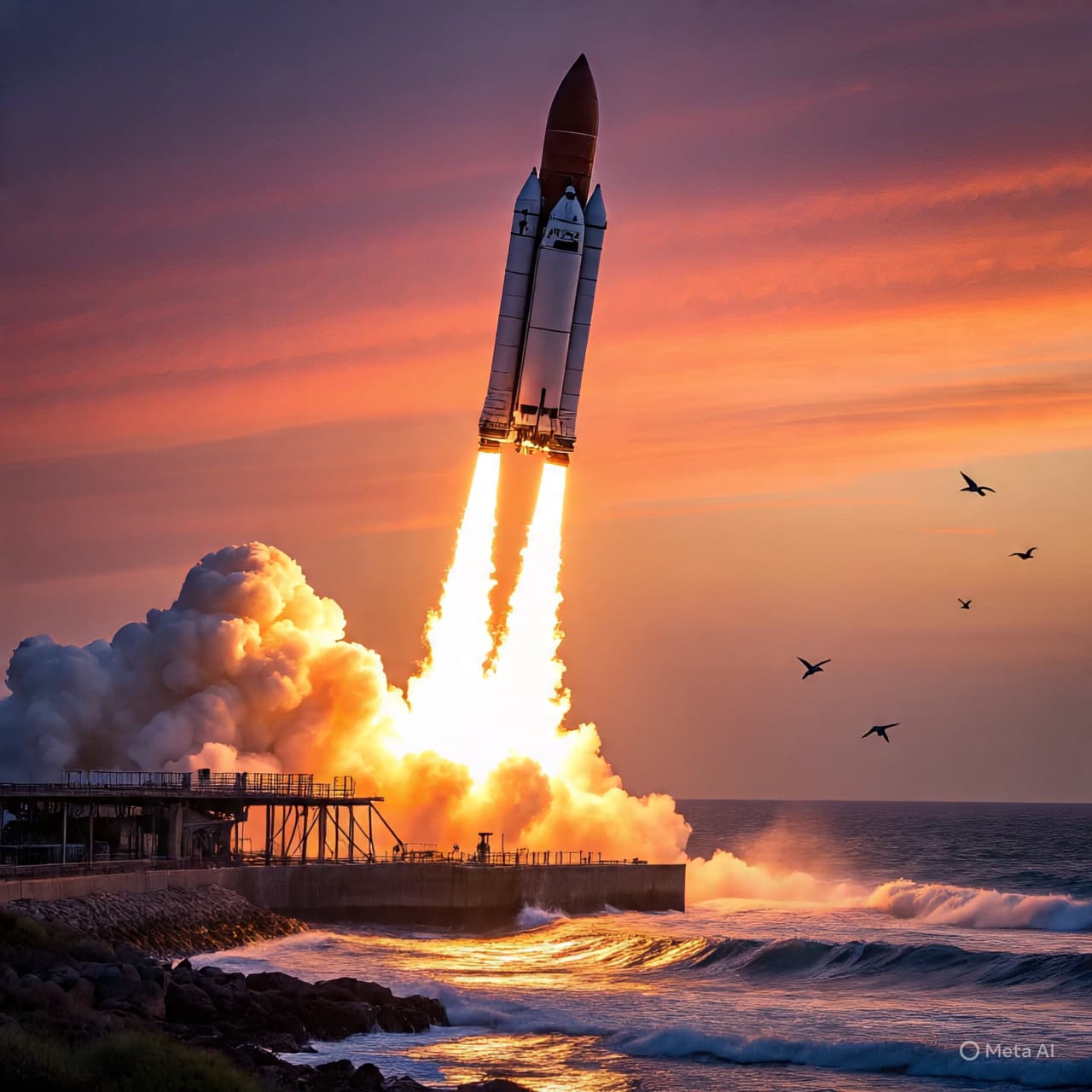
On a clear evening in South Texas, a giant silver arrow rose into the twilight, stirring the hush of spectators and engineers alike. It was more than a launch: it felt like a question posed to the sky. Astronautical ambitions, long nurtured in metal and fire, asked for another moment to show their promise. Monday’s flight marked not just another trial — it was the final dance of the current Starship before its successors take the spotlight.
SpaceX launched its 11th test mission of Starship from its Starbase facility, sending the vehicle on a suborbital arc before it reentered and splashed down gracefully in the Indian Ocean. Meanwhile, the Super Heavy booster separated and executed a controlled descent into the Gulf of Mexico. The mission tested a suite of innovations: relight of engines in space, deployment of mock satellites, heat-shield tile behavior, and a novel landing burn profile for the booster. This blend of ambition and restraint—pushing boundaries while honoring safety—feels like the work of modern pioneers. (Sources: Reuters; AP News; Space.com)
This flight carries weight beyond its minutes in the sky. For months, the Starship program wrestled with challenges—some flights ended prematurely, others consumed in explosions. Yet in recent months, resilience has sharpened in those trials, reframing what counts as success in a rocket’s life. This 11th mission arrives not as perfection, but as proof that iteration can transcend failure. (Sources: AP News; Reuters)
What’s quietly striking is how this flight serves both as a finishing chapter and a prologue. It is likely the last launch of this particular generation of Starship and Super Heavy. From here, new variants will incorporate lessons learned: loftier thrust, refined engine configurations, enhanced reusability, and systems for orbital refueling. (Sources: Space.com; Reuters)
In its trajectory across the sky, the rocket carried eight dummy payloads to mimic future satellite missions, and tested relighting engines midflight—moves essential for deep-space voyages. The booster, in its final act, ignited 13 engines at landing burn start, then shifted to a new configuration of five engines during the divert phase—previewing what future versions may adopt. (Sources: Reuters; Space.com)
For observers, the imagery is powerful: a rocket piercing dusk, shedding its first stage like a good farewell, then the upper stage arcing into sea spray. It bridges our longing for spectacle with the steely drive of engineering. One cannot help but see in it a metaphor: we launch from what we know even as we aim for what lies ahead.
Still, challenges remain. No component was recovered intact this time, and the path from tests to routine missions is narrow and treacherous. Each mission must prove reliability; each variant must carry confidence. The transition from prototypes to regular flight cadence always tests momentum, funding, and public faith.
But for tonight, the roar fades, the sea absorbs the splash, and we are left with a quiet sense of promise. Not every flight writes history in flame, but every successful test adds a brick to the doorway between Earth and the beyond.
We move into a new chapter now. The version just retired bows out with dignity, handing the torch to its successors. SpaceX will soon push its newer rockets into space, carrying forward the lessons of the past eleven flights. In that modest relay lies the truth of progress: time and again, we must test, fail, relearn—and then launch again.
AI Image Disclaimer: “Visuals are created with AI tools and are not real photographs.”
Sources: Reuters; AP News; Space dot com
Published by Banx Network. This article is part of the Banx decentralized media programme, powered by the BXE token on the XRP Ledger.