

Key Highlights
- Death Toll:At least 21 villagers killed in Zamfara attacks.
- Attack Details:Gunmen launched coordinated raids on five communities.
- Ongoing Crisis:The violence underscores a worsening security situation in Nigeria's northwest.
GUSAU, Nigeria — A wave of coordinated horror swept across Zamfara State as heavily armed gunmen launched brutal raids on five farming communities, leaving at least 21 villagers dead. The coordinated assault underscores the deepening security crisis gripping Nigeria’s troubled northwestern region.
Local authorities and surviving residents described a chaotic scene as large bands of criminal gangs, locally referred to as bandits, breached the borders of the rural settlements simultaneously, unleashing gunfire on unsuspecting residents and pillaging properties. Eyewitness accounts reveal that the attackers, riding on dozens of motorcycles, surged into the cluster of villages in a synchronized offensive designed to overwhelm local volunteer defense forces. The gunmen began shooting indiscriminately at anyone in sight, setting fire to structures and grain stores while forcing hundreds of terrified families to scatter into surrounding forests for safety.
The 21 confirmed victims include local farmers who were caught in their fields and members of community vigilante groups who bravely attempted to repel the invaders with rudimentary weapons. This tragic incident highlights the vulnerability of rural communities in Zamfara, where residents often rely on local defense groups to protect them from such attacks.
Zamfara State has long stood at the epicenter of a brutal conflict driven by heavily armed criminal syndicates operating from deep forest hideouts spanning the northwest. These groups—unaffiliated with ideological or religious insurgencies—are largely motivated by financial gain, relying on mass abductions for ransom, cattle rustling, and extortion of farming communities to fund their operations. The latest multi-village massacre highlights a disturbing pattern where security vacuums in remote regions allow large criminal networks to operate with near-impunity, frequently outpacing the response times of state security forces.
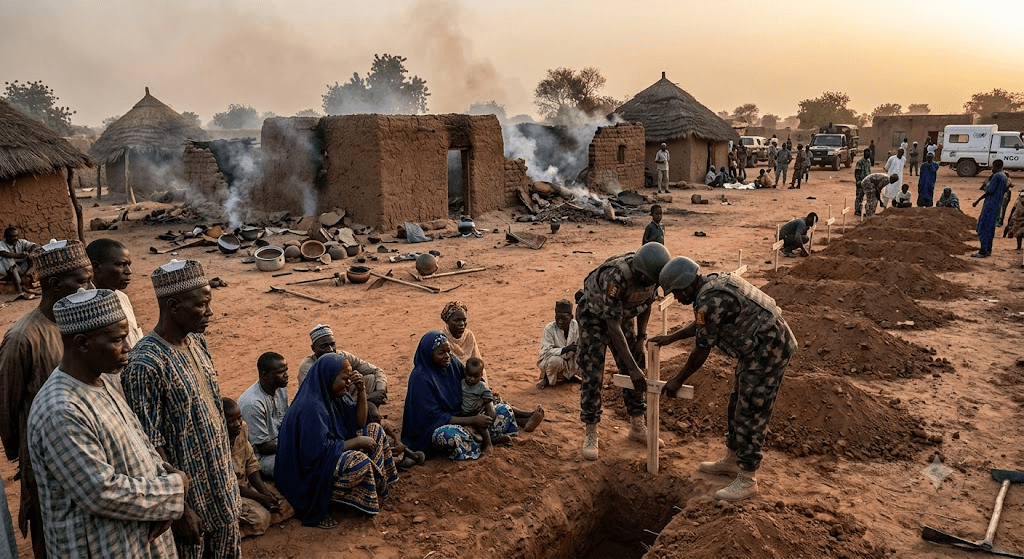
Following the withdrawal of the gunmen, state police commands and military detachments were deployed to secure the affected areas and recover the bodies of the victims. Medical teams are currently treating a significant number of wounded survivors who suffered severe gunshot injuries during the onslaught. The local health facilities are overwhelmed, struggling to provide adequate care for the influx of injured individuals.
Community leaders have renewed their urgent pleas to the federal government to establish permanent military outposts in the vulnerable border zones of Zamfara. They argue that without a sustained military presence, the region will continue to suffer from these violent attacks. A full-scale search-and-rescue operation is currently underway in the surrounding wilderness to locate unaccounted-lost villagers who fled the initial gunfire. The ongoing violence has left many families in despair, fearing for their safety and the future of their communities.
As the situation develops, the need for a comprehensive strategy to address the root causes of violence in Zamfara becomes increasingly urgent. The federal government faces mounting pressure to take decisive action to restore security and protect the lives of its citizens in this troubled region.
Published by Banx Network. This article is part of the Banx decentralized media programme, powered by the BXE token on the XRP Ledger.




