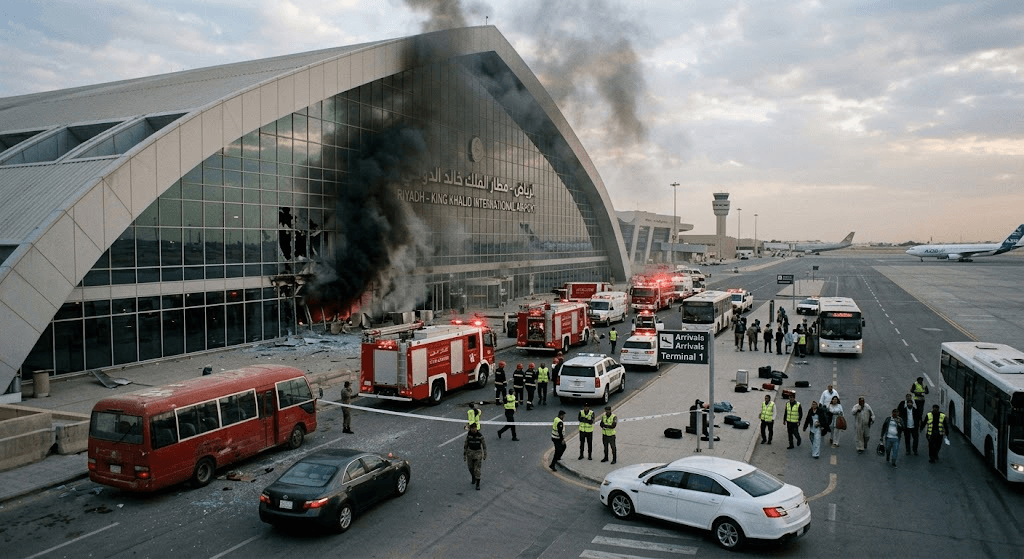
RIYADH — A projectile attack targeting King Khalid International Airport in the Saudi capital on Sunday, October 11, 2026 killed a Pakistani resident and injured 11 others, Saudi authorities confirmed. The incident sparked a localized fire and caused material damage at the facility, marking a sharp escalation in regional strikes across the Kingdom's transportation hubs.
Saudi Arabia’s General Authority of Civil Aviation (GACA) announced early Monday that emergency services swiftly responded to the strike, transferring the wounded to nearby medical facilities for urgent treatment.
The Sunday assault comes just one day after a massive barrage struck the same international facility, leaving 12 dead and over 300 injured. Witnesses in northern Riyadh reported hearing loud explosions overhead that shook residential structures.
"The whole house shook when the blast went off," said one resident of the capital's Al-Aarid neighborhood.
The Saudi-led coalition blamed Yemen’s Houthi movement for the wave of aerial strikes and reported intercepting additional ballistic missiles and armed drones targeting eastern regions and southern base installations.
Following the attack, flight operations at King Khalid International Airport faced severe disruptions. Multiple incoming flights were diverted to regional airports, while grounded aircraft were held as aviation authorities extended operational closures to assess structural damage and secure the site.
Pakistan’s Ministry of Foreign Affairs condemned the strike, expressing condolences to the victim's family and reiterating its full solidarity and support for Saudi Arabia’s security and territorial integrity. Regional coalition forces vowed a firm response to the targeting of civilian infrastructure, calling the repeated airport attacks a clear violation of international humanitarian law.
As diplomatic fallout mounts, international aviation monitors and security analysts warn that continued strikes on major Gulf transit hubs could severely disrupt global trade corridors and passenger routes across the Middle East. United Nations envoys have renewed calls for an immediate de-escalation, urging all parties to refrain from actions that endanger civilian lives and critical public infrastructure.
Published by Banx Network. This article is part of the Banx decentralized media programme, powered by the BXE token on the XRP Ledger.