The Dream of a Second Earth
For centuries, Mars has represented something more than another planet.
It has represented possibility.
A second world.
A place where humanity could eventually establish permanent settlements, build cities and perhaps create an entirely new branch of civilisation.
Today, Mars is brutally hostile to humans. Its atmosphere is extremely thin, its surface is cold and its environment offers no breathable oxygen. Liquid water is not stable on much of the surface, while radiation and dust create additional hazards.
Yet Mars was not always like this.
Billions of years ago, evidence suggests that liquid water existed across portions of the Martian surface. Ancient valleys, deltas and mineral deposits indicate that Mars once possessed environmental conditions dramatically different from those found today. NASA's MAVEN mission has helped scientists understand how atmospheric loss and interaction with the solar wind contributed to Mars becoming the cold, dry world we see today. [1][2]
That raises an extraordinary question:
If nature transformed Mars once, could humanity transform it again?
That is the fundamental idea behind terraforming.
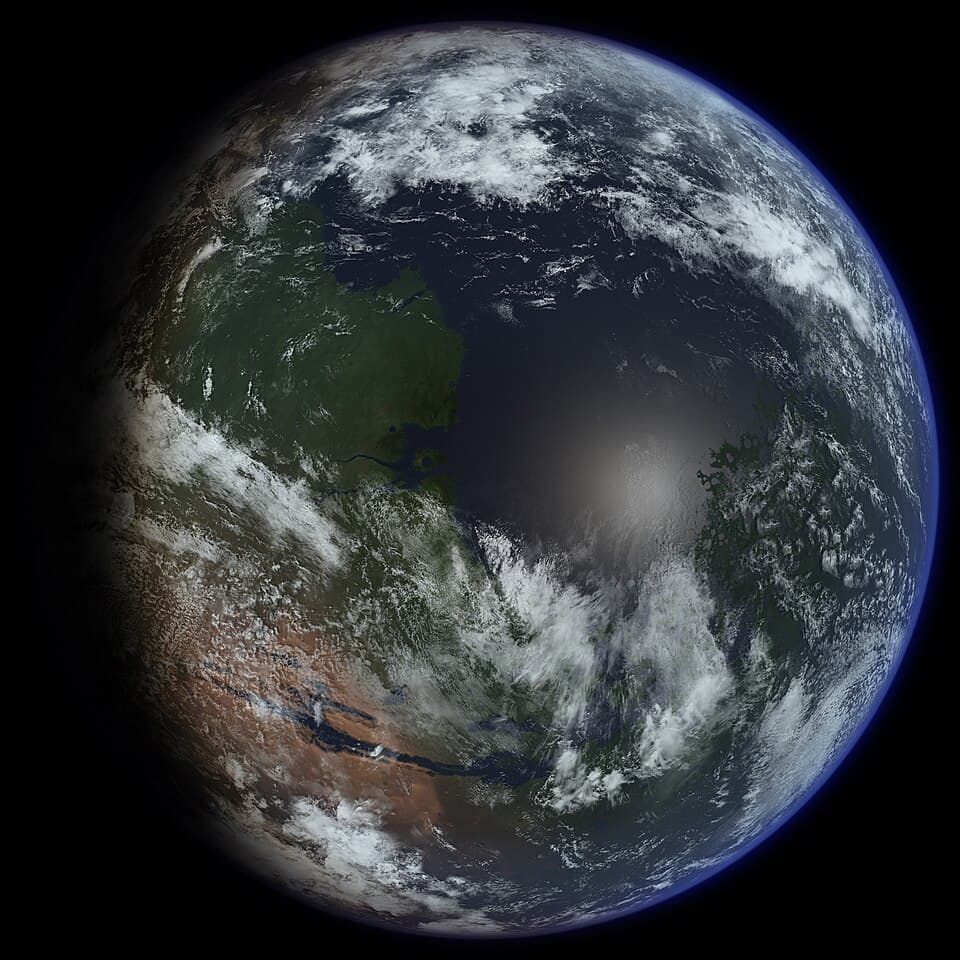
Terraforming means deliberately changing another world's environment so that it becomes substantially more suitable for terrestrial life.
On Mars, that would mean transforming an inhospitable desert into something resembling a living planetary ecosystem.
But there is a major problem.
We do not currently know how to do it.
Mars Is Not Another Earth
Mars looks surprisingly familiar in photographs.
It has mountains, valleys, deserts, polar ice caps and enormous geological formations.
But beneath the surface similarities is a world radically different from Earth.
Mars has an atmosphere with a pressure of roughly 0.6% of Earth's surface pressure. It is composed primarily of carbon dioxide, but there simply isn't enough atmospheric pressure for humans to breathe or for liquid water to remain stable across the surface under ordinary conditions. [3]
Mars is also colder because it receives less solar energy than Earth.
And unlike Earth, Mars does not possess a global internally generated magnetic field protecting its atmosphere from the solar wind.
That last difference is particularly important.
Mars did once have a much thicker atmosphere. Over immense periods of time, interactions between the upper atmosphere and the solar wind helped remove atmospheric particles into space.
NASA's MAVEN mission spent more than a decade studying this process before the spacecraft's mission ended in 2026. Researchers have directly observed mechanisms involved in atmospheric escape, including processes associated with solar-wind interaction and atmospheric sputtering. [1][4]
Mars therefore presents terraforming humanity with a fundamental engineering problem:
It isn't enough to create an atmosphere. Humanity would also need to maintain it.
What Would Terraforming Actually Require?
Terraforming Mars would not be one project.
It would be a planetary-scale sequence of projects.
A simplified roadmap could look something like this:
Phase 1 — Industrialisation
Build autonomous mines, factories, nuclear power systems and large-scale infrastructure.
Phase 2 — Atmospheric engineering
Increase atmospheric pressure and raise the planet's temperature.
Phase 3 — Water mobilisation
Make additional water accessible and create environments where liquid water can persist.
Phase 4 — Biological engineering
Introduce carefully selected or engineered organisms capable of surviving increasingly hostile Martian environments.
Phase 5 — Oxygen production
Allow biological and industrial processes to gradually increase available oxygen.
Phase 6 — Ecosystem development
Create increasingly complex biological systems.
Phase 7 — Human surface civilisation
Eventually allow humans to operate outdoors with progressively less dependence on artificial life support.
The crucial word is eventually.
Terraforming would not mean building a few machines and watching Mars turn green within decades.
It could require centuries, millennia—or technologies that do not yet exist.
The First Challenge: Heat Mars Up
The first major problem is temperature.
Mars is cold enough that large amounts of surface water cannot remain liquid for long.
So the planet would need to become warmer.
One obvious idea is to increase the greenhouse effect.
Greenhouse gases trap outgoing infrared radiation and can increase planetary temperatures.
On Earth, greenhouse gases are a major component of the climate system.
On Mars, however, there is a serious limitation:
Where would the gases come from?
Researchers have examined carbon dioxide stored in Martian polar deposits, minerals and soil.
The problem is that available Martian carbon dioxide appears insufficient to transform Mars into an Earth-like environment using present-day technology.
NASA has reported that processing known accessible sources would only raise atmospheric pressure to a fraction of Earth's, far below what would be required for a naturally habitable surface. [3][5]
That means simply releasing the planet's existing carbon dioxide would not solve the problem.
Terraforming therefore requires thinking beyond the resources sitting conveniently on the surface.
Could Giant Space Mirrors Warm Mars?
One more futuristic proposal involves manipulating sunlight.
Imagine enormous reflective structures positioned in space.
Instead of blocking sunlight, these structures would redirect additional solar energy toward Mars.
The concept sounds like science fiction, but the underlying principle is simple:
More energy reaching Mars means more heating.
Large orbital mirrors could potentially focus additional sunlight toward specific regions, warming the atmosphere and surface.
However, constructing structures of that scale would itself require a massive space-industrial economy.
Humanity would need:
asteroid or lunar mining automated construction enormous quantities of materials autonomous spacecraft advanced propulsion reliable orbital manufacturing long-term maintenance systems
The mirror would therefore not be the beginning of terraforming.
It would be a consequence of becoming a mature spacefaring civilisation.
Could We Create Artificial Greenhouse Gases?
Another possibility would be manufacturing powerful greenhouse gases specifically for Mars.
These compounds could theoretically produce warming without requiring naturally abundant atmospheric gases.
This approach is particularly interesting because it changes the problem.
Instead of asking:
"What resources does Mars already have?"
we ask:
"What can an industrial civilisation manufacture?"
Future technology could potentially produce compounds specifically designed for planetary climate engineering.
But there would still be enormous manufacturing requirements.
Factories would need to operate on Mars for long periods, powered by huge amounts of energy.
And even successful warming would not automatically create a breathable atmosphere.
It would only solve one part of the puzzle.
The Water Problem
Mars has water.
That is one of the most important facts for future settlement.
Scientists have identified substantial evidence for water ice beneath the Martian surface, including potentially accessible deposits in the northern mid-latitudes. [6]
Water could become one of the most valuable resources on Mars.
It could provide:
drinking water agriculture industrial processes hydrogen oxygen rocket propellant radiation shielding
Water could therefore become the foundation of a Martian economy.
But having water is not the same as having oceans.
Much of Mars' accessible water exists as ice or in other forms that require energy and infrastructure to extract and process.
A future Martian civilisation would therefore probably begin by treating water as an industrial resource rather than simply recreating Earth's hydrological cycle.
Could Mars Have Oceans Again?
This is where terraforming becomes dramatically more difficult.
Even if humans released enormous quantities of water, Mars would still have a weak atmosphere and low temperatures.
Water exposed directly to the Martian environment could freeze, evaporate or sublimate.
To create stable oceans, humanity would first need to transform the atmospheric environment enough to allow liquid water to persist.
This creates a planetary feedback problem:
More heat → more stable water → more atmospheric water vapour → stronger greenhouse effect → more heat.
In principle, such feedback could become useful.
But getting the system started would require enormous intervention.
Mars would need a technological push before natural processes could potentially begin amplifying the transformation.
The Missing Magnetic Shield
Then comes one of the biggest problems of all.
Earth has a global magnetic field generated by processes deep inside the planet.
Mars does not have an equivalent global magnetic field today.
That matters because the solar wind interacts directly with the upper Martian atmosphere.
NASA's MAVEN observations have provided detailed evidence of how solar-wind interactions contribute to atmospheric escape. [1][4]
So even if humanity somehow created a thicker atmosphere, Mars would remain exposed to the processes that helped strip its atmosphere away in the first place.
That raises an extraordinary engineering possibility:
Could humanity build an artificial magnetic shield?
Could We Build a Magnetic Shield for Mars?
In theory, an artificial magnetic field could potentially reduce the amount of solar-wind interaction with Mars.
One speculative concept involves placing a powerful magnetic system between Mars and the Sun.
The system would act as an artificial planetary shield.
This is not a technology humanity currently possesses.
It would require extraordinary quantities of energy and engineering capability.
But the concept illustrates something important about terraforming:
The challenge is not merely changing Mars. It may be necessary to recreate some of the planetary systems that Earth naturally possesses.
Atmosphere.
Magnetic protection.
Climate regulation.
Water cycling.
Biological ecosystems.
Terraforming could ultimately become an attempt to manufacture an artificial planetary system.
The Biological Revolution
Climate engineering alone would not create a living Mars.
Eventually, biology would have to enter the equation.
This is where advances in biotechnology and synthetic biology become particularly interesting.
Scientists could theoretically investigate microorganisms capable of surviving extreme conditions and potentially engineer organisms with traits suited to Martian environments.
Future organisms might be designed to tolerate:
low temperatures high radiation extreme dryness high carbon dioxide concentrations Martian soil chemistry
The objective would not initially be forests.
It would be survival.
Imagine microscopic organisms spreading through protected environments, gradually altering their surroundings.
Some could potentially produce organic compounds.
Others could participate in chemical cycles.
Others could eventually contribute to oxygen production.
The transformation would begin at the microscopic level.
From Microbes to Plants
Terraforming would therefore resemble evolution—but accelerated and directed by technology.
The earliest biological systems might be microscopic.
Later could come increasingly complex organisms.
Eventually, if atmospheric conditions became sufficiently favourable, plants could become part of the transformation.
But plants need more than carbon dioxide.
They require appropriate temperatures, water, nutrients and protection from environmental extremes.
This means agriculture would probably arrive long before terraforming was complete.
The first Martian farms would almost certainly exist inside controlled environments.
Greenhouses could become the first ecosystems.
Over generations, those controlled biological systems could become increasingly integrated with the planet outside them.
Oxygen Is the Final Boss
Even if Mars became warmer and wetter, humans still could not simply walk outside and breathe.
Mars would need a vastly different atmospheric composition.
Creating oxygen on a planetary scale is extraordinarily difficult.
Plants and microorganisms can produce oxygen through photosynthesis, but the process would require enormous biological productivity over very long periods.
Industrial systems could also produce oxygen by splitting water or other compounds, but scaling that process to planetary proportions would require an enormous energy infrastructure.
And there is another problem:
oxygen is not enough.
Humans need the correct combination of atmospheric pressure, temperature and breathable gases.
Terraforming is therefore not simply about making Mars greener.
It is about making the entire environmental system compatible with human biology.
AI Could Become the First Terraformer
One of the most important technologies in a future terraforming project may not be rockets.
It could be artificial intelligence.
Mars is too large and too dangerous for humans to perform every task manually.
Autonomous systems could operate continuously.
AI-controlled machines could:
mine resources build infrastructure maintain power systems construct habitats process water manufacture equipment monitor atmospheric conditions repair damaged machinery manage biological systems coordinate thousands of robotic workers
A future Martian industrial network could function almost like a planetary organism.
Machines would extract resources.
Factories would transform them.
Robots would construct infrastructure.
AI systems would coordinate the entire process.
Humans would increasingly become supervisors, scientists, engineers and inhabitants rather than the primary labour force.
The First Terraformers May Not Be Human
This leads to an important possibility.
The first generation of Martian settlers may not actually be the people who begin terraforming.
Robots could arrive first.
They could spend decades building mines, power plants and manufacturing facilities before large human populations arrive.
A future mission might therefore look very different from today's Mars missions.
Instead of sending a handful of astronauts to establish a small research station, humanity could eventually send industrial fleets.
Hundreds or thousands of autonomous machines could arrive before the first major settlement.
Their mission would be simple:
Build the infrastructure required for the humans who come later.
Mars Could Become an Industrial Economy
Terraforming is usually discussed as a scientific project.
But there is another way to view it.
Terraforming could become an economic project.
Mars contains resources that could become strategically important to a mature space economy.
Water could provide fuel and life-support resources.
Regolith could become construction material.
Minerals could support manufacturing.
Solar energy could power industrial systems.
And eventually, Martian production could serve settlements across the planet.
The first Martian economy might therefore be less about tourism and more about infrastructure.
Mining.
Energy.
Construction.
Manufacturing.
Transportation.
Robotics.
Biotechnology.
Terraforming itself could become the largest infrastructure project humanity has ever attempted.
The Mars Economy Could Begin Before Terraforming
There is an important distinction between settling Mars and terraforming Mars.
Humanity could establish permanent settlements without making the planet Earth-like.
In fact, that is much more realistic.
Mars could develop:
Stage 1 — Research stations
Small scientific outposts dependent heavily on Earth.
Stage 2 — Permanent settlements
Larger habitats with local food, water and energy production.
Stage 3 — Industrial colonies
Mining and manufacturing begin supplying local demand.
Stage 4 — Self-sufficient cities
Settlements become increasingly independent from Earth.
Stage 5 — Planetary engineering
Large-scale environmental modification begins.
Stage 6 — Terraforming
The planet's atmosphere, climate and biosphere are gradually transformed.
This could take generations.
What Could Mars Look Like in 2050?
By 2050, a fully terraformed Mars is extremely unlikely.
The physics and resource requirements simply do not support such a rapid transformation with known technology.
But the foundations of a Martian civilisation could potentially look very different from today.
Humanity could have:
more advanced robotic exploration increasingly capable autonomous systems permanent or semi-permanent human habitats improved surface power generation large-scale water extraction advanced Martian construction sophisticated closed-loop life-support systems increasingly local manufacturing
These technologies would not terraform Mars.
They would create something arguably more important:
the infrastructure required to eventually attempt it.
What Could Mars Look Like in 2100?
The 22nd century becomes much more interesting.
If humanity establishes a permanent presence on Mars during the 21st century, several generations could spend their lives improving the planet's infrastructure.
By 2100, Mars could potentially have multiple settlements connected through transportation networks.
Large underground cities could protect populations from radiation.
Industrial zones could process local resources.
Artificial habitats could support agriculture.
Autonomous robots could operate across enormous areas.
And the first serious planetary-scale climate experiments might begin.
At this stage, Mars would not yet be another Earth.
But humanity could finally possess something it currently lacks:
the industrial capacity to attempt planetary engineering.
The 22nd-Century Question
Eventually, the question could change.
Instead of asking:
"Can we live on Mars?"
humanity might ask:
"Should we change Mars?"
That is a much harder question.
Mars may contain evidence about its own geological and potentially biological history.
If humanity introduced Earth organisms, the scientific value of pristine Martian environments could be permanently altered.
If indigenous Martian life exists—even microscopic life—terraforming could potentially destroy it.
This creates one of the greatest ethical questions in planetary exploration.
Do humans have the right to transform another world simply because we can?
The Planetary Protection Problem
Before humanity begins deliberately introducing organisms across Mars, scientists would need to understand the planet's existing environments much better.
A living Martian ecosystem—even a microscopic one—would fundamentally change the ethical calculation.
Terraforming an entirely lifeless planet is one thing.
Terraforming a planet containing its own independent biology is another.
The distinction could become one of the most important scientific questions of the century.
Before becoming gardeners of Mars, humanity would first need to establish whether Mars already has something growing there.
Could We Accidentally Destroy Mars' History?
There is another concern.
Mars is effectively a geological archive.
Its surface preserves evidence from billions of years of planetary history.
Large-scale terraforming could erase some of that information.
New oceans, vegetation and human infrastructure could cover geological sites that currently provide scientists with clues about the ancient planet.
Terraforming could therefore create a conflict between two goals:
Preserve Mars so we can understand it.
or
Transform Mars so we can live there.
Humanity may ultimately have to choose where—and how much—to intervene.
The Environmental Cost Could Be Enormous
Terraforming would not be environmentally neutral.
It would involve moving immense quantities of material and energy.
Industrial systems could transform landscapes on a planetary scale.
Mining could reshape regions.
Atmospheric engineering could change weather patterns.
Biological introductions could create unpredictable ecological interactions.
And once a planetary climate system begins changing, controlling its eventual outcome could become extremely difficult.
Terraforming therefore cannot simply be treated as a giant engineering project.
It would be an experiment involving an entire planet.
Three Possible Futures
The future of Mars could ultimately follow several different paths.
Scenario One: Mars Remains a Frontier
Humanity establishes settlements but never attempts full terraforming.
Mars becomes a network of technologically advanced habitats.
Humans live inside controlled environments while the natural Martian landscape remains largely intact.
This may be the most realistic outcome for centuries.
Scenario Two: Partial Terraforming
Humanity begins modifying the atmosphere and climate but never creates an Earth-like environment.
Mars becomes warmer and more habitable, but humans still require breathing equipment and protective infrastructure.
This could represent a compromise between preservation and transformation.
Scenario Three: A Second Earth
Humanity eventually develops technologies capable of transforming Mars on a planetary scale.
Atmospheric pressure increases.
Temperatures rise.
Water becomes more widespread.
Biological systems expand.
Oxygen slowly accumulates.
Over extremely long periods, Mars becomes capable of supporting complex ecosystems and perhaps eventually humans living on the surface with minimal technological assistance.
This is the science-fiction scenario.
But it is not physically impossible in the broadest sense.
It is simply far beyond humanity's current capabilities.
The Timescale Problem
This may be the most important point of all.
Terraforming Mars is not a project like building a bridge.
It is not even like building a city.
It is a project measured against geological and biological timescales.
Human political systems operate over years.
Businesses operate over decades.
Civilisations operate over centuries.
Terraforming may operate over far longer periods.
That creates an unusual challenge.
The people who begin terraforming Mars may never see its completion.
Their descendants would inherit the project.
Generation after generation would continue it.
Terraforming Mars could therefore become humanity's first truly multi-generational engineering project.
Humanity Would Be Designing a New Planet
There is something profound about that idea.
Humanity has always transformed its environment.
We built cities.
Redirected rivers.
Cleared forests.
Constructed artificial islands.
Changed landscapes.
But terraforming would represent a completely different scale.
Instead of changing a valley, we would change a planet.
Instead of controlling a river, we would attempt to influence an atmosphere.
Instead of building an ecosystem inside a greenhouse, we would attempt to build one across an entire world.
Terraforming Mars would represent the transition from planetary inhabitant to planetary engineer.
Could Humanity Actually Do It?
With today's technology?
No.
NASA research indicates that Mars cannot currently be terraformed by simply releasing the carbon dioxide naturally available on the planet. The available inventory is insufficient to produce the atmospheric conditions required for an Earth-like environment. [3][5][7]
But that does not mean the concept is permanently impossible.
A 2025 Nature Astronomy perspective argued that renewed research into Mars terraforming is warranted because advances in Mars science, climate modelling, space capabilities and bioscience have created new possibilities worth investigating. It also highlighted research into techniques that could potentially produce substantial warming over decades, while emphasising that fundamental physical, chemical and biological constraints still need to be understood. [8]
That distinction matters.
The scientific question is increasingly moving from:
"Could we terraform Mars with technology we have today?"
to:
"What technologies would a future civilisation need to terraform Mars?"
Those are very different questions.
The Future Could Begin Underground
Ironically, the first stage of terraforming Mars may involve humans going deeper underground rather than walking across a green surface.
Underground habitats could protect people from radiation.
Artificial ecosystems could provide food.
Recycling systems could recover water.
Nuclear and solar systems could provide energy.
Robots could build infrastructure.
AI could coordinate entire settlements.
Over time, these artificial environments could become increasingly sophisticated.
Eventually, humanity may build miniature versions of Earth before attempting to recreate Earth itself.
The first Martian forests may therefore exist inside enormous controlled habitats long before anything resembling a forest grows outside.
Mars as Humanity's Greatest Experiment
Terraforming Mars would ultimately be more than a space project.
It would be an experiment in whether an intelligent species can deliberately construct a planetary environment.
It would combine almost every major technological field humanity is developing today:
Artificial intelligence.
Robotics.
Nuclear energy.
Renewable energy.
Synthetic biology.
Climate engineering.
Materials science.
Space manufacturing.
Advanced propulsion.
Autonomous systems.
Planetary science.
The technologies required to terraform Mars could therefore produce enormous benefits even if Mars itself never becomes fully habitable.
The attempt could accelerate the development of technologies needed to build a permanent human civilisation beyond Earth.
The Ultimate Question
Mars does not need humanity.
Humanity needs to decide whether it wants Mars.
That distinction matters.
Terraforming would consume enormous resources and require unprecedented cooperation across generations.
There would be scientific risks.
Economic risks.
Environmental risks.
Ethical risks.
And perhaps the greatest risk of all:
We may not fully understand the planet we are trying to redesign.
But if humanity eventually becomes a civilisation capable of managing planetary-scale systems, Mars could become the ultimate test.
Not simply:
Can we reach another planet?
But:
Can we build another home?
From Red Planet to Second World
The dream of terraforming Mars has always sounded like science fiction.
A red desert becoming green.
Frozen landscapes becoming oceans.
Artificial habitats becoming cities.
Robots transforming the surface.
And eventually, humans walking beneath an alien sky without spacesuits.
Today, that future remains far beyond our technological capabilities.
Mars is still too cold.
Its atmosphere is too thin.
Its radiation environment is dangerous.
Its global magnetic protection is absent.
Its available carbon dioxide is insufficient for straightforward terraforming.
And the timescale of planetary transformation remains uncertain.
But humanity is developing something that previous generations did not possess:
the ability to deliberately engineer increasingly complex systems at planetary scale.
The first steps will not look like terraforming.
They will look like robots.
Mines.
Power stations.
Greenhouses.
Underground habitats.
Water extraction.
AI-controlled factories.
And eventually, cities.
The transformation of Mars may therefore begin long before anyone calls it terraforming.
Perhaps the first generation will simply try to survive there.
The next will try to build there.
The next will try to expand there.
And one day, generations far beyond our own may look at the red horizon and ask a question that seems impossible today:
What if this world could become ours?
Mars may never become another Earth.
But if humanity survives long enough, it could become something even more remarkable:
the first world we deliberately built.
References
[1] NASA — MAVEN mission research into Mars' atmosphere, atmospheric escape and interaction with the solar wind. NASA MAVEN Mission
[2] NASA — Evidence for Mars' ancient atmosphere, liquid water and transition into a cold, dry world. NASA: New Insights into How Mars Became Uninhabitable
[3] NASA — Research concluding that Mars cannot be terraformed using currently available technology and its naturally accessible CO₂ inventory. NASA: Mars Terraforming Not Possible Using Present-Day Technology
[4] NASA — MAVEN observations of atmospheric sputtering and the mechanisms contributing to atmospheric loss. NASA: MAVEN's First Observation of Atmospheric Sputtering at Mars
[5] NASA — Assessment of the available Martian carbon dioxide and its limitations for terraforming. NASA: Terraforming the Martian Atmosphere
[6] NASA/JPL — Research identifying regions of potentially accessible subsurface water ice on Mars. NASA/JPL: Where Should Future Astronauts Land on Mars? Follow the Water
[7] Jakosky, B. M. & Edwards, C. S. — Inventory of CO₂ available for terraforming Mars, Nature Astronomy. Nature Astronomy: Inventory of CO₂ Available for Terraforming Mars
[8] Nature Astronomy — The case for Mars terraforming research, discussing modern approaches to Mars climate modification and the scientific questions surrounding terraforming. Nature Astronomy: The Case for Mars Terraforming Research
Published by Banx Network. This article is part of the Banx decentralized media programme, powered by the BXE token on the XRP Ledger.