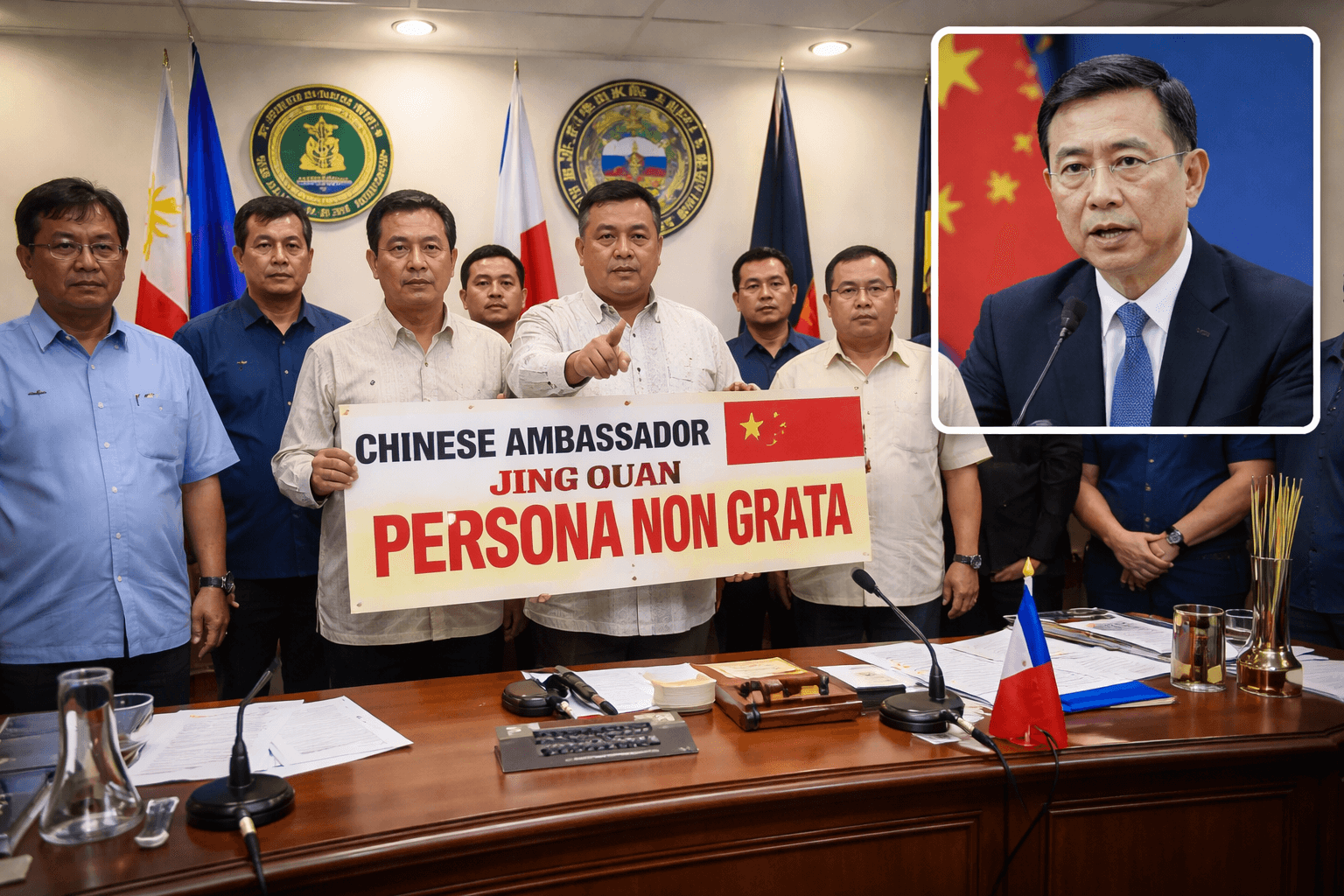
Kalayaan, Palawan / Manila, Philippines — January 28-29, 2026 — A small municipality at the forefront of the Philippines’ maritime dispute with China has taken a bold symbolic step amid rising diplomatic tension by declaring Chinese Ambassador Jing Quan persona non grata — a formal expression of political disapproval that underscores local frustration with China’s posture in the disputed waters of the West Philippine Sea.
What Happened?
The Sangguniang Bayan (municipal council) of Kalayaan, Palawan — the only Philippine local government unit in the contested West Philippine Sea — passed Resolution No. 092-016 on January 27, 2026, condemning Ambassador Jing Quan for what the council described as repeated violations of diplomatic protocol and interference in Philippine internal affairs.
In the resolution, local officials criticized the ambassador for what they called increasingly confrontational and aggressive statements in public forums and on social media, including direct attacks on Philippine government officials who defend Manila’s maritime rights under the 1982 United Nations Convention on the Law of the Sea (UNCLOS) and international arbitration rulings.
Kalayaan’s leaders said their jurisdiction — the administrative center for Philippine-held features in the Spratly Islands — cannot remain silent as a foreign representative attempts to “dictate how our government should discipline its own citizens or interpret its sovereign rights.”
The declaration is symbolic — local governments in the Philippines can express political disapproval but cannot expel accredited diplomats or dictate national foreign policy. That authority lies exclusively with the national government through the President and the Department of Foreign Affairs (DFA) under international diplomatic law (Vienna Convention on Diplomatic Relations).
Diplomatic Backlash and ‘Word War’
The Kalayaan action came amid a broader “word war” between Manila and Beijing. Philippine lawmakers have strongly criticized recent statements and social media posts by the Chinese Embassy in Manila that they perceive as disrespectful, provocative, and crossing accepted diplomatic norms.
A group of 15 Philippine senators signed a resolution condemning the embassy’s statements and urging possible diplomatic measures — including, in some legislative discussions, declaring Chinese diplomatic personnel persona non grata.
The Senate leadership has also floated alternative targets for such declarations — including the embassy’s deputy spokesperson — though action has been withheld pending further deliberation.
Chinese Embassy’s Response
Beijing’s diplomatic mission in Manila, through spokesperson Ji Lingpeng, dismissed the idea that the embassy had overstepped. The Chinese Embassy argued that it was merely responding to what it considers misinformation and “slanders” about China promoted by Philippine officials, especially concerning maritime disputes.
Ji stressed that only President Ferdinand “Bongbong” Marcos Jr. has the legal authority to declare Ambassador Jing Quan persona non grata at the national level. If such a declaration were made by the President, Jing would depart the Philippines “immediately” — and, the embassy said, “with pride and honor.”
In fact, the embassy spokesperson said if any Chinese diplomat were to be declared persona non grata, he and the entire 12-member media affairs team should be included, vowing that they would “stay or leave together.”
Palace and DFA Reaction
At the national level, Malacañang Palace and the Department of Foreign Affairs have urged caution. Palace officials described declaring diplomats’ persona non grata as one of the most severe forms of diplomatic action, advising that it will be used only as a last resort given the possible consequences for broader Philippines–China relations.
President Marcos has emphasized a “firm but diplomatic” stance to manage the dispute, balancing defense of national interests with the need to maintain channels of dialogue with China. Context: Ongoing Maritime Dispute
The fallout reflects decades of tension between Manila and Beijing over competing territorial and maritime claims in the South China Sea/West Philippine Sea — a critical trade route rich in resources and geopolitical significance. Many incidents between Philippine and Chinese vessels have fueled public and political pressure in the Philippines to adopt firmer stances.
What ‘Persona Non Grata’ Really Means
Under international law, a persona non grata declaration usually means a host country withdraws its consent for a foreign diplomat to remain. This step — when taken by a national government — often prompts reciprocal actions and can significantly strain bilateral ties. Local declarations, such as Kalayaan’s, are symbolic and do not carry legal obligations on Beijing or Manila’s national authorities.
AI Image Disclaimer: Visuals created with AI tools for illustrative purposes only; they do not represent real-life photographs.
Published by Banx Network. This article is part of the Banx decentralized media programme, powered by the BXE token on the XRP Ledger.