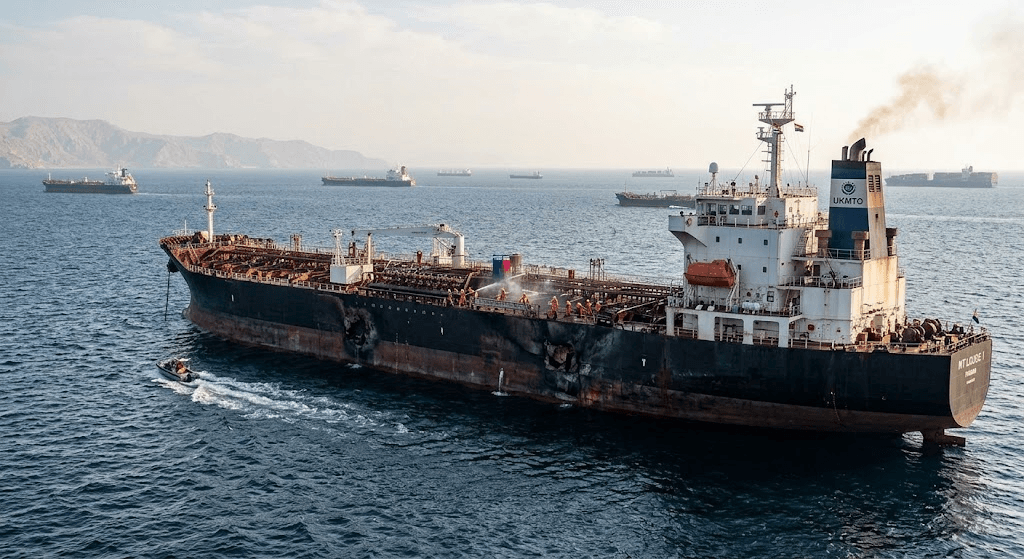
STRAIT OF HORMUZ — Maritime security in the Middle East reached a heightened state of alert after the Panama-flagged oil tanker MT Louise 1, carrying 27 Indian seafarers on board, was struck by limpet mines approximately 25 nautical miles northeast of Khasab, Oman, near the strategic Strait of Hormuz.
The attack unfolded when a small craft approached the moving commercial vessel in the crowded shipping corridor. Assailants attached two magnetic limpet mines directly to the vessel's hull before fleeing the scene.
The resulting detonations triggered a fire in the tanker’s engine room and temporarily disabled the ship. The 27 Indian crew members acted swiftly to contain and extinguish the fire, preventing catastrophic structural damage or an oil spill, before resuming their journey.
Union Minister for Ports, Shipping, and Waterways Sarbananda Sonowal confirmed that all 27 Indian crew members aboard MT Louise 1 escaped unharmed. He added that the ministry is actively monitoring the situation alongside another recent incident involving the Liberia-flagged VLCC MT Arzanah, which had two Indian crew members on board when targeted by projectiles in the same corridor a day prior.
"All 29 Indian seafarers across both vessels are completely safe with no injuries. We are continuously monitoring the situation and coordinating with ship management companies to ensure their ongoing security and well-being," Sonowal stated.
Maritime risk experts from Greece-based management group Marisks noted that the use of limpet mines marks a cost-effective, low-technology strategy designed to cripple ships rather than sink them. This incident represents the first successful limpet mine strike on a commercial vessel in the region during the ongoing geopolitical conflict in the Gulf.
While no group has officially claimed responsibility for the attack, international naval agencies—including the UK Maritime Trade Operations (UKMTO)—and regional defense authorities have tightened security monitoring across the Strait of Hormuz to safeguard commercial shipping routes.
Published by Banx Network. This article is part of the Banx decentralized media programme, powered by the BXE token on the XRP Ledger.