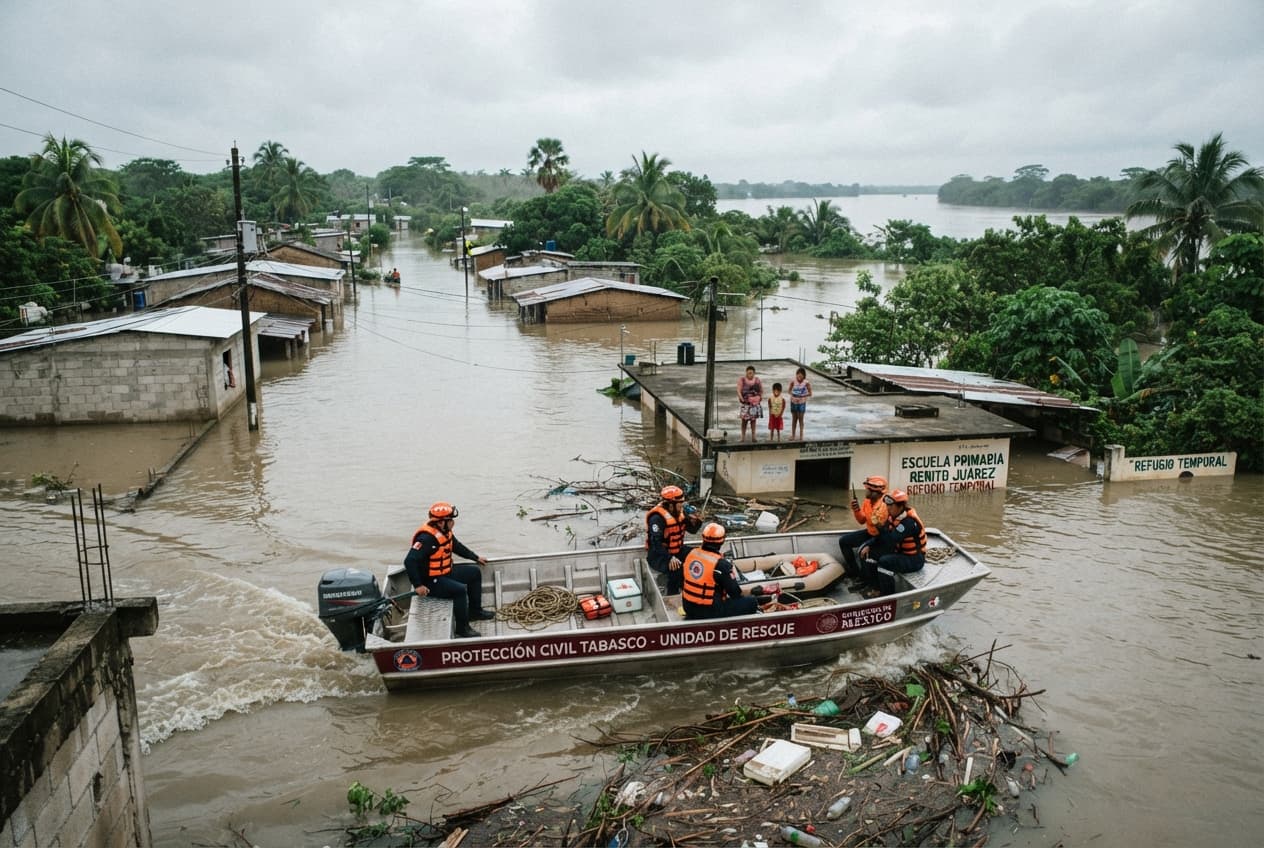
Villahermosa, Mexico—Relentless regional precipitation pushed major river basins past their containment dikes, inundating low-lying agricultural plains across Tabasco state. Civil protection authorities confirmed one drowning fatality after a resident was caught by fast-moving currents while attempting to secure livestock. The sudden overflow forced mandatory emergency evacuations across multiple rural municipalities as muddy water advanced onto residential properties. State rescue units deployed amphibious vehicles and flat-bottom boats to reach stranded families.
The surging waters submerged entire agricultural sectors, destroying staple crops and cutting off rural access roads. Strong currents swept away boundary fences and outbuildings, leaving communities isolated beneath heavy gray skies. Emergency dispatchers coordinated continuous rescue operations as river levels continued rising past critical flood marks. First responders utilized life rings and guide ropes to navigate submerged street grids.
State civil protection coordinator Salvador Bravo briefed journalists at the Villahermosa operational command post. Upstream reservoir discharges combined with heavy local rainfall have created an aggressive flood pulse across the entire floodplain, Bravo stated. Our teams are prioritizing forced evacuations in low-lying sectors before nightfall. Shelters are fully operational across safe zones.
Agricultural associations criticized federal water management agencies for releasing dam capacity too rapidly without providing adequate advance warning to downstream farmers. Chronic delays in dredging regional river channels left drainage systems incapable of handling standard tropical downpours. Those administrative oversights magnified the speed and severity of the inundation across the valley floor. Families watched helplessly as their belongings were swallowed by the rising brown tide.
Temporary shelters established in schools and municipal gymnasiums received hundreds of displaced citizens seeking refuge from the floodwaters. Relief workers distributed bottled water, blankets, and basic medical provisions to arrivals from rural sectors. Local health clinics treated evacuees for water-related skin irritations, exhaustion, and acute stress. Power distribution companies cut electrical service across flooded sectors to prevent short-circuit hazards.
Heavy machinery operators constructed temporary earth levees along vulnerable urban margins to protect commercial districts. State police maintained traffic checkpoints around flooded highway stretches to prevent motorists from entering dangerous currents. Civil defense monitoring stations tracked hourly precipitation telemetry to anticipate secondary flood waves. Relief operations continue around the clock under emergency floodlights.
Published by Banx Network. This article is part of the Banx decentralized media programme, powered by the BXE token on the XRP Ledger.