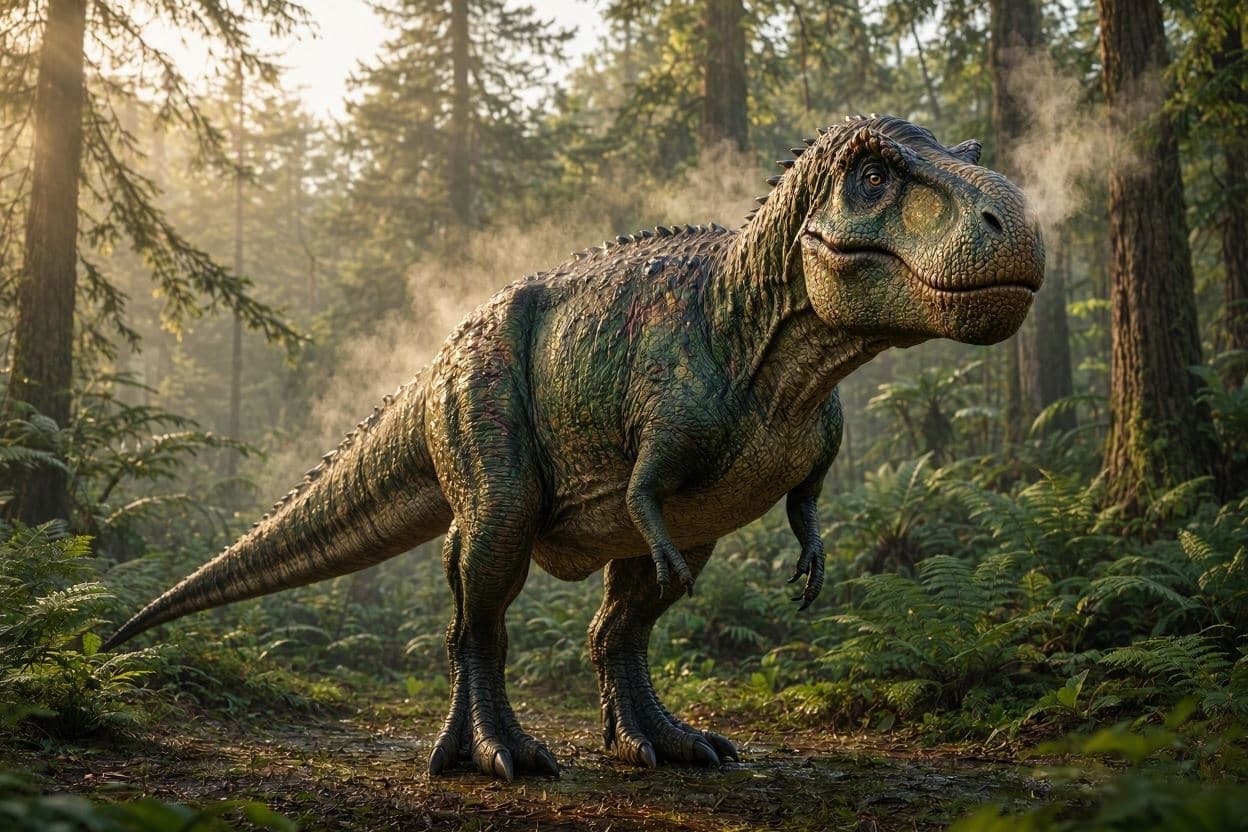
For decades, the Tyrannosaurus rex has been depicted as a cold-blooded killer, a sluggish reptile relying on the sun to warm its massive body before hunting. However, new scientific evidence suggests that this iconic predator was far more dynamic, maintaining a body temperature of approximately 97 degrees Fahrenheit. This finding places T. rex closer to modern mammals than to typical reptiles, reshaping our understanding of its metabolism, behavior, and role in the Late Cretaceous ecosystem.
The research, published in recent paleontological journals, utilized geochemical analysis of fossilized eggshells and bone isotopes to estimate the dinosaur’s internal temperature. By measuring the ratio of oxygen isotopes, scientists can infer the temperature at which the minerals formed, providing a reliable proxy for body heat. The results indicate that T. rex was able to regulate its temperature internally, a trait known as endothermy, which would have allowed for sustained activity and faster growth rates.
This metabolic advantage would have been crucial for a predator of such size. Maintaining a high body temperature requires significant energy intake, suggesting that T. rex was an active hunter rather than a mere scavenger. It would have needed to consume large amounts of meat regularly to fuel its internal furnace, influencing the population dynamics of its prey species. This insight helps explain the robust build and powerful jaws of the animal, adapted for efficient killing and consumption.
The discovery also challenges the traditional view of dinosaur physiology as uniformly cold-blooded. It suggests that endothermy may have evolved independently in different dinosaur lineages, or that it was a common trait among large theropods. This complexity adds depth to our understanding of dinosaur evolution, showing that they were not monolithic in their biology but diverse in their adaptations.
Comparing T. rex to modern animals, its body temperature is similar to that of humans and many mammals. This similarity implies that it may have had comparable levels of activity and endurance. It could have pursued prey over longer distances, regulated its body heat in varying climates, and possibly even cared for its young with a level of attentiveness seen in warm-blooded animals today.
The findings have implications for how we reconstruct dinosaur behavior in popular media. The image of the slow, lumbering T. rex is being replaced by a more agile and energetic creature, capable of complex behaviors. This shift reflects the ongoing nature of scientific discovery, where new data continuously refines our picture of the past. It invites us to imagine these ancient giants not as monsters, but as living, breathing animals with their own unique physiologies.
Furthermore, understanding the metabolism of T. rex helps scientists model the energy flow of Cretaceous ecosystems. If top predators were warm-blooded, the entire food web would have required higher productivity to support them. This perspective influences how we interpret fossil records and the abundance of plant and animal life during that period.
As we continue to uncover the secrets of the dinosaurs, each discovery brings us closer to understanding their true nature. The warm-blooded T. rex is a testament to the ingenuity of evolution, showing how life adapts to thrive in even the most competitive environments. In the heat of its body, we find a connection to the vitality that drives all living things.
AI Image Disclaimer: The visual aids included here are AI-generated illustrations of T. rex and its environment, not actual photographs or fossil scans.
Sources: Nature Communications Smithsonian Magazine Live Science
Published by Banx Network. This article is part of the Banx decentralized media programme, powered by the BXE token on the XRP Ledger.