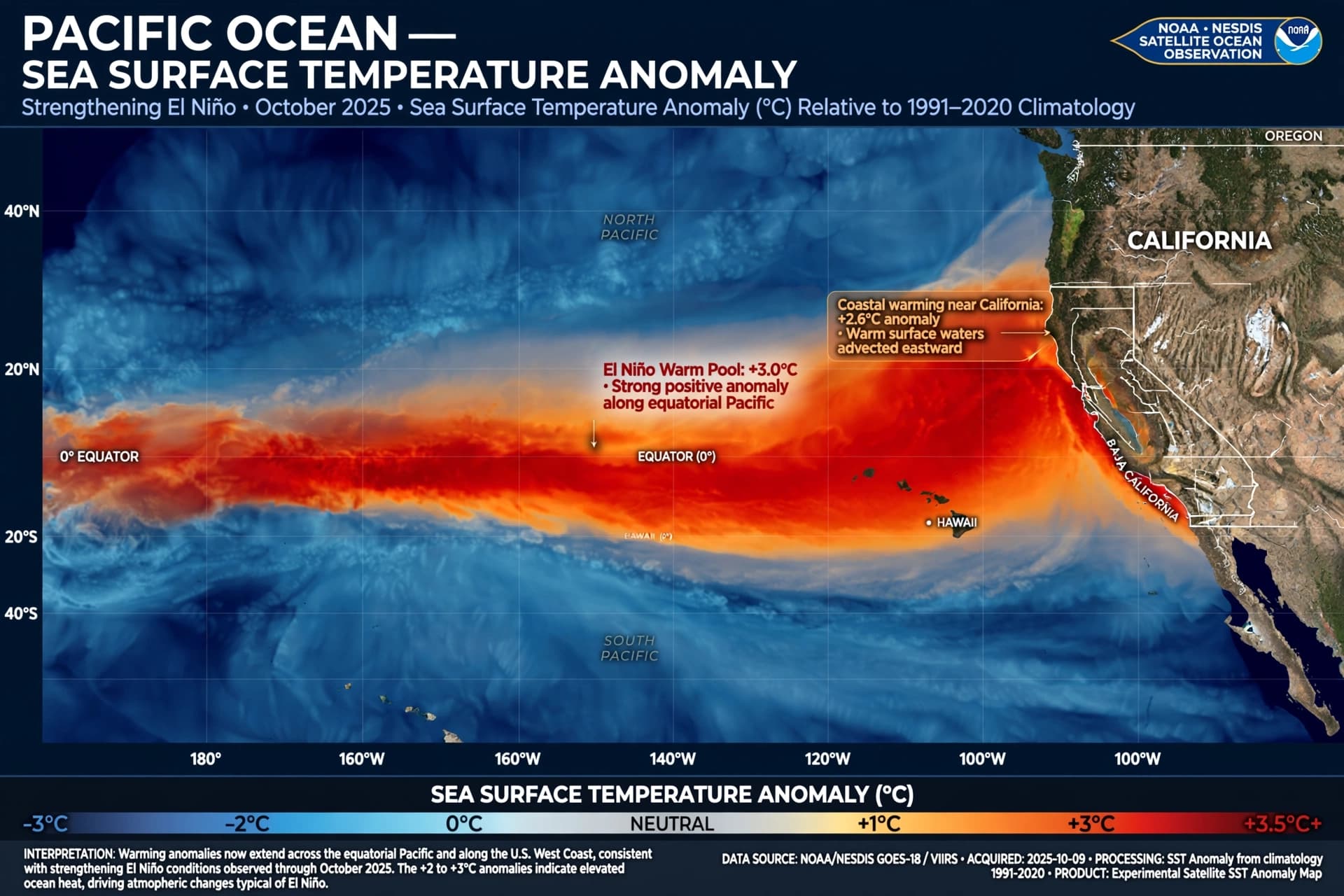
There is a particular kind of anticipation that accompanies a Super El Niño—an anticipation that is not simply about the weather but about the way a single climate pattern can reshape an entire state's relationship with water, with fire, with the land itself. In California, that anticipation has now intensified. New data from the National Oceanic and Atmospheric Administration shows that the current El Niño is strengthening faster than expected, with a greater than 90 percent chance of a "very strong" event this winter—a Super El Niño that could bring torrential rain, flooding, and coastal erosion to a state that has spent years in drought .
The numbers behind the forecast are striking. NOAA's Climate Prediction Center now puts the chance of a very strong El Niño at greater than 90 percent, with a 75 percent chance that the event will exceed previous records dating back to 1950 . California has a 70 to 100 percent chance of experiencing above-average rainfall along its coast, according to the European Centre for Medium-Range Weather Forecasts . The odds favoring above-normal precipitation increase as winter arrives, reaching 50 to 60 percent near the California coast during December through February .
What makes this El Niño particularly concerning is its potential intensity. Only three "very strong" El Niños have occurred in the last half-century: 1982-83, 1997-98, and 2015-16. The first two brought massive and destructive precipitation to California. In 1982-83, 33 oceanfront homes were destroyed and 3,000 other residences damaged. In 1997-98, storms brought widespread flooding and mudslides, causing 17 deaths and more than half a billion dollars in damage . Downtown Los Angeles received nearly a year's worth of rain in just one month .
The state is preparing. Governor Gavin Newsom declared a state of emergency in September, well before the rainy season's usual peak. Emergency officials have gathered millions of sandbags and hundreds of tons of rock. Los Angeles County officials have urged residents to clear gutters, assess hillside risks, and consider flood insurance. The county's flood control infrastructure—dams, spreading grounds, and 144 debris basins—is prepared, but officials warn that individual residents also have a role to play .
There is, of course, an irony in all of this. California has spent years in drought, and the rain is desperately needed to replenish reservoirs and aquifers. But too much rain can be as destructive as too little. The state's ability to capture and store water has improved, but it remains limited. Much of the rain that falls may rush into the Pacific before it can be captured . The Super El Niño is coming. The question is not whether California will get rain, but whether it will be ready for how much.
AI Image Disclaimer: All images in this article are AI-generated and are intended for illustrative purposes only.
Sources: ABC7 Los Angeles, PreventionWeb, Los Angeles Times, Mercury News, Raleigh News & Observer
Published by Banx Network. This article is part of the Banx decentralized media programme, powered by the BXE token on the XRP Ledger.