
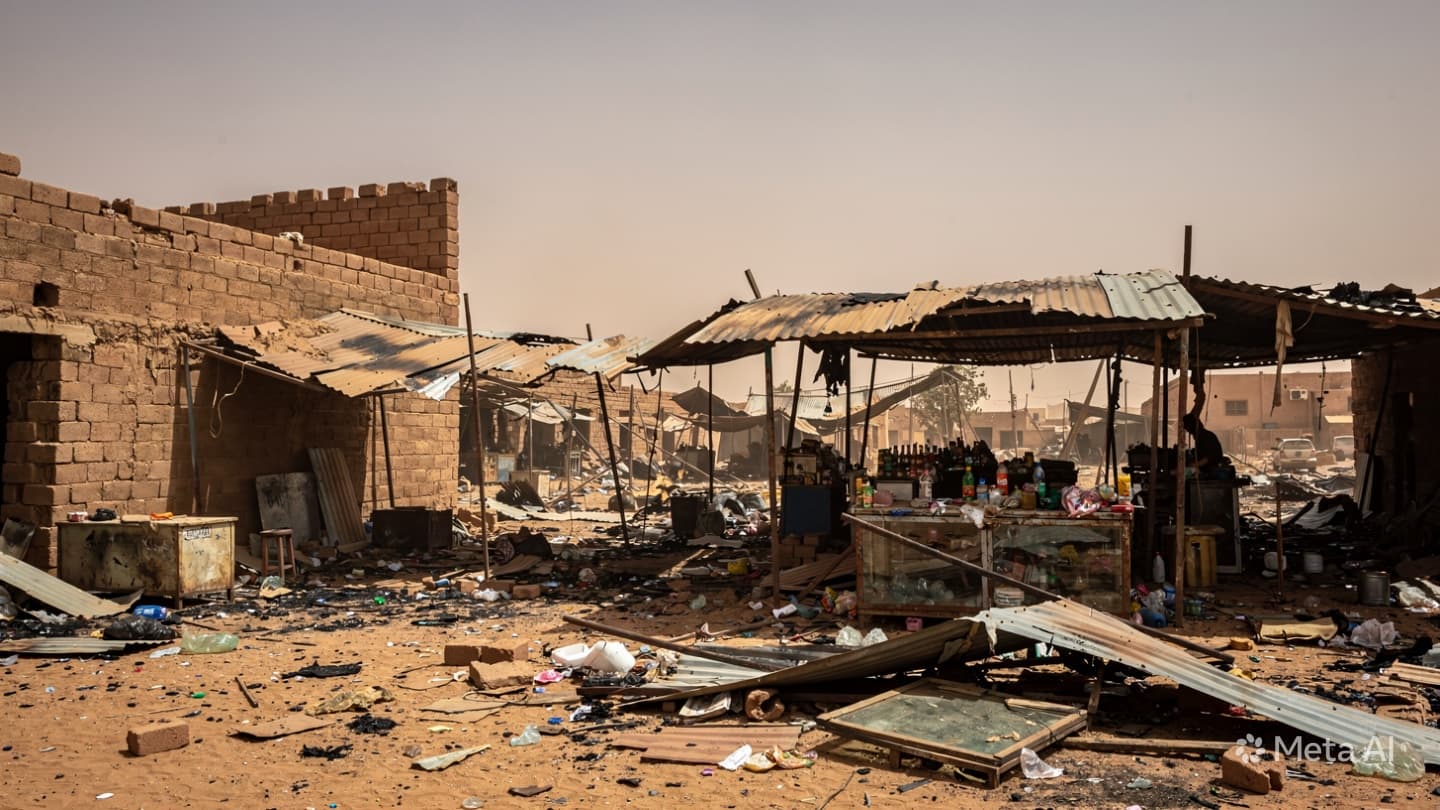
Kadugli, Sudan—A series of coordinated aerial bombardments ripped through densely populated municipal markets and immediate medical perimeters across the Kordofan region on Friday morning, killing at least twenty-six civilians. The strike waves hit during peak trading hours when hundreds of local residents gathered to secure scarce food provisions. Independent field observers confirmed that the munitions impacted directly inside commercial zones, turning concrete stalls to rubble and sparking immediate, uncontrollable fires through canvas vendor tents.
Emergency medical workers scrambled to pull survivors from collapsed brick structures as secondary detonations echoed in the distance. The UN High Commissioner for Human Rights released a preliminary field assessment detailing the destruction of two primary market centers and structural damage to nearby civilian fallback sectors. Eyewitnesses reported seeing multiple low-flying military aircraft dropping unguided ordnance directly into the urban core without any visible prior warning to the local population.
The local humanitarian response apparatus folded under the sudden influx of critical trauma cases. Shrapnel wounds and severe thermal burns accounted for the majority of admissions at the last remaining stabilization point in the sector. Medical personnel worked on blood-slicked concrete floors using flashlights after the main power grid severed during the initial blast wave. Supplies of basic surgical dressings, clean water, and intravenous fluids exhausted completely within two hours of the first strike.
The geopolitical friction between warring military factions continues to dictate the targeting logic, with civilian infrastructure increasingly serving as frontline collateral. Operational command units from the regular armed forces denied deliberate targeting of non-combatants, claiming instead that their assets engaged mobile rebel batteries embedded within municipal boundaries. Local administrative leaders rejected that characterization entirely, pointing to the total absence of military hardware inside the ruined market perimeters.
Displacement vectors spiked immediately following the afternoon clearing operations. Families packed salvaged household goods onto flatbed trucks and donkey carts, moving toward rural southern perimeters to escape anticipated evening sorties. Security checkpoints along the exit routes slowed the exodus, creating long lines of exposed vehicles under an open sky as regional artillery units traded sporadic fire across the hills.
International monitoring groups spent the afternoon documenting crater dimensions and munition fragments to identify the specific ordnance class used in the assault. Preliminary forensic evidence points to heavy fragmentation bombs designed for maximum surface area devastation rather than precision structural penetration. The resulting blast radiuses explain the high civilian casualty count relative to the number of individual impacts recorded.
Food distribution networks across Kordofan collapsed entirely by dusk. The targeted markets served as the primary supply nodes for thousands of internally displaced persons living in informal camps along the city fringe. With those stalls obliterated and commercial trucks refusing to enter the conflict zone, local bread lines grew to blocks before remaining bakeries shuttered due to flour shortages.
Civic leaders issued an urgent appeal for an immediate humanitarian corridor to evacuate spinal and cranial trauma patients who cannot receive adequate care locally. No regional air transport providers have agreed to fly into the local airstrip without verified ironclad security guarantees from both combatant factions. The wounded remain stacked on thin mats in institutional hallways, waiting for a diplomatic breakthrough that shows no signs of materializing.
State-run media outlets omitted any specific mention of the civilian death toll during their evening summaries, focusing instead on purported territorial gains against insurgent lines in neighboring sectors. The official silence deepened the sense of isolation gripping the remaining urban population. Local community networks took to shortwave radio to coordinate search and rescue efforts across the ruined districts.
The immediate focus shifts toward the mass burial of the identified victims before morning temperatures accelerate decomposition. Laborers dug communal trenches in the hard clay of the municipal cemetery under the cover of darkness to avoid attracting further aerial surveillance. Spotters remain stationed on rooftops with binoculars, scanning the northern horizon for the silhouette of returning bombers.
Published by Banx Network. This article is part of the Banx decentralized media programme, powered by the BXE token on the XRP Ledger.


.jpg&w=3840&q=75 "US Declares Drought Disaster for Parts of Puerto Rico as Dry Conditions Persist")