

Key Highlights
- Date of Attack:June 22, 2026, marked a significant escalation in the conflict.
- Casualties:Five confirmed dead, with dozens injured in the strike.
- Target:Voronezh Semiconductor Device Plant, crucial for Russian military operations.
Ukrainian forces executed a high-precision missile strike on a critical Russian military electronics factory on June 22, 2026, resulting in the deaths of five individuals and substantial damage to the facility. This attack is viewed as a pivotal moment in the ongoing conflict, as it directly impacts Russia's ability to produce advanced weaponry.
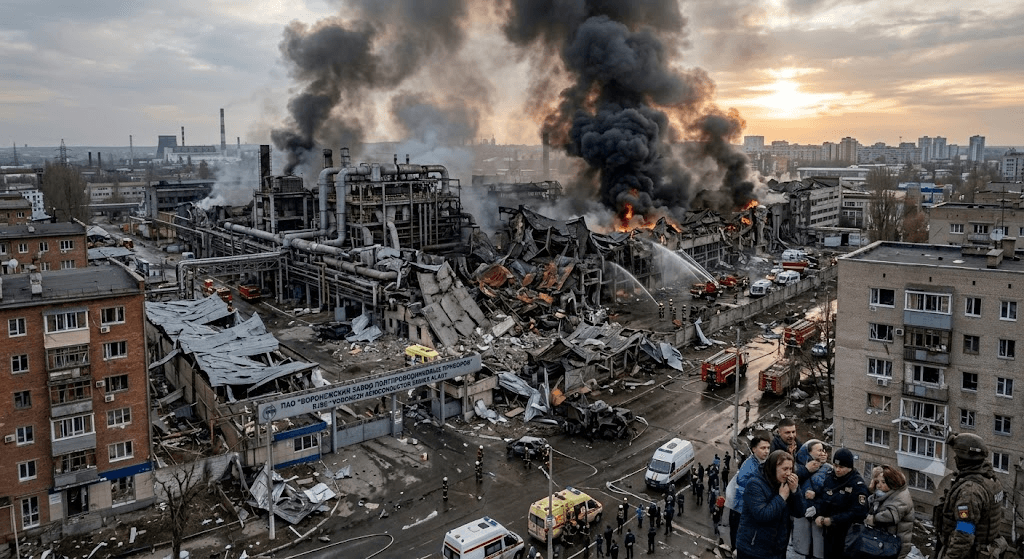
The strike targeted the Voronezh Semiconductor Device Plant, located in the Zheleznodorozhny district along the Voronezh River. The Ukrainian General Staff confirmed that air-launched cruise missiles were employed to breach local air defenses, successfully hitting the facility. Analysts utilizing open-source intelligence and geolocated footage identified the plant as a key component of Russia's military-industrial complex, responsible for manufacturing microelectronics essential for precision-guided munitions.
In an official statement, the Ukrainian military emphasized the significance of the strike, stating, "The plant's products are directly used by the enemy to produce precision-guided weapons deployed to strike Ukrainian territory and civilian infrastructure." The destruction of this facility is expected to severely hinder Russia's capacity to manufacture new missiles, thereby altering the dynamics of the conflict.
Eyewitness accounts and videos shared on social media depicted thick black smoke rising from the factory as fires erupted across the site. Voronezh Regional Governor Alexander Gusev confirmed the fatalities and reported that many workers managed to escape to bomb shelters after missile alerts were issued. Unfortunately, those who perished or were injured reportedly did not heed the warnings.
The blast's impact extended beyond the factory, affecting nearby residential areas. Falling debris and shockwaves shattered windows in ten apartment complexes and damaged six private homes. Approximately 50 vehicles parked near the site were either incinerated or crushed, illustrating the strike's extensive collateral damage.
In response to the incident, local authorities declared a state of emergency in several adjacent streets. Russia's consumer safety regulator, Rospotrebnadzor, initiated air quality monitoring to assess any potential hazardous material leaks from the facility, ultimately reporting no toxic chemicals had escaped.
Governor Gusev announced that a regional fund would provide 1 million rubles (around €11,700) in compensation to the families of the deceased victims, while those hospitalized with severe injuries would receive 300,000 rubles each. This financial support aims to address the immediate needs of those affected by this tragic event.
As the conflict continues to evolve, the implications of this strike on both military strategy and civilian safety remain to be seen, highlighting the ongoing volatility in the region and the high stakes involved in the war between Ukraine and Russia.
Published by Banx Network. This article is part of the Banx decentralized media programme, powered by the BXE token on the XRP Ledger.




