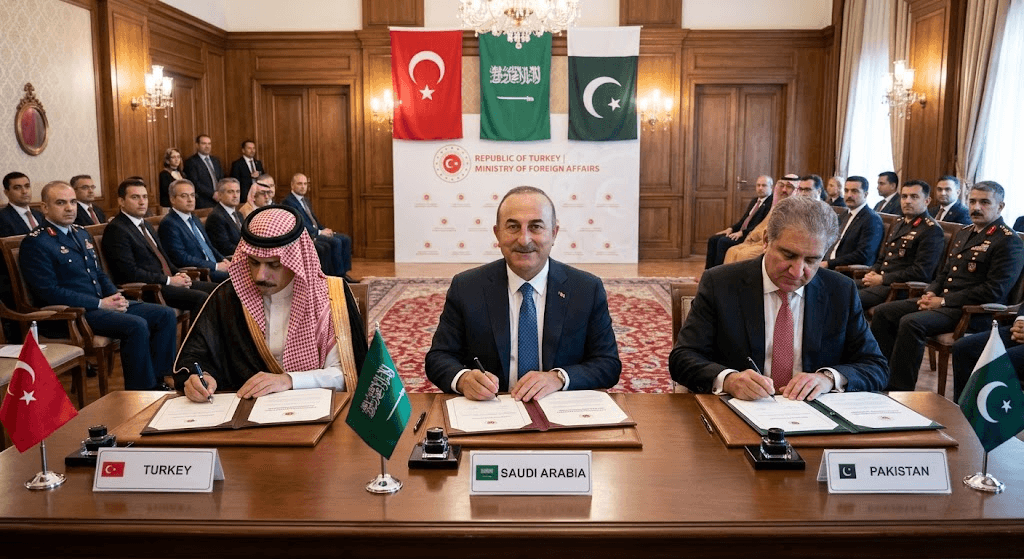
ANKARA — In a major development reshaping regional security architectures, Turkey is preparing to submit a parliamentary mandate allowing for military personnel to be deployed to Saudi Arabia. The move follows the official submission of the Mecca Joint Defense Agreement to the Turkish parliament for ratification.
According to officials from the ruling AK Party, the legislative mandate authorizing the troop deployment will be formally forwarded to parliament once the core bill ratifying the trilateral defense accord is approved. The landmark agreement was originally signed in Mecca by Turkey, Saudi Arabia, and Pakistan.
The newly forged Mecca Joint Defense Alliance establishes a formal mutual defense pledge among the three nations. Under the terms of the accord, an armed attack originating externally against any of the parties is treated as an attack against all member states, committing signatories to provide immediate assistance in accordance with the United Nations Charter.
The alliance builds upon an earlier strategic mutual defense agreement enacted between Pakistan and Saudi Arabia, expanding its scope to include NATO’s second-largest military. The pact covers deep cooperation in military training, interoperability, defense-industry technology sharing, intelligence integration, and joint counterterrorism measures.
Addressing the strategic implications of the pact, Turkish Foreign Minister Hakan Fidan emphasized the strictly defensive nature of the arrangement. Clarifying Ankara’s position, officials reiterated that Turkish forces will not take part in offensive operations or be deployed abroad to launch attacks on foreign territory.
Instead, the prospective deployment is designed to bolster mutual security, enhance defensive capabilities, and support regional stability as member states navigate escalating security challenges. The parliamentary ratification process is expected to advance in the coming weeks, paving the way for closer institutionalized defense coordination between Ankara and Riyadh.
Looking forward, defense analysts anticipate that the alliance will soon lay the groundwork for combined military exercises and coordinated logistical planning across the Middle East and South Asia. As the ratification debates proceed, defense ministries from all three nations are expected to establish joint coordination committees to oversee the practical implementation of interoperability protocols and technology-sharing initiatives.
Published by Banx Network. This article is part of the Banx decentralized media programme, powered by the BXE token on the XRP Ledger.