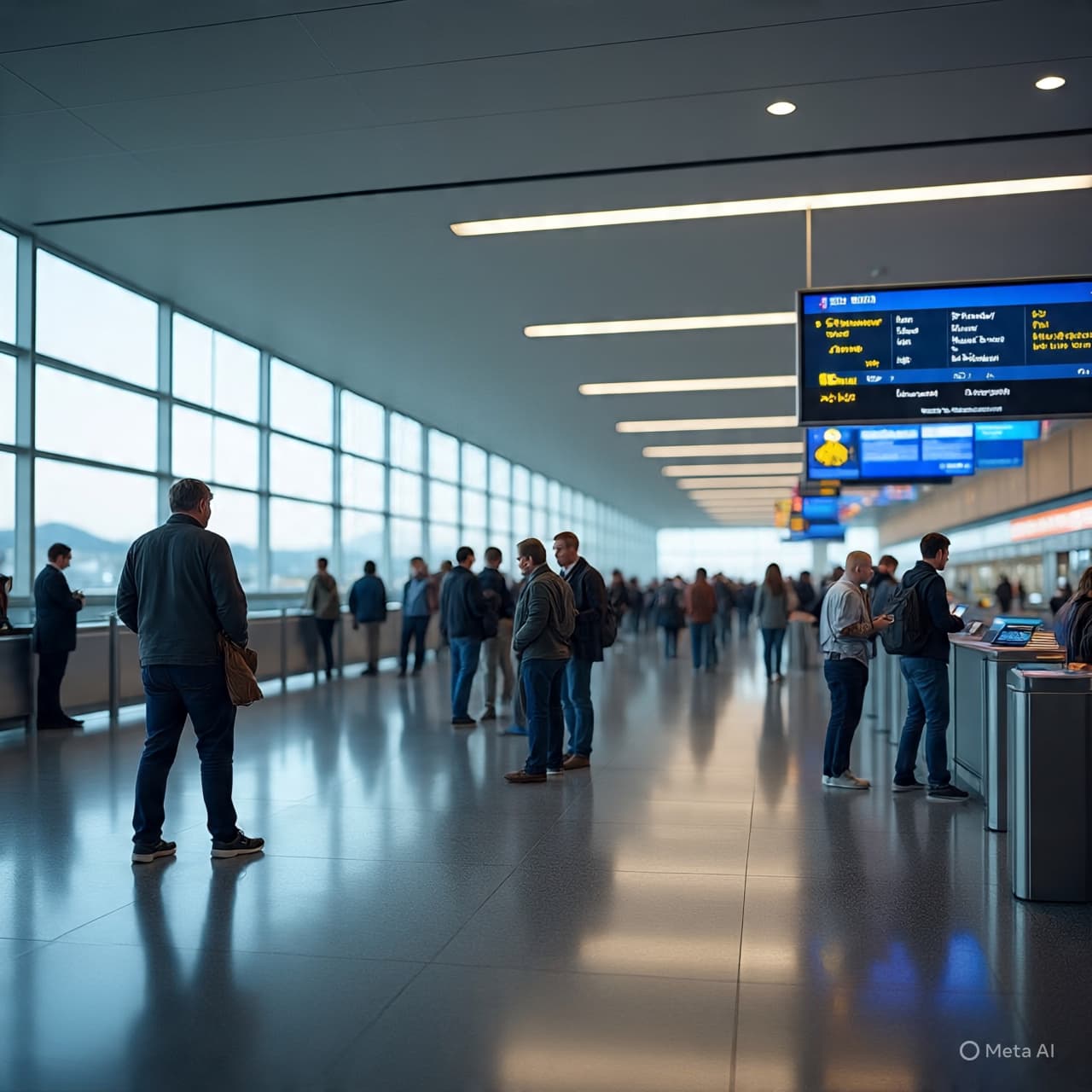
Air travel often unfolds as a sequence of careful timings—connections aligned, departures measured, arrivals anticipated with quiet certainty. Airports become spaces of transition rather than pause, designed for movement rather than stillness. Yet when that movement falters, time itself seems to gather in unexpected ways.
In the Gulf region, recent disruptions to flights have done just that.
Across major transit hubs in places such as Dubai and Doha, delays and cancellations have unsettled travel plans, leaving passengers suspended between destinations. The causes lie in wider regional instability, where airspace restrictions and shifting conditions have forced airlines to adjust routes, postpone departures, and, in some cases, ground flights altogether.
For one grandmother caught within this disruption, the experience extended beyond inconvenience. Her journey, interrupted mid-transit, led to an unintended consequence—an overstay of her visa by two days. What might have been a brief layover instead became an extended wait, shaped not by choice but by circumstance.
The result was a cost that arrived quietly but firmly: a fee of $441, imposed as a penalty for exceeding visa limits. It is a figure that reflects not only regulation, but the rigid structure of immigration systems, where time is counted precisely, regardless of the reasons behind its passage.
Such situations reveal the delicate balance that underpins international travel. Passengers move through layers of coordination—airlines, airports, immigration authorities—each operating according to its own rules and timelines. When one element shifts unexpectedly, the effects ripple outward, sometimes landing on individuals in ways that feel disproportionate to the moment itself.
Airlines, for their part, continue to manage the broader disruption, rerouting flights and working to clear backlogs. Yet the experience on the ground remains varied, shaped by individual circumstances and the specific points at which journeys are interrupted. For those in transit, the difference between delay and disruption can hinge on factors as small as a visa expiry date or a missed connection.
There is also a quieter dimension to such events—the human experience of waiting. Airports, designed for movement, can feel unfamiliar when stillness takes hold. Time stretches, uncertainty settles in, and what was meant to be a brief passage becomes something more prolonged and uncertain.
The grandmother’s experience becomes, in this sense, both specific and representative. It speaks to the broader reality of travel in a moment of instability, where even well-planned journeys can encounter forces beyond their control.
Flight disruptions across Gulf airports have led to delays and cancellations, with one traveler required to pay $441 after overstaying a visa by two days. Airlines continue to manage the situation as regional conditions affect air travel.
AI Image Disclaimer
These visuals are AI-generated and serve as conceptual representations only.
Source Check
BBC News Reuters The Guardian CNN Al Jazeera
Published by Banx Network. This article is part of the Banx decentralized media programme, powered by the BXE token on the XRP Ledger.