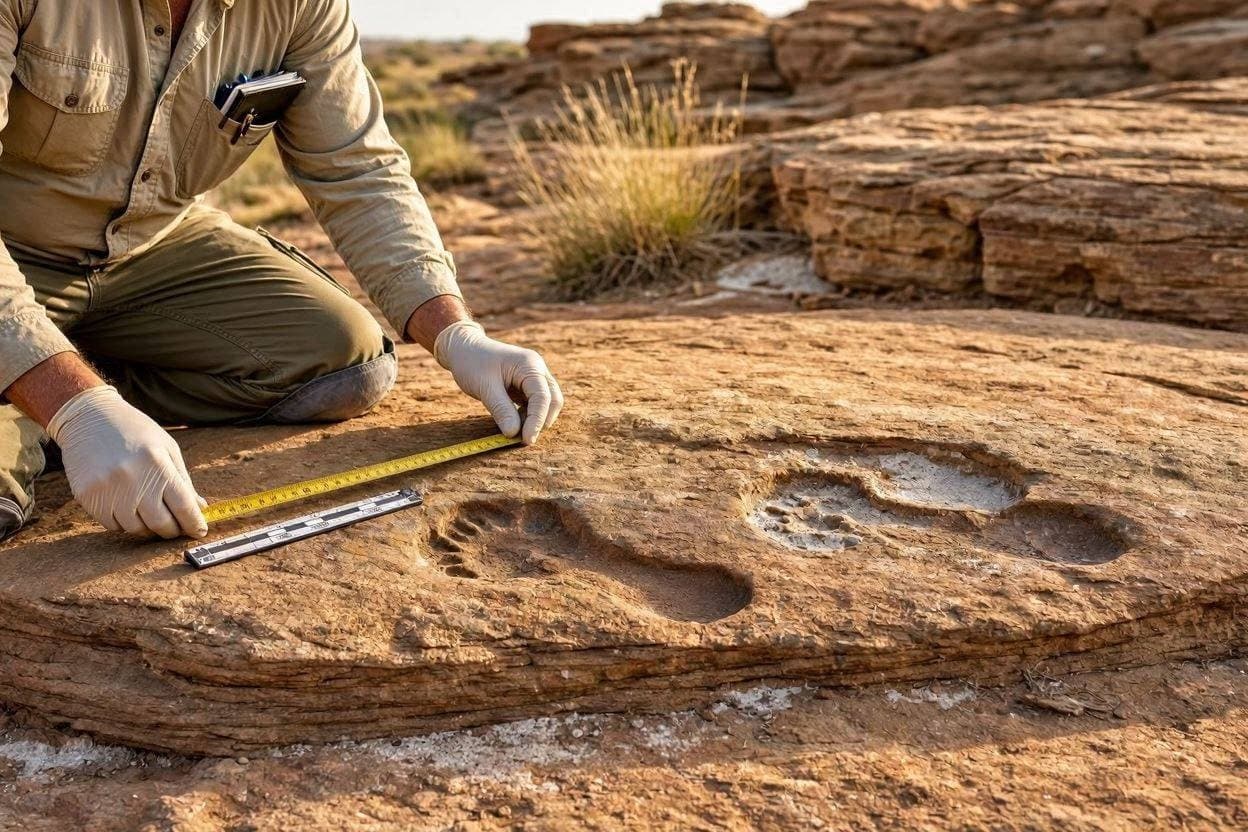
In the dusty layers of time, a set of footprints has remained hidden for 1.4 million years, waiting to tell its story. Recently uncovered in Ethiopia, these ancient impressions offer a tangible connection to our early ancestors. They are not just marks in the earth but evidence of how our predecessors walked, lived, and interacted with their environment. This discovery bridges the gap between skeletal remains and behavioral reality, providing a rare glimpse into the daily lives of Homo erectus.
The footprints, preserved in sedimentary rock, capture the gait and posture of individuals who walked the Earth long before modern humans emerged. They serve as a reminder that our history is written not only in bones but in the steps we take.
Body: The site, located in the Afar Region, has yielded a series of footprints attributed to Homo erectus, a key species in human evolution. Analysis of the prints reveals a walking style remarkably similar to our own, with a heel-strike and toe-off mechanism. This suggests that bipedalism was well-established and efficient by this period, allowing for long-distance travel and endurance.
Researchers measured the stride length and depth of the prints to estimate the height and weight of the individuals. The data indicates a group of varying sizes, possibly including adults and children. This diversity hints at social structures and family units, suggesting that these ancestors lived and moved together.
The preservation of such footprints is extremely rare, requiring specific conditions of soft mud and rapid drying. The fact that they survived for over a million years is a testament to the geological stability of the region. For scientists, each print is a precious data point, offering insights that bones alone cannot provide.
Comparing these footprints to those of earlier hominins, such as Australopithecus, shows a clear progression toward modern human anatomy. The arch of the foot and the alignment of the toes indicate adaptations for efficient walking on varied terrain. This evolutionary trajectory highlights the importance of mobility in human success.
The discovery also provides context for other fossils found in the area. By linking footprints to skeletal remains, researchers can build a more complete picture of the species. It helps to validate theories about locomotion and behavior derived from bone structure.
For the local community and the world, the find is a source of pride and wonder. It underscores Ethiopia’s role as a cradle of humanity, where many key chapters of our story were written. The footprints are a symbol of our shared heritage, connecting us to our deepest roots.
Ongoing studies aim to extract more information from the site, including potential tool use or dietary evidence from surrounding sediments. Each layer of rock holds potential clues, waiting to be decoded by careful science. The story of these footprints is still being written.
As we look at these ancient marks, we see ourselves. The way we walk, the way we move, is a legacy passed down through millions of years. The footprints are a mirror, reflecting our origins.
Closing: The 1.4-million-year-old footprints from Ethiopia offer a profound connection to our ancestors. They remind us that every step we take is part of a long and continuous journey of human evolution.
AI Image Disclaimer: The visuals in this article are AI-generated illustrations designed to reflect the archaeological significance of the ancient footprints.
Sources: Science Advances National Geographic Smithsonian Magazine BBC News
Published by Banx Network. This article is part of the Banx decentralized media programme, powered by the BXE token on the XRP Ledger.