There is a particular desperation that settles over a border when it becomes a bottleneck—when the people who have crossed it have nowhere to go, and the place they have reached has nothing left to offer. In Ceuta, a small Spanish enclave on the northern coast of Africa, that desperation has become a daily reality. Thousands of migrants who entered the territory during a mass border crossing in late July remain there, sleeping on beaches and streets, with scarce food, water, and sanitation. Local residents complain about insecurity, hygiene, and the government's failure to respond. And the enclave's resources—housing, healthcare, sanitation—have been overwhelmed by a crisis that no one predicted and no one has fully resolved .
The numbers behind the crisis are staggering. On July 30 and 31, between 50,000 and 80,000 people crossed from Morocco into Ceuta, a territory whose entire population is roughly 85,000. The vast majority—around 70,000—returned voluntarily to Morocco within days. But thousands remained, including 2,168 unaccompanied minors identified by Spanish national police and handed over to Ceuta's authorities. At least 67 people died trying to enter, according to official figures; non-governmental organizations place the death toll well over a hundred .
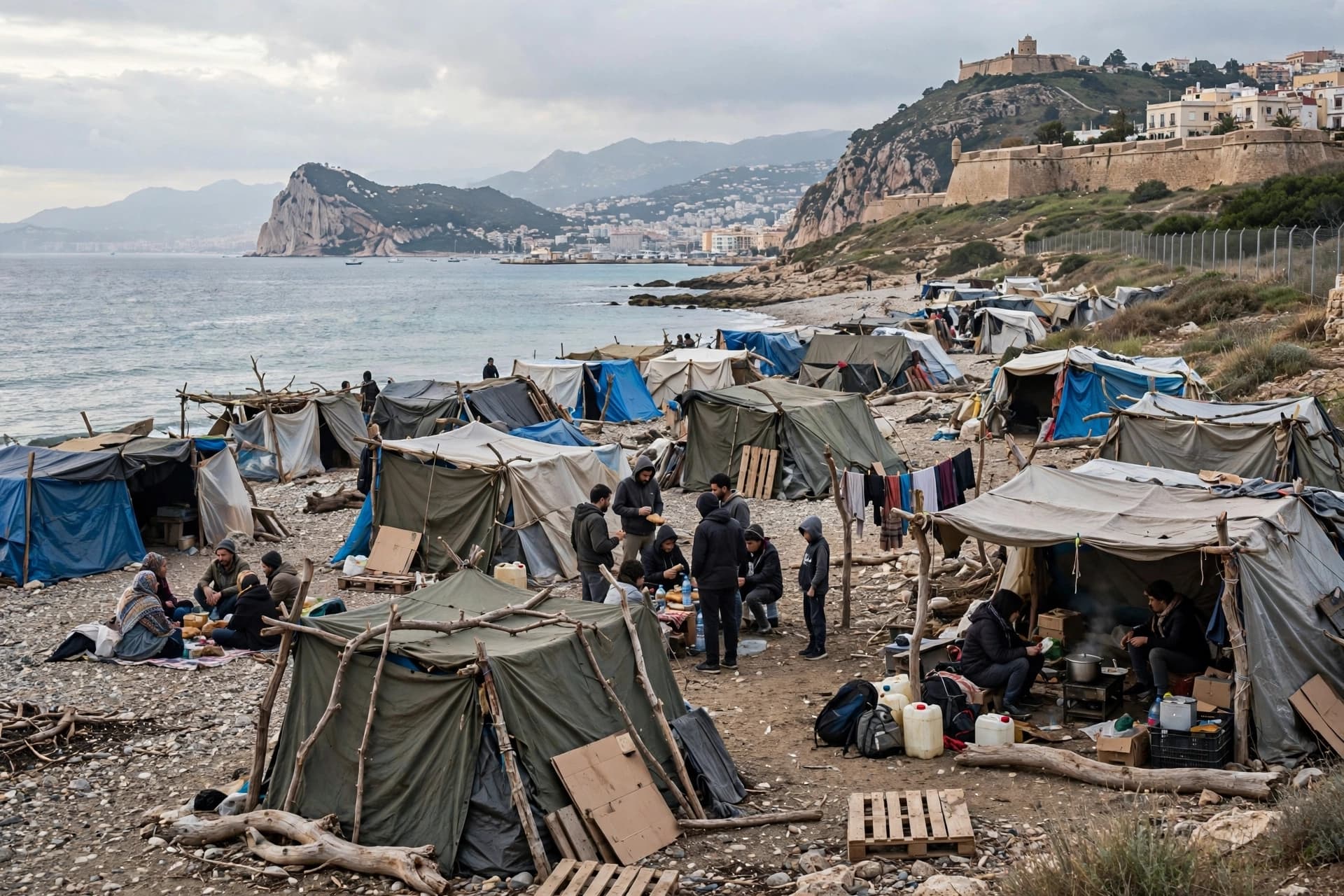
For those who stayed, the conditions have been grim. Many spent weeks sleeping on the streets or on the beach at Trampolín, in makeshift shelters made of wood and tarps, dependent on the Red Cross for daily food. Local residents have complained about insecurity and hygiene problems linked to the homeless migrants roaming the streets, accusing the government of neglecting Ceuta. Spain's leftist central government has sought to relocate unaccompanied children to the mainland, but the plan has run into political resistance from conservative and far-right regional governments, which resist taking in the minors. The government aims to transfer 500 girls to mainland Spain, but the opposition Popular Party has demanded the expulsion of all remaining migrants. "In Spain, mass deportations of minors are illegal," Secretary of State for Children Rubén Pérez Correa responded .
The crisis has drawn comparisons to other migration flashpoints in Europe, but its scale and speed are unprecedented. The European Commissioner for Internal Affairs and Migration, Magnus Brunner, described the influx as "incredible"—"Nothing on this scale has happened at any EU external border in 20 years, not in a single day" . Spain has installed a floating barrier near the sea wall between Morocco and Ceuta and expanded shelters for 1,800 migrants . An evacuation of the beach encampment at Trampolín began on Sunday, with around 3,000 people estimated to be living there, ahead of a planned visit by King Felipe VI and Queen Letizia on October 13—the first visit by a Spanish monarch to the enclave since 2014, and one with delicate diplomatic implications given Morocco's claim to sovereignty over Ceuta .
For the migrants who remain, the future is uncertain. Many are from sub-Saharan African countries, not Morocco, and believe they cannot be returned. They have not eaten regularly since arriving. Women and girls are particularly vulnerable. The enclave's reception centers remain overwhelmed, and the political battle between Madrid and the regions over how to distribute the migrants—especially the unaccompanied children—shows no sign of resolution. Ceuta, a place that was meant to be a gateway, has become a place of waiting. And the waiting has become a crisis.
AI Image Disclaimer: All images in this article are AI-generated and are intended for illustrative purposes only.
Sources: Bernama, RTBF, CCTV+, BSS/AFP, The New York Times
Published by Banx Network. This article is part of the Banx decentralized media programme, powered by the BXE token on the XRP Ledger.