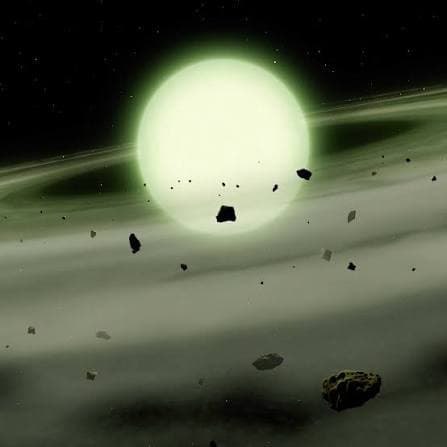
Some stars are born into quiet neighborhoods, circling the galaxy with the patience of tradition. Others are less fortunate, or perhaps more daring. They are cast out early, flung from their stellar families, set adrift across the Milky Way at speeds that defy the calm order of the night sky. For centuries, these runaway stars were glimpsed only as curiosities, bright travelers whose stories were difficult to trace. Now, with the patient gathering of data and time, their journeys are beginning to speak more clearly.
In the largest study of runaway stars ever conducted, researchers have mapped and analyzed thousands of these fast-moving objects, drawing from precise measurements of stellar motion across our galaxy. Using data primarily from the European Space Agency’s Gaia mission, scientists identified stars traveling at unusually high velocities, often moving on paths that point away from dense stellar regions or the galactic center. These trajectories suggest dramatic origins, shaped by violence rather than calm formation.
Runaway stars are typically launched through one of two cosmic events. In some cases, close gravitational encounters in crowded star clusters act like celestial slingshots, ejecting stars outward at tremendous speeds. In others, the explosion of a companion star as a supernova abruptly breaks a binary system, sending the surviving star racing away. The new study reveals that both processes are common, but their signatures differ subtly in speed, direction, and stellar composition, allowing researchers to reconstruct past events long after the chaos has faded.
Beyond cataloging motion, the research offers insight into the structure and history of the Milky Way itself. Runaway stars act as moving probes, carrying information from their birthplaces into distant regions of the galaxy. By tracking them, scientists gain a clearer picture of star-forming environments, supernova rates, and the gravitational landscape that shapes stellar movement. In this way, what once appeared as disorder becomes a map of influence and interaction.
The scale of the study marks a shift from individual case studies to population-level understanding. Thousands of stars, once isolated anecdotes, now form patterns that reveal how often stars are displaced, how fast they travel, and how long they survive their journeys. Some will eventually escape the galaxy altogether, while others will slow, settle, and become quiet members of unfamiliar stellar neighborhoods.
There is a gentle irony in this work. Stars that were once expelled are now central to understanding the systems that rejected them. Their paths, traced backward, point to regions of intense activity and transformation. Their futures, projected forward, help refine models of galactic evolution. The Milky Way, it seems, remembers even those it casts away.
Researchers say the dataset will continue to improve as Gaia releases more precise measurements in the coming years. With each refinement, the stories of these traveling stars grow less blurred. The findings do not rewrite astronomy, but they expand it carefully, showing how motion, loss, and chance are woven into the life of a galaxy. In the steady glow of the night sky, not all light stays where it began.
AI Image Disclaimer Graphics are AI-generated and intended for representation, not reality.
Source Check Nature Astronomy Science NASA European Southern Observatory Smithsonian Magazine
Published by Banx Network. This article is part of the Banx decentralized media programme, powered by the BXE token on the XRP Ledger.