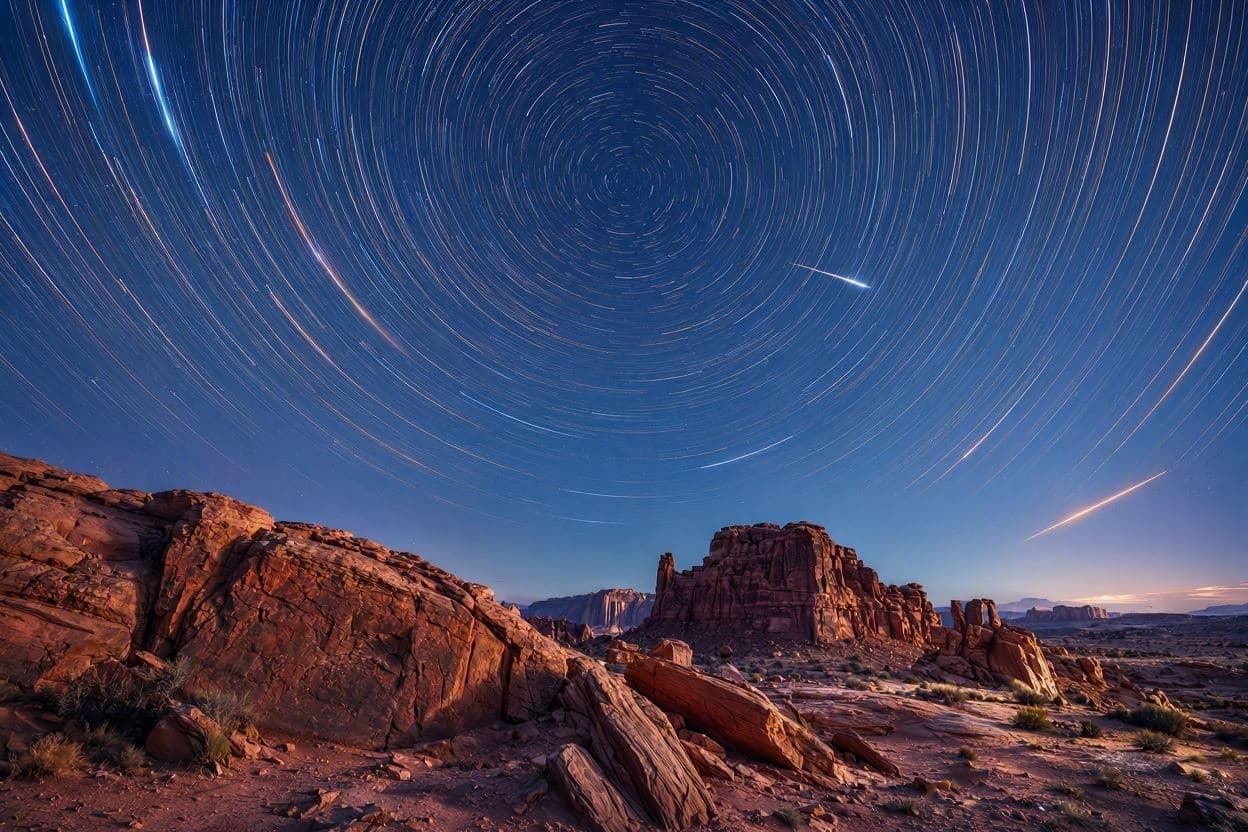
In the vast silence of Egypt’s Western Desert, where the sand stretches to the horizon and the air is dry and clear, the night sky reveals its deepest secrets. Here, away from the light pollution of cities, the Perseid meteor shower put on a spectacular display in August 2026. Captured in stunning photographs, the streaks of light from dying comets intersected with the slow arcs of star trails, creating a celestial ballet that mesmerized observers and astronomers alike.
The Perseids, caused by debris from Comet Swift-Tuttle entering Earth’s atmosphere, peaked on the night of August 12–13. This year, the absence of moonlight provided ideal conditions for viewing, allowing even fainter meteors to shine brightly. In the Western Desert, locations such as the White Desert and remote oases offered perfect vantage points. Photographers set up their cameras for long exposures, capturing the motion of the stars as the Earth rotated, while waiting for the sudden flash of a meteor.
One particularly striking image, taken by astrophotographer Osama Fathi, shows multiple meteor trails cutting across the circular paths of stars. The contrast between the fleeting, linear bursts of the meteors and the steady, curved lines of the stars highlights the different scales of time and motion in the cosmos. The meteors burn up in seconds, while the star trails record hours of movement, together telling a story of both immediacy and eternity.
The Western Desert is renowned for its dark skies, making it a premier destination for stargazing in North Africa. Its low humidity and high elevation reduce atmospheric interference, resulting in crisp, clear views of the Milky Way and other celestial objects. For locals and tourists, the desert offers not just a physical landscape but a window into the universe, fostering a sense of wonder and connection to the broader cosmos.
The Perseid shower is one of the most reliable and active annual meteor showers, typically producing dozens of meteors per hour at its peak. In 2026, observers reported rates of 50 to 75 meteors per hour, with some brighter fireballs lighting up the sky. The event draws enthusiasts from around the world, who camp in the desert to witness the show and share in the collective experience of awe.
Beyond the visual beauty, meteor showers provide scientific value. Studying the frequency and brightness of meteors helps astronomers understand the distribution of debris in the solar system and the behavior of comets. Each streak of light is a piece of cosmic history burning up in our atmosphere, offering clues about the origins of our planetary neighborhood.
As the night ends and the sun rises over the dunes, the memory of the meteor shower lingers. It serves as a reminder of the dynamic nature of space and the beauty that can be found when we look up. In the quiet of the desert, under a canopy of stars and shooting lights, we find a moment of peace and perspective, grounded in the vastness of the universe.
AI Image Disclaimer: The images used in this report are AI-generated visuals created to illustrate the beauty of astrophotography and night skies.
Sources: Space.com, EarthSky, Royal Museums Greenwich
Published by Banx Network. This article is part of the Banx decentralized media programme, powered by the BXE token on the XRP Ledger.