
On January 28, 2026, India's diplomatic strategy faced significant challenges as the country looks to balance its relationships with both the United States and China. The recent tariffs imposed by President Donald Trump on various imports, including a 50% tariff on Indian goods, have strained U.S.-India relations, leading to frustrations in New Delhi.
These tariffs are part of a broader U.S. strategy under the Trump administration that many Indian officials perceive as unilateral and aggressive. In the wake of this tension, India has turned its focus toward fostering relationships with other global players, seeking to establish strong partnerships that can mitigate its reliance on the U.S. market.
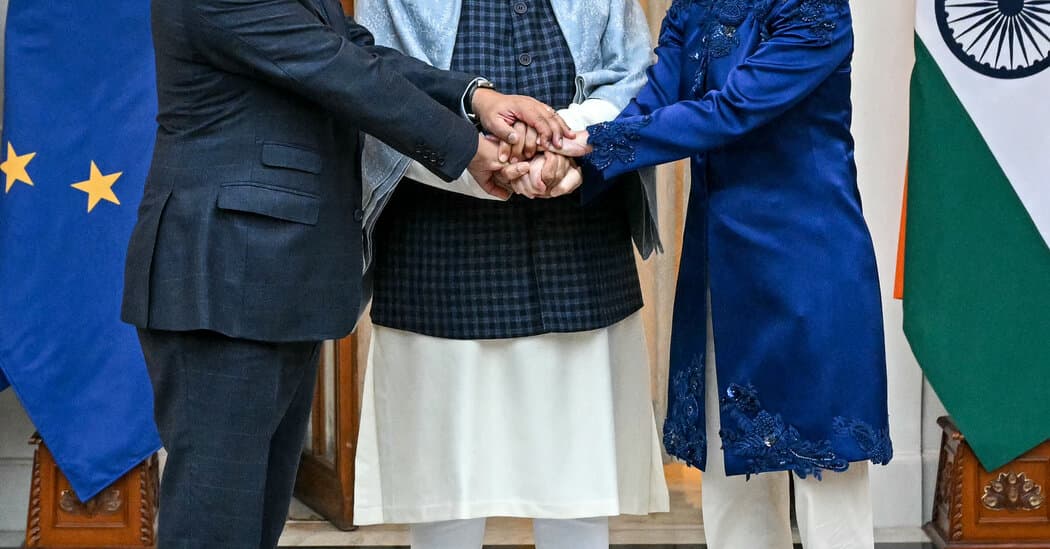
Heightened tensions in Asia, particularly with China, have prompted India to explore new alliances. India recently embarked on significant trade negotiations with the European Union, finalizing a landmark Free Trade Agreement announced earlier this month. This agreement represents around a quarter of global trade and aims to weave together economic ties that move beyond the influence of the U.S.
In parallel, India is also enhancing its strategic ties with nations in Southeast Asia and Africa, diversifying its economic partnerships while looking to enhance security frameworks to counterbalance China’s growing assertiveness in the region. Prime Minister Narendra Modi has emphasized the importance of multi-alignment in foreign policy, enabling India to engage with multiple partners simultaneously without becoming overly reliant on any single nation.
Experts suggest that India’s current approach reflects a necessary shift, given the turbulent global landscape and its own domestic requirements. As Modi prepares to host various international leaders in 2026, including the BRICS summit, the country aims to position itself as a central player in regional and global dialogues.
Despite these efforts, concerns remain about India’s long-term effects of a potential shift away from traditional alliances. The unpredictability of U.S. policies under Trump continues to cast a shadow over diplomatic engagements, making it crucial for India to maintain flexible strategies that can adapt to future changes.
India's efforts to secure "faraway friendships" aim to create a network of partnerships that promotes economic growth and political stability, thereby strengthening its foothold in an ever-changing geopolitical arena.
Published by Banx Network. This article is part of the Banx decentralized media programme, powered by the BXE token on the XRP Ledger.


.jpg&w=3840&q=75 "Same-Sex Couple Sue Slovakia Over Refusal to Register Their Marriage")