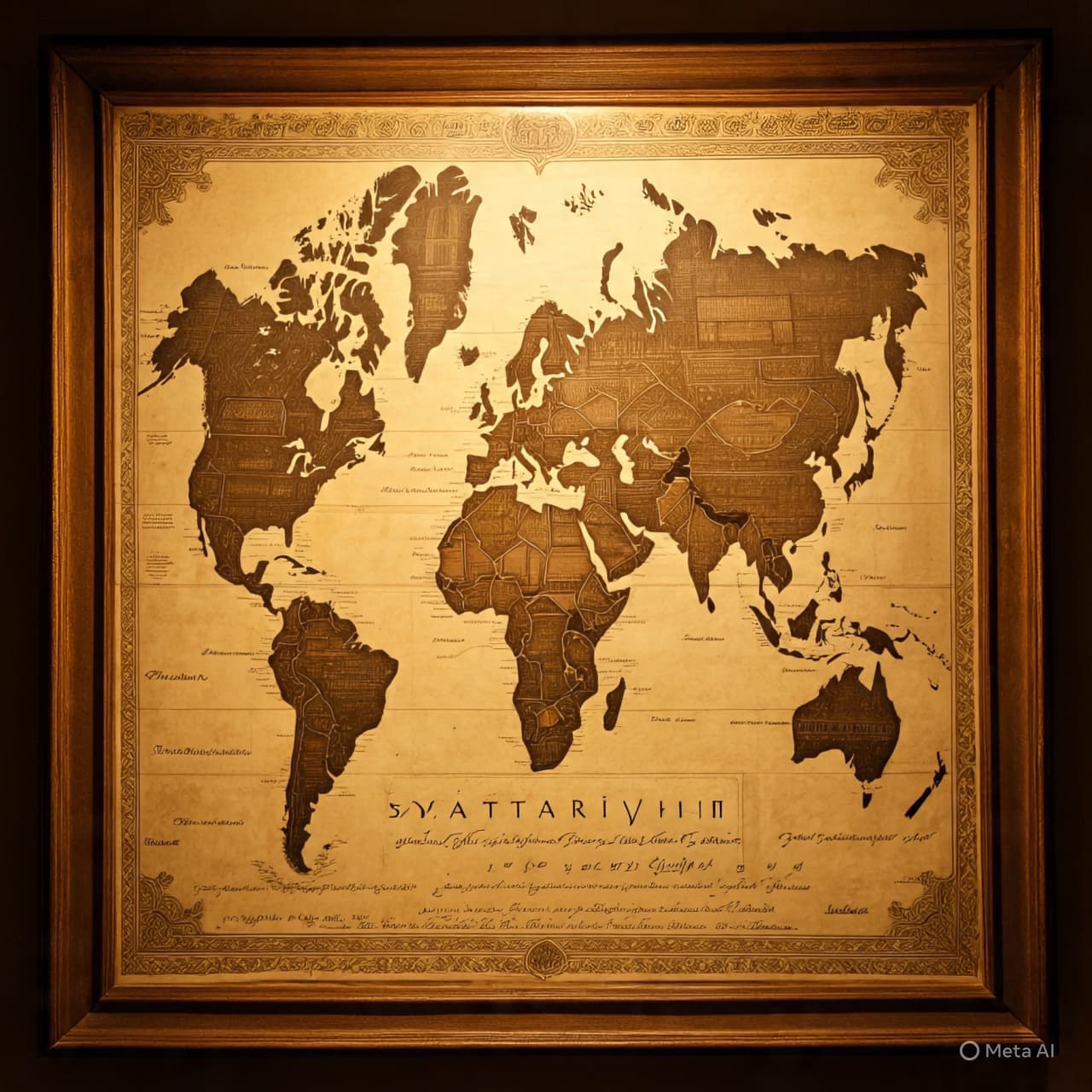
The winds of spirituality have long carried the whispers of mystics across deserts, mountains, and oceans, and among these whispers, the Thoriqoh Syattariyah — known in English as the Shattariyya Sufi order — has traveled far and wide. Emerging in the 15th century, its founder Sheikh Abdullah Shattar earned his epithet “Shattar,” or “lightning‑quick,” for the order’s distinctive emphasis on swift progression along the spiritual path. Rooted in Persian and Indian Sufi traditions, the Shattariyya combined the contemplative insights of earlier mystics such as Abu Yazid al-Bustami with Persian theological currents, creating a path both rigorous and accessible.
From its Central Asian and Indian origins, the Syattariyah order expanded through South Asia, influencing mystical circles in India and Bengal, where it adapted to local devotional practices while maintaining the essential focus on dhikr — the remembrance of God. It was during this period that the order solidified its reputation for guiding aspirants rapidly toward spiritual realization, blending discipline with direct experiential learning.
The order’s journey continued to the Hejaz region, including the holy cities of Mecca and Medina, where eminent scholars such as Shaykh Ahmad al-Qushashi and Ibrahim al-Kurani disseminated its teachings among pilgrims and students from across Asia. This scholarly network laid the foundation for its eventual expansion into Southeast Asia.
In the Malay-Indonesian world, the Syattariyah order gained prominence through figures like Syekh Abdurrauf al-Singkili of Aceh, who studied in Mecca and returned home to teach the order’s spiritual methods. From Aceh, the order spread to Minangkabau in West Sumatra, where disciples like Syekh Burhanuddin further propagated its practices, and into Java, reaching areas such as Tasikmalaya under leaders like Syekh Abdul Muhyi. Here, the order merged with local Islamic traditions, participating in rituals, educational systems, and community spiritual life.
Distinctively, the Syattariyah emphasizes rapid spiritual progress while adhering to Islamic law (shariah). Its practices combine dhikr, meditation, and guidance from a spiritual master, fostering a direct and profound awareness of the Divine. In Southeast Asia, these practices are celebrated during events such as maulid (the Prophet’s birthday) and remain integral to communal religious life in regions like Aceh and Minangkabau.
Across Asia, the Thoriqoh Syattariyah exemplifies the transmission of mystical knowledge, bridging cultures from Persia to Indonesia, and leaving a legacy that reflects both the universality of Sufi devotion and the particularities of regional practice.
AI Image Disclaimer Visuals are AI-generated illustrations and are not real photographs.
Sources: Wikipedia
• Journal of Islamic Studies (UIN Said)
• At-Turas Journal (UNUJA)
• Kompas TV
• Jurnal Al-Fikru
Published by Banx Network. This article is part of the Banx decentralized media programme, powered by the BXE token on the XRP Ledger.