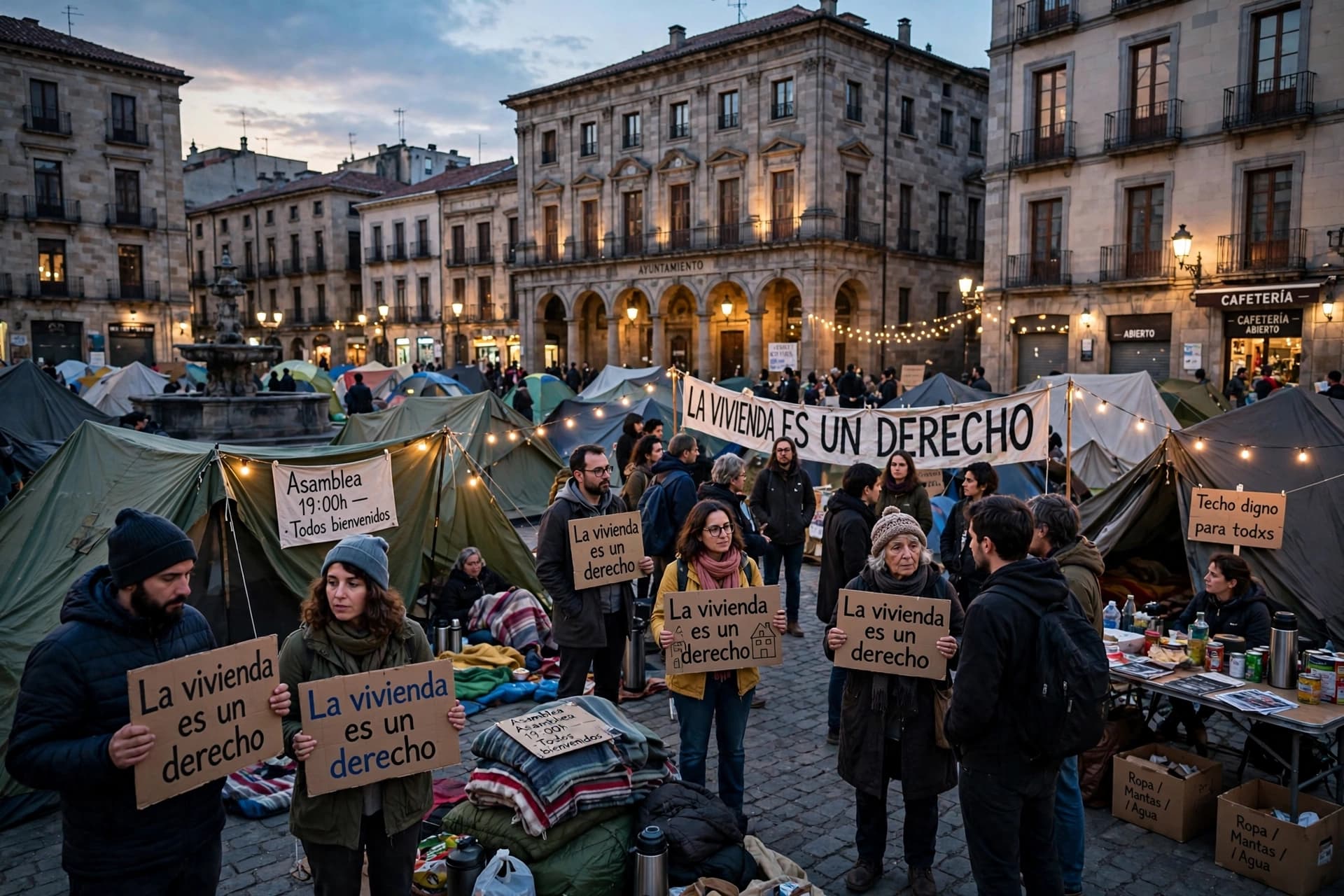
There is a particular anger that ignites when a government promises action and then delivers nothing—an anger that begins as disappointment and hardens into something more combustible. In Spain, that anger is now visible in the streets. On Friday, Parliament rejected two housing decrees proposed by Prime Minister Pedro Sánchez's minority government. By Saturday, tens of thousands of protesters had returned to the streets of Madrid and other cities, demanding affordable housing and threatening a general strike.
The measures that were defeated included automatic renewal of rental contracts when they expire, restrictions on the eviction of vulnerable tenants, and provisions targeting investment funds that buy properties at low prices. The government had hoped the bills would quell a wave of protests that began in September after the eviction of Maricarmen Abascal, an eighty-seven-year-old woman forced from the Madrid apartment she had lived in for seven decades after an investment company raised her rent by 275 percent. Her case became a symbol of a housing crisis that has priced millions of Spaniards out of the market.
The numbers behind the protest are stark. Government figures put Saturday's crowd at 70,000; organizers claimed 500,000. In Madrid, where the average rent has nearly doubled in a decade, a one-bedroom apartment now costs about 1,000 euros per month—half the median salary. A twenty-six-year-old librarian told Agence France-Presse that he and a friend pay 900 euros for a two-bedroom flat; he said he will keep protesting "until someone dares to fully regulate rents, otherwise we'll all have to leave Madrid".
The political consequences are uncertain. The decrees failed because the Catalan separatist party Junts, whose support Sánchez depends on, voted against them alongside the conservative Partido Popular and the far-right Vox. Junts argued the measures were not strict enough. The rejection exposed the fragility of Sánchez's parliamentary position and prompted opposition leader Alberto Núñez Feijóo to call for snap elections, saying "this country cannot take any more".
Recent polls show the PP leading the Socialists, but Sánchez's government has insisted there is no need for early elections and accused the right of using the crisis to manufacture political instability. The tenant unions, meanwhile, have called for a general strike, and the tent encampment in central Madrid remains a visible symbol of a movement that shows no sign of fading. For now, the housing crisis remains what it has been for years: a problem that Spain's political system has not been able to solve, and a grievance that is increasingly being expressed outside the institutions that are meant to address it.
AI Image Disclaimer: The visual elements in this article were created using AI generation tools and are intended for illustrative purposes only.
Sources: Dawn, Toutiao, 163.com, Elconfidencial, elpais
Published by Banx Network. This article is part of the Banx decentralized media programme, powered by the BXE token on the XRP Ledger.