In the vast theater of the cosmos, gravity acts as both a sculptor and a lens, bending light and warping our perception of reality. For years, astronomers have puzzled over a specific gravitational wave signal, designated GW190521, which suggested the merger of two black holes so massive that they should not have existed according to current stellar evolution models. Now, new research proposes a fascinating alternative: what we perceived as an impossible collision may instead be a cosmic optical illusion, distorted by the curvature of spacetime itself.
The original detection indicated that two black holes, each roughly 85 times the mass of the sun, merged to form a single entity of about 142 solar masses. This event was problematic because stars of such size typically collapse directly into black holes without leaving behind a remnant, or they explode as supernovae, leaving behind smaller cores. The existence of black holes in this "mass gap" challenged fundamental assumptions about how stars live and die, creating a mystery that captivated the scientific community.
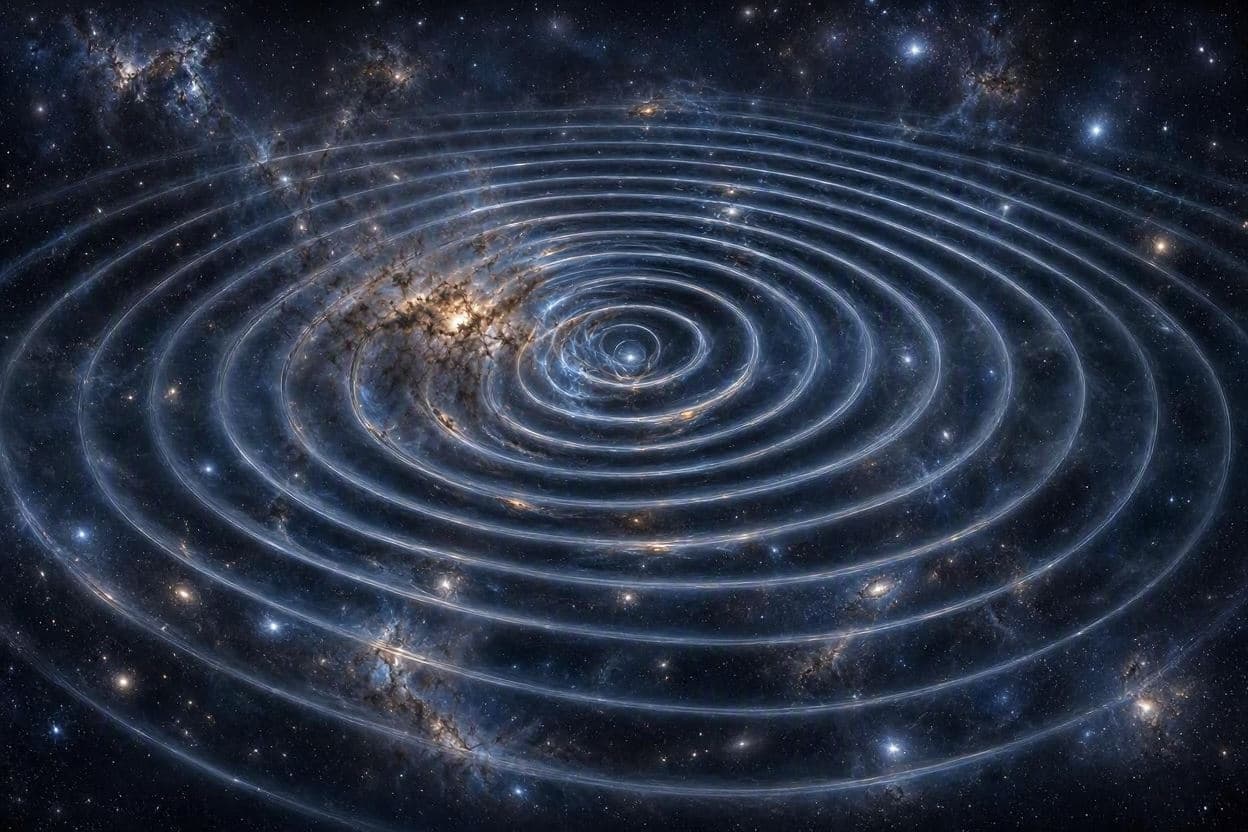
Recent analysis suggests that gravitational lensing may be the key to resolving this paradox. As gravitational waves travel across billions of light-years, they can pass near massive objects like galaxy clusters, which bend their path much like a glass lens bends light. This distortion can amplify the signal, making the source appear closer and more massive than it actually is. If GW190521 was lensed, the true masses of the black holes could be significantly lower, placing them firmly within the realm of standard astrophysical expectations.
This hypothesis does not diminish the significance of the discovery but rather refines our understanding of the universe’s complexity. It highlights the intricate interplay between distant events and the intervening matter that shapes our observations. By accounting for lensing effects, astronomers can recalibrate their models, ensuring that the data aligns more closely with theoretical predictions while opening new avenues for studying the distribution of dark matter and large-scale structures.
The implications extend beyond a single event. If lensing is more common than previously thought, it may affect how we interpret other gravitational wave detections. Researchers are now revisiting past data, looking for subtle signatures of distortion that might have been overlooked. This careful re-examination underscores the iterative nature of science, where each answer leads to deeper questions and more precise measurements.
For the public, this story serves as a reminder that our view of the universe is always mediated by the tools and theories we use. What seems impossible at first glance may simply be a matter of perspective, altered by the vast distances and powerful forces at play. It invites us to remain humble and curious, recognizing that there is always more to learn about the cosmos.
As technology improves and more sensitive detectors come online, our ability to distinguish between genuine anomalies and optical illusions will grow. The journey to understand black holes is far from over, but each step brings us closer to a coherent picture of the universe’s most extreme phenomena. The mystery of GW190521, whether resolved by lensing or not, remains a testament to the power of human inquiry.
In the end, the universe continues to surprise us, revealing its secrets in layers. Whether the black holes were truly impossible or just seemingly so, the pursuit of truth drives us forward. It is a journey of discovery that connects us to the deepest mysteries of space and time.
AI Image Disclaimer: The visual elements accompanying this article are AI-generated interpretations designed to illustrate the concepts of gravitational waves and spacetime curvature, without depicting specific real-world data or instruments.
Sources: Space.com, LIGO Scientific Collaboration, Simons Foundation, Nature Astronomy
Published by Banx Network. This article is part of the Banx decentralized media programme, powered by the BXE token on the XRP Ledger.