
Key Highlights
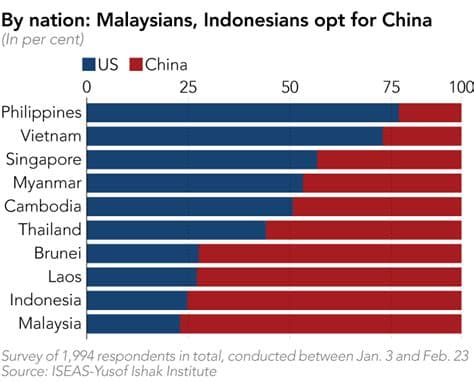
- Southeast Asian countries are increasingly aligning with China over the U.S.
- Economic ties and cultural connections drive this shift.
- Security concerns influence regional defense strategies.
[Regional Shift Towards China]
In a notable shift in regional alliances, Southeast Asian countries are increasingly gravitating towards China, signaling a potential realignment in geopolitical relationships. This trend is fueled by several key factors that highlight a complex interplay of economic interests, historical connections, and evolving security dynamics.
[Economic Dependency]
Southeast Asia has long been a crucial area for economic growth, primarily driven by trade and investment. China's Belt and Road Initiative (BRI) has significantly intensified this economic engagement. Nations such as Vietnam, Malaysia, and Thailand are not only participating but are also seeing real benefits such as infrastructure development and access to Chinese markets. The allure of Chinese investment often outweighs that of the United States, with financial packages that are seemingly less conditional than those offered by Western nations.
[Historical and Cultural Ties]
Many Southeast Asian countries share deep historical and cultural connections with China, which can enhance diplomatic relations. For instance, Singapore, with its substantial Chinese population, emphasizes cultural affinities that facilitate closer ties with Beijing. This complicates the relationship with the U.S., which, while a security partner, does not possess the same cultural resonance. The historical context of trade and migration has fostered a sense of kinship that influences contemporary political decisions.
[Global Strategic Dynamics]
The rise of China as a global superpower has shifted the regional balance of power. Southeast Asian nations often pursue a policy of balancing between major powers. However, as U.S.-China tensions escalate—particularly over issues like trade, security, and technology—Southeast Asian countries see an opportunity in forging stronger ties with China. Many view closer relations with Beijing as a safeguard against potential U.S. unilateral actions, which may not always align with regional interests. This strategic recalibration reflects a pragmatic approach to international relations.
[Security Concerns]
While the U.S. has traditionally been seen as a security guarantor in the region, its ability to project power is called into question amid strategic challenges. Over the past few years, incidents in the South China Sea highlight the precariousness of U.S. military commitments. In contrast, countries like the Philippines and Indonesia are recalibrating their defense strategies to accommodate a more assertive Chinese military presence, considering cooperation as a way to bolster their own security frameworks. This shift underscores a growing recognition of the need for regional autonomy in security matters.
[Conclusion]
The inclination of Southeast Asia towards China marks a significant pivot in global geopolitics. While many remain cautious about the implications of closer ties with Beijing, the advantages of economic partnership, cultural ties, and strategic alignment are compelling a re-evaluation of traditional alliances. As this shift continues to unfold, the implications for U.S. foreign policy in the region will be profound, necessitating a response that addresses the nuanced needs and aspirations of Southeast Asian nations. The future of U.S.-China relations, as much as Southeast Asia's regional stability, may depend on how these dynamics evolve in the coming years.
Published by Banx Network. This article is part of the Banx decentralized media programme, powered by the BXE token on the XRP Ledger.



