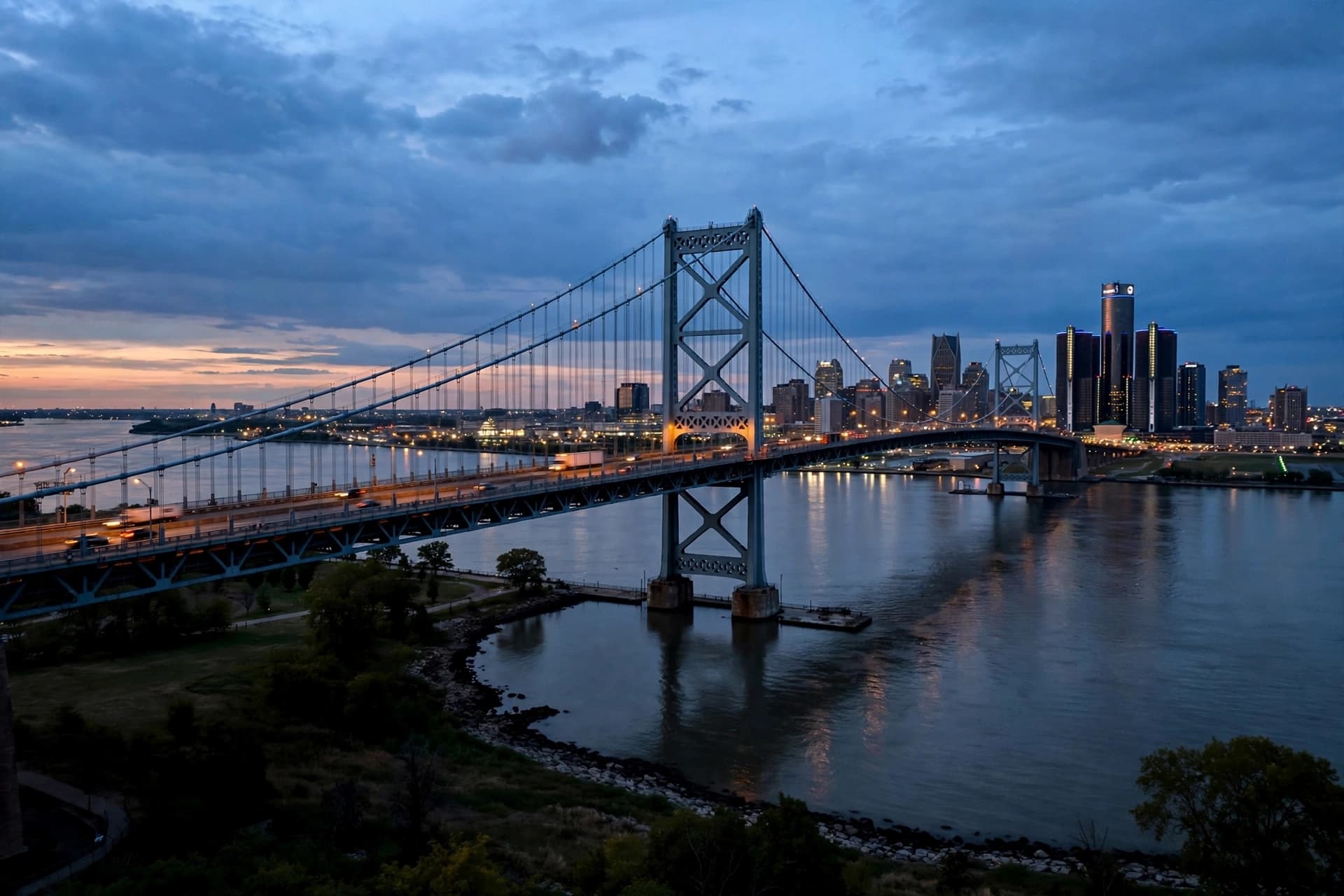
There is a particular sadness in watching a bridge that has carried traffic for generations grow quiet, not because the road has failed but because the weather has turned. The Ambassador Bridge and the Detroit-Windsor Tunnel have long been more than infrastructure; they are the physical expression of a relationship that has survived tariffs, recessions, and the ordinary friction of neighbors. This week, that relationship registered another tremor. Detroit's tourism bureau, Visit Detroit, confirmed it has completely stopped marketing to Canada, a decision that is less a severing than a retreat, a quiet acknowledgment that the moment for persuasion has passed .
The numbers tell a story of steady erosion. Historically, Visit Detroit spent seven figures annually on Canadian advertising, roughly ten percent of its budget, trying to draw travelers across the border. Over the past two years, the organization has seen a thirty percent drop in Canadians visiting its jurisdiction, a decline that has only modestly reversed in recent months . The bureau's president and CEO, Claude Molinari, spoke about the decision with an unusual candor, describing American federal policies as "antagonistic toward Canada" and acknowledging that those policies have hurt his organization's mission .
What makes Molinari's comments notable is their refusal to pretend. He did not frame the advertising pause as a strategic recalibration or a data-driven optimization. He said the quiet part aloud: marketing to Canadians right now would come off as tone deaf, perhaps even antagonistic, and the bureau did not want to be that . The marketing dollars once directed north have been redirected toward Europe, an attempt to fill a void that no other market can quite replicate. Canadians, Molinari noted, were Southeast Michigan's largest international visitor market before the tensions began .
The trade war that prompted this retreat is not abstract. U.S. President Donald Trump has imposed tariffs on a range of Canadian goods, with particular impact on Windsor's automotive industry, and Canada has responded with retaliatory measures of its own . The dispute has filtered down into the everyday decisions of ordinary people, many of whom have chosen to avoid U.S. travel altogether. For a border city like Detroit, whose identity is woven into the fabric of cross-border life, that choice carries a specific weight. The river is still there. The bridge is still open. But the traffic has thinned, and the reasons are not mysterious.
Molinari has been careful not to assign blame to Canadians. "I can understand why Canadians are upset with us, and I don't hold that against Canadians," he said. "I don't want to be tone deaf and just assume, 'Okay, all is forgiven; we're coming all back.' We miss our Canadian friends for sure" . There is a humility in that language that is difficult to manufacture, a recognition that goodwill cannot be advertised back into existence once it has been spent.
The bureau says it will resume marketing in Canada when the tariff issue is resolved and a greater level of respect and positive relationship exists between Ottawa and Washington . That is a conditional promise, and it is the right one. Until then, Detroit will wait, its tourism dollars pointed elsewhere, its bridges carrying less traffic than they once did. The relationship between these two countries has weathered worse and recovered. But recovery, when it comes, will not be the work of a marketing campaign. It will be the work of something slower and more difficult, something that begins with the people who still believe the bridge is worth crossing.
---
Image Disclaimer: The visuals accompanying this article are generated by artificial intelligence and are not photographs of the individuals or locations mentioned.
Sources: CBC News, Radio-Canada, Axios
Published by Banx Network. This article is part of the Banx decentralized media programme, powered by the BXE token on the XRP Ledger.