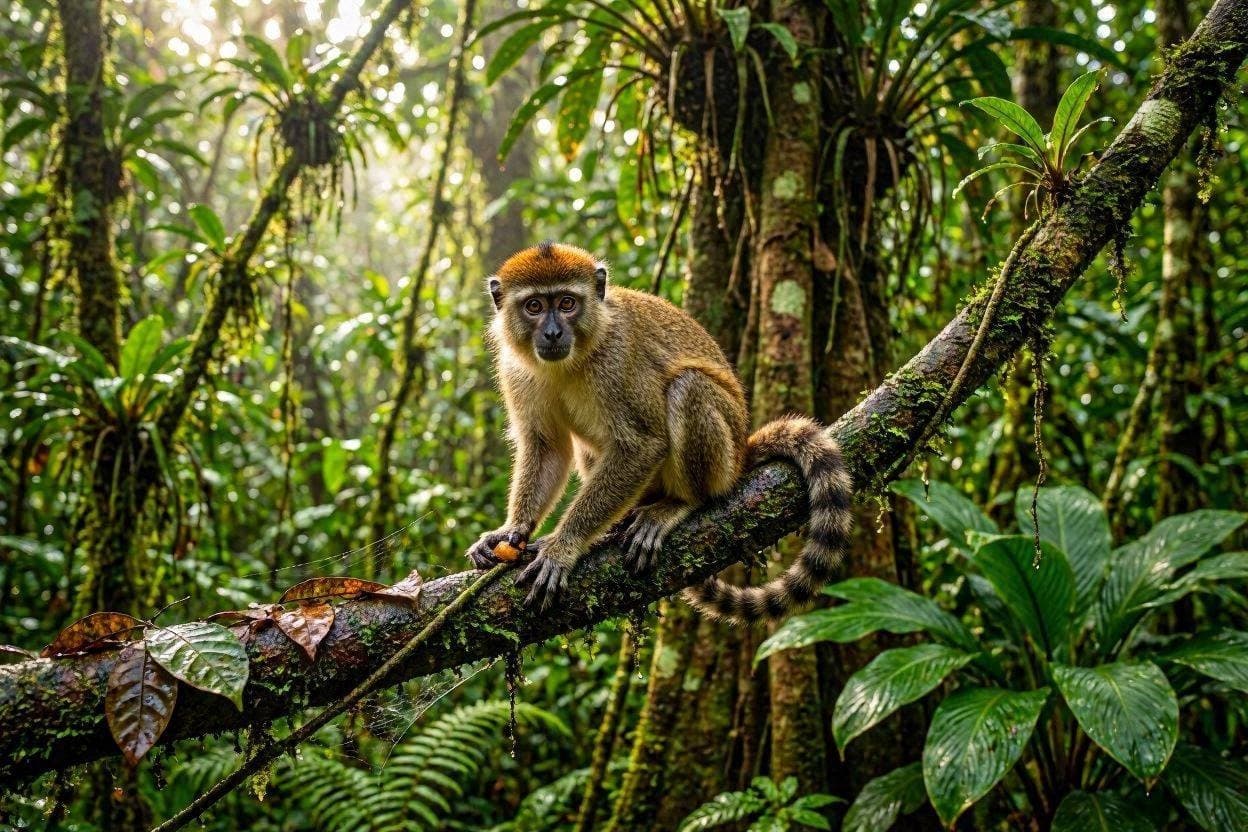
Some of the world's greatest discoveries are not found in distant galaxies but within forests that have stood for millions of years. Beneath towering trees and dense canopies, life continues to evolve in ways that often remain hidden from human observation. The latest scientific discovery from the Congo rainforest serves as another reminder that Earth still holds remarkable biological mysteries waiting to be understood.
An international team of researchers has announced the identification of a previously unrecognized monkey species in the Congo rainforest after extensive field observations, genetic analysis, and comparisons with closely related primates. The discovery highlights the extraordinary biodiversity of Central Africa and reinforces the importance of continued scientific exploration in one of the world's largest tropical forests.
Scientists determined that the newly identified primate differs from neighboring monkey populations through a combination of physical characteristics, vocal behavior, habitat preferences, and genetic evidence. Modern DNA sequencing played a central role in confirming that the population represents a distinct species rather than a regional variation of an already known primate.
The Congo Basin is widely recognized as one of Earth's most significant biodiversity hotspots. Stretching across several Central African countries, the rainforest provides habitat for thousands of plant and animal species, many of which are found nowhere else. Researchers believe that remote regions within the basin continue to contain species that have yet to be formally described by science.
Beyond its scientific significance, the discovery also carries important conservation implications. Newly identified species often inhabit relatively limited geographic ranges, making them more vulnerable to habitat loss, illegal hunting, and environmental change. Understanding where these animals live and how they interact with their ecosystems helps conservation organizations develop more effective protection strategies.
Field researchers spent considerable time documenting the monkeys' feeding behavior, social organization, movement patterns, and preferred habitats before confirming the discovery. Combined with laboratory-based genetic analysis, these observations provide a more complete understanding of the species' ecological role within the rainforest ecosystem.
Experts note that advances in molecular biology, camera trapping, acoustic monitoring, and satellite mapping have accelerated the pace of wildlife discoveries over the past two decades. Even so, scientists estimate that numerous vertebrate and invertebrate species remain undocumented, particularly in remote tropical forests that are difficult to access.
The identification of a new monkey species in the Congo rainforest illustrates that scientific exploration continues to reveal previously unknown aspects of Earth's biodiversity. As researchers continue studying the species and its habitat, the discovery contributes to a broader understanding of evolution, conservation, and the extraordinary diversity of life within one of the planet's most important ecosystems.
AI Image Disclaimer: The illustrations accompanying this article are AI-generated visual reconstructions inspired by scientific descriptions and do not represent documentary photographs of the newly identified species.
Source Verification Check: Strong credible sources found.
Sources:
International Union for Conservation of Nature (IUCN) Mongabay Nature Ecology & Evolution Science Reuters
Published by Banx Network. This article is part of the Banx decentralized media programme, powered by the BXE token on the XRP Ledger.