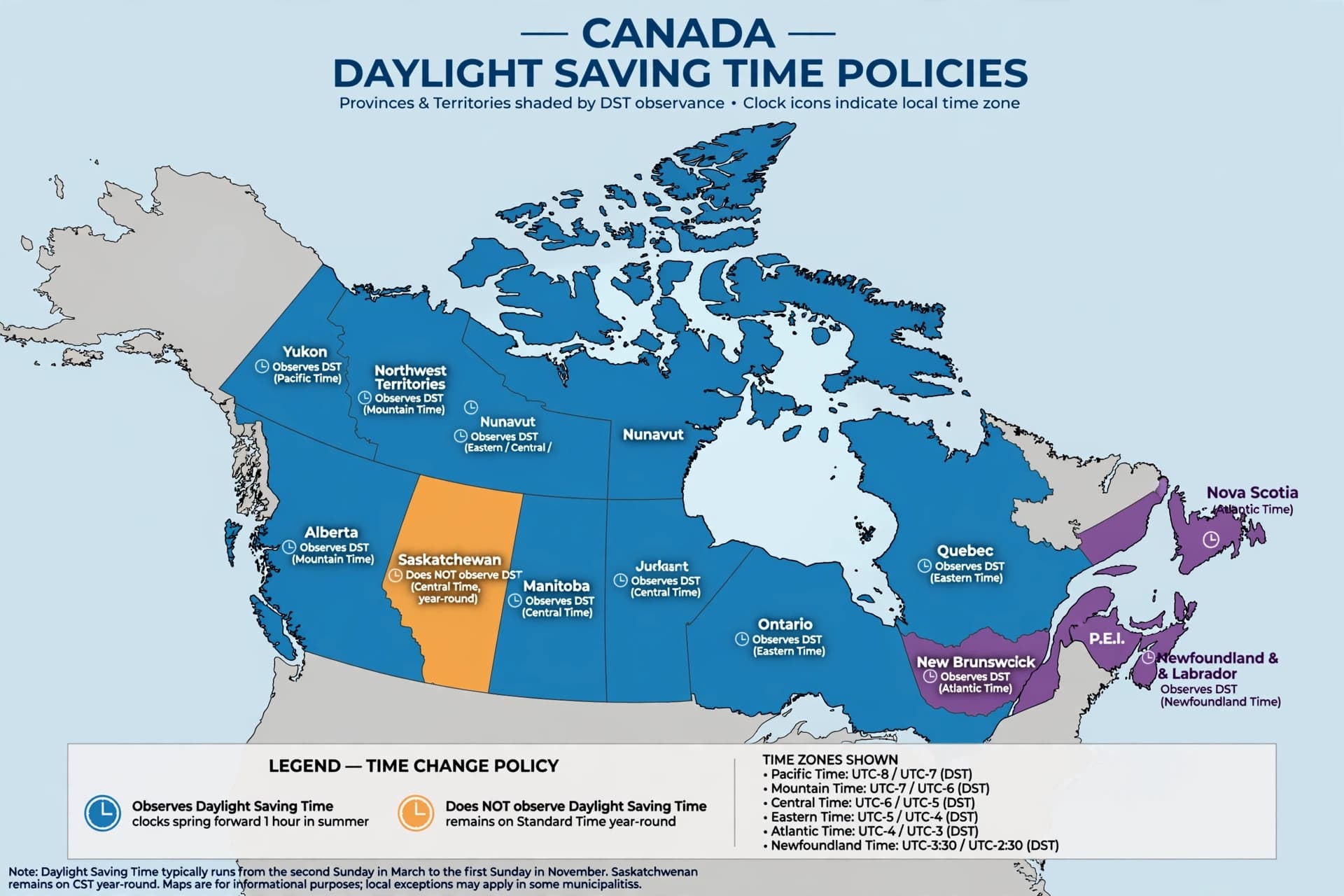
Twice a year, Canadians perform a small ritual that has become as familiar as it is contested: they change their clocks. But this November, the ritual is no longer uniform. Some provinces will turn their clocks back. Others will not. And for a country already stretched across six time zones, the result is a patchwork of schedules that can confuse even those who live within it.
The shift began earlier this year, when British Columbia announced it would adopt permanent daylight time, staying on Pacific Time year-round . Alberta followed, adopting what it calls “Alberta Time,” previously known as Mountain Daylight Time . Manitoba announced it would remain on daylight saving time permanently. And just this week, Ontario announced that parts of its northwest region will also move to permanent daylight time, aligning with Manitoba .
The result, as of November 1, is a country divided not just by geography but by the clock. Most of Ontario, including Toronto and Ottawa, will fall back to Eastern Standard Time. Quebec will do the same. Atlantic Canada will set its clocks back one hour. But British Columbia, Alberta, Manitoba, and Saskatchewan will not change at all .
For travelers, the implications are practical. British Columbia will remain one hour ahead of Washington state, meaning a drive to catch a ferry or a flight requires a recalculation of time . Alberta will be just one hour behind Ontario instead of two. Manitoba will share the same time as most of Ontario. Saskatchewan, which has observed Central Standard Time year-round since 1966, will now be in sync with Alberta year-round .
For businesses, the stakes are higher. Professor Patrick Baylis, an economist at the University of British Columbia, notes that when neighboring economies share the same time rules, trade and business hours stay in sync. But when jurisdictions diverge, coordination becomes more complicated . The United States remains Canada’s major trading partner, and American states are not making the same changes.
For health researchers, the debate is not just about convenience. Rebecca Robillard, co-chair of the Canadian Sleep Research Consortium, says the biannual clock change disrupts the alignment between our biological clocks and the natural cycle of the day. “It’s really a question of public health,” she says . But she also cautions that permanent daylight time—which many provinces are adopting—means darker mornings in winter, which can affect mood and circadian regulation .
Quebec’s incoming premier, Paul St-Pierre Plamondon, has said his government would consider abolishing the time change but wants to consult experts first . For now, no timeline has been set. The result is a country where the question of what time it is depends not just on where you are, but on which province you happen to be in.
AI Image Disclaimer: Visual content accompanying this article is generated by artificial intelligence for illustrative purposes only.
Sources: Daily Hive, CBC News, The Boston Globe, The Canadian Press
Published by Banx Network. This article is part of the Banx decentralized media programme, powered by the BXE token on the XRP Ledger.