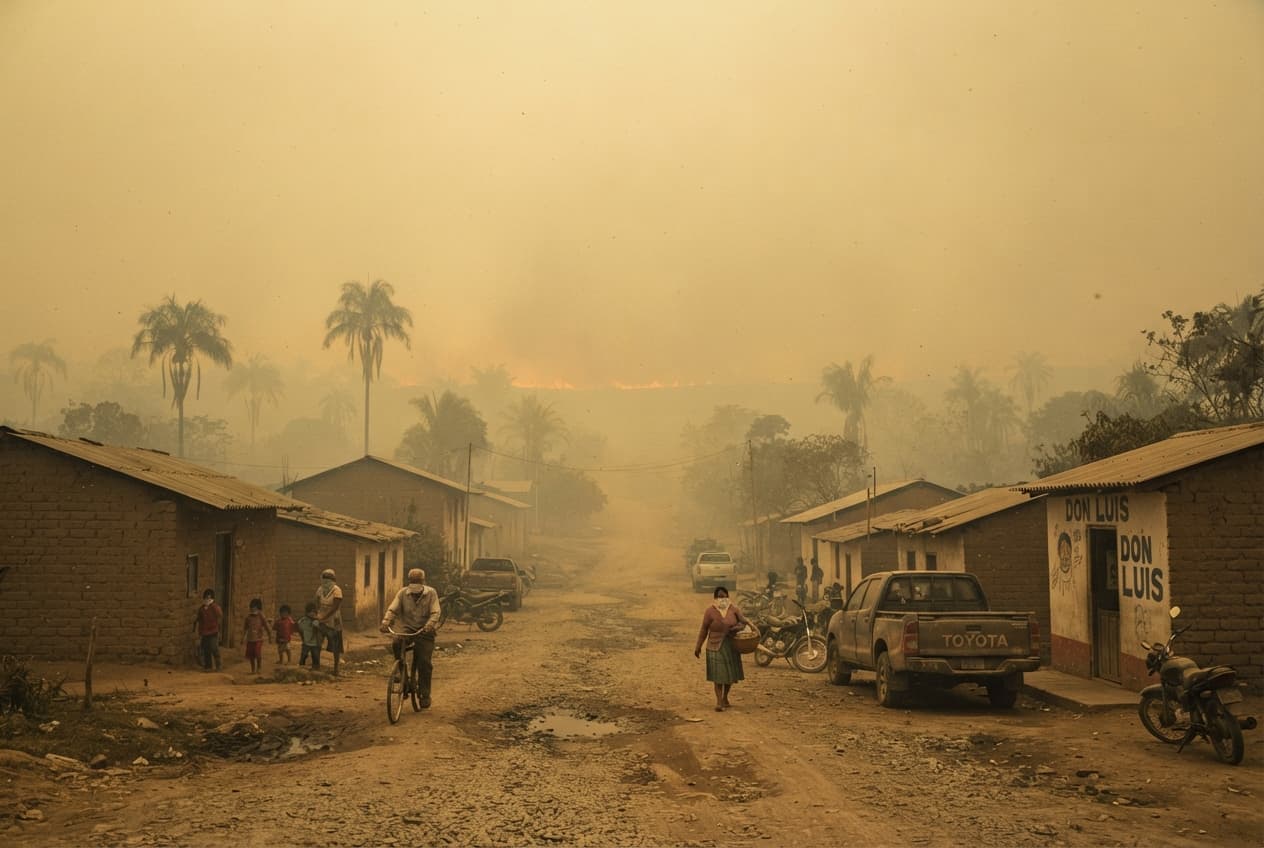
Santa Cruz, Bolivia—Raging forest fires and thick toxic drought smoke choked rural communities across eastern Bolivia on September 28, 2026, resulting in a surge of respiratory-related hospitalizations and one confirmed fatality among vulnerable elderly residents. Unprecedented dry conditions and high winds fueled multiple aggressive blazes across the agricultural frontier, blanketing entire provinces in a dense, yellowish haze. Civil defense authorities confirmed that volunteer firefighters and military units are battling remote flames without adequate aerial support.
In the rural agricultural municipality of San Ignacio de Velasco, particulate matter concentrations surpassed historic safety thresholds as smoke settled heavily over residential sectors. Local hospital administrators reported treating dozens of patients suffering from acute asthma attacks, severe bronchitis, and eye irritation. Regional health director Dr. Roberto Silva confirmed that an eighty-one-year-old resident succumbed to acute respiratory failure brought on by prolonged smoke inhalation.
Agricultural production zones experienced severe disruptions as visibility dropped below fifty meters along primary rural transit arteries. Commercial freight transport and local bus services reduced speeds significantly to avoid collisions on smoke-choked dirt roads. Agrarian cooperatives report that uncontained fires have scorched thousands of hectares of pastureland and native forest cover.
Public health outposts in remote districts report running critically low on nebulizers, oxygen tanks, and essential respiratory medications. Medical personnel struggle to triage incoming patients as local clinic waiting rooms fill beyond capacity with coughing children and elderly citizens. National health ministry officials dispatched emergency pharmaceutical supplies via ground transport from Santa Cruz.
Municipal water boards implemented strict conservation measures as prolonged drought conditions depleted local municipal reservoirs and shallow wells. Rural villagers gathered near emergency water tanker trucks to collect drinking supplies amidst falling ash and soot. Community leaders demanded immediate governmental intervention to control out-of-control land-clearing fires.
Meteorological forecasters predict that dry atmospheric stability and strong wind patterns will maintain heavy smoke blankets over the eastern lowlands for several days. Satellite thermal imaging tracks multiple active fire fronts advancing across unattended brush and forested tracts. Environmental protection agencies maintained maximum alert levels across the entire lowland department.
Power transmission grids in rural zones experienced localized outages following utility pole damage from advancing brush fires. Regional emergency command centers coordinated nighttime fire containment lines using manual back-pumps and cleared fire breaks. Response commanders emphasize that comprehensive fire suppression will require sustained seasonal rainfall shifts.
Emergency medical teams continue monitoring vulnerable populations throughout the evening hours as air quality conditions remain hazardous. Response coordinators evaluate satellite fire maps to deploy ground units to threatened settlement perimeters. Relief agencies prepare for extended humanitarian operations focused on public health protection and shelter management.
Published by Banx Network. This article is part of the Banx decentralized media programme, powered by the BXE token on the XRP Ledger.