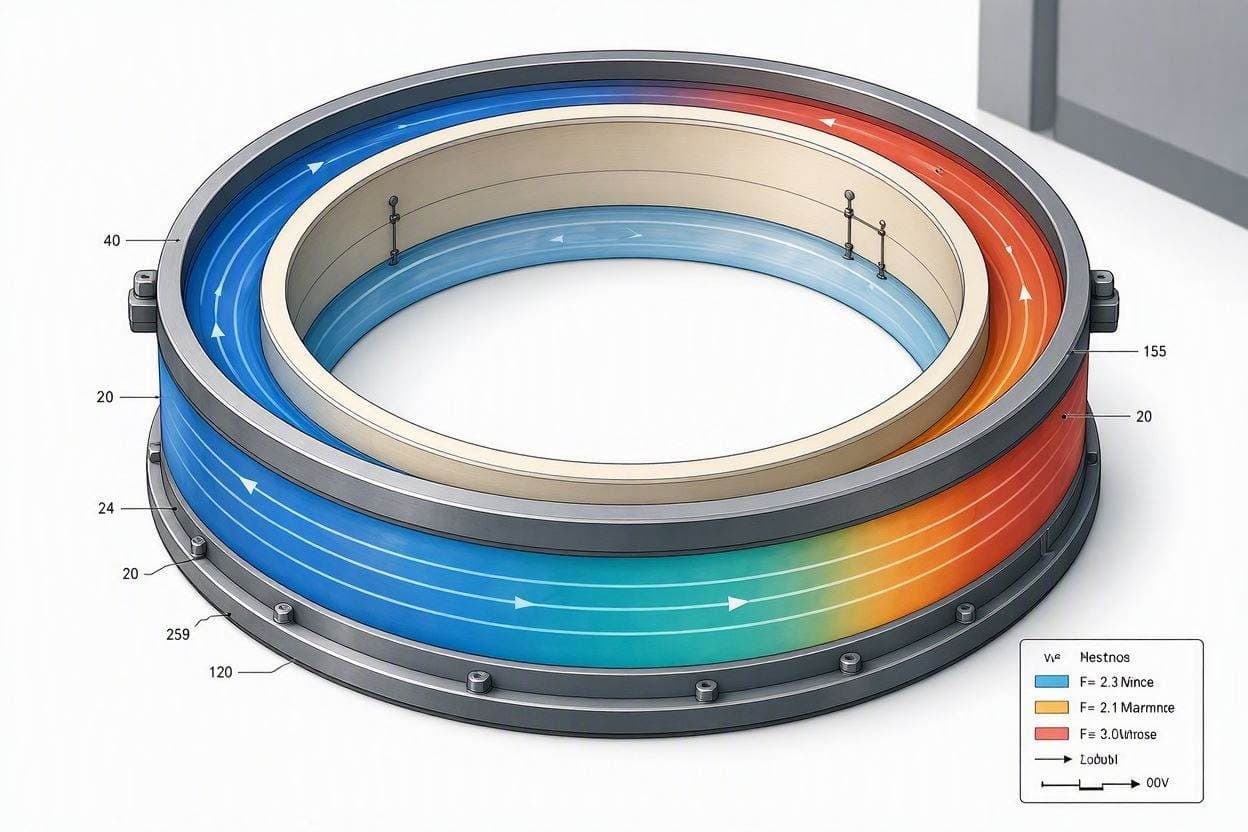
In the quiet realm of fluid dynamics, where heat and motion dance in intricate patterns, scientists are uncovering new ways to understand the behavior of complex liquids. Recently, researchers have turned their attention to ternary hybrid nanofluids, mixtures that combine three different types of nanoparticles to enhance thermal performance. By studying their flow within a rotating annulus, a space between two concentric cylinders, they aim to unlock secrets that could revolutionize cooling systems in engineering. This exploration is not just about numbers; it is a journey into the heart of efficiency, guided by the innovative use of hybrid physics-informed neural networks. It is a testament to how modern technology can illuminate the subtle workings of nature.
The study focuses on a specific mixture: aluminum oxide, graphene, and carbon nanotubes suspended in water. This ternary combination offers unique properties, such as improved thermal conductivity and stability, making it ideal for high-performance applications. The rotating annulus provides a controlled environment to observe how these particles move under the influence of centrifugal forces and magnetic fields. Understanding this flow is crucial for designing better heat exchangers, electronic cooling devices, and even energy storage systems.
To model this complex behavior, traditional computational methods often fall short due to their high cost and complexity. Enter the hybrid physics-informed neural network (PINN), a tool that blends the power of artificial intelligence with the fundamental laws of physics. Unlike standard black-box models, PINNs are constrained by physical equations, ensuring that their predictions remain grounded in reality. This approach allows for more accurate and efficient simulations, capturing nuances that might otherwise be missed.
Sensitivity analysis plays a key role in this research, helping scientists identify which parameters have the most significant impact on the system. By varying factors such as rotation speed, magnetic field strength, and nanoparticle concentration, researchers can determine how each element influences heat transfer and fluid flow. This knowledge is vital for optimizing designs, ensuring that every component works in harmony to achieve maximum efficiency.
The implications of this work extend beyond the laboratory. Industries ranging from aerospace to renewable energy stand to benefit from more effective cooling solutions. As devices become smaller and more powerful, the need for efficient heat management grows. Ternary hybrid nanofluids, guided by advanced modeling techniques, offer a promising path forward, reducing energy consumption and enhancing performance.
For the scientific community, this study represents a step toward integrating machine learning with traditional physics. It demonstrates that AI can be a partner in discovery, not just a tool for prediction. By respecting the underlying principles of nature, researchers can build models that are both intelligent and interpretable, fostering trust and deeper understanding.
The application of hybrid physics-informed neural networks to model ternary hybrid nanofluid flow in a rotating annulus marks a significant advancement in thermal science. By combining AI with physical laws, researchers gain deeper insights into complex fluid behaviors. The hope is for broader adoption of these methods to improve engineering efficiency and sustainability.
AI Image Disclaimer: The visual elements accompanying this report are AI-generated interpretations designed to reflect the scientific and technological context of the story.
Sources: Nature Scientific Reports ScienceDirect World Scientific
Published by Banx Network. This article is part of the Banx decentralized media programme, powered by the BXE token on the XRP Ledger.