There are nights when the sky seems to whisper — urging us to lift our eyes and remember how vast and gently ordered the cosmos can be. In the late glow of a February evening, the heavens will offer just such a whisper: six of our solar system’s worlds tracing a shared path, like dancers across an ink‑blue tapestry. This rare “planetary parade,” where multiple planets line up in the sky from Earth’s viewpoint, is more than a scientific charting of orbits; it is a quiet reminder of the clockwork elegance of our celestial neighborhood.
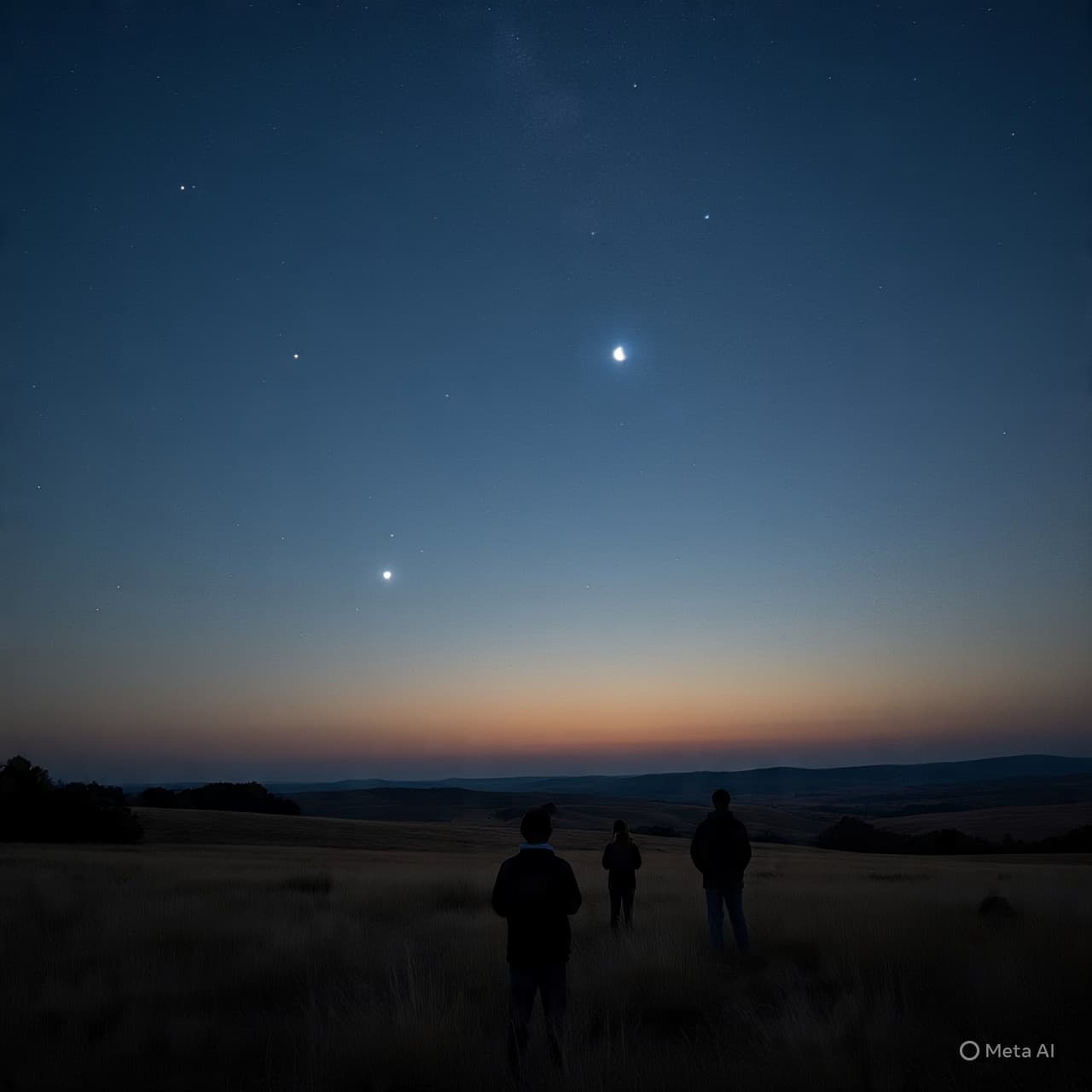
On the evening of February 28, 2026, observers around the world will be able to see a gathering of planets — Mercury, Venus, Jupiter, Saturn, Uranus, and Neptune — stretching across the night sky shortly after sunset. From a clear horizon facing west‑southwest, Venus, Jupiter, Saturn and even the faint glow of Mercury near the horizon will be visible to the unaided eye as daylight turns to dusk. The more distant planets, Uranus and Neptune, will require binoculars or a small telescope to spot their dim light against the darkening sky.
This cosmic arrangement is produced by the shared flat plane — known as the ecliptic — in which the planets orbit the sun. At certain times, Earth’s perspective brings them into a visually tight group, as though the planets have taken a brief step into a common dance. Though they remain separated by millions or billions of miles in reality, from our earthly vantage their arc across the sky can form a graceful parade of lights.
The best window to see this phenomenon is roughly 30–45 minutes after local sunset, when the sun’s glow has faded but the sky is still tenderly lit, making the brighter planets easier to pick out. Patience and a clear western view — preferably away from harsh city lights — become companions to anyone hoping to witness this subtle choreography.
For many, moments like this are more than astronomy; they are miniature invitations into the vastness that surrounds our everyday lives. Whether seen with binoculars or simply through awe and quiet evenings, the planetary parade offers both wonder and a gentle pause — a celestial procession reminding us of our small place amid grand cosmic rhythms.
AI Image Disclaimer (rotated wording) “Images in this article are AI‑generated illustrations, meant for concept only.”
If you’d like, I can also include a step‑by‑step viewing guide for specific latitudes or cities — just tell me your preferred location!
Published by Banx Network. This article is part of the Banx decentralized media programme, powered by the BXE token on the XRP Ledger.