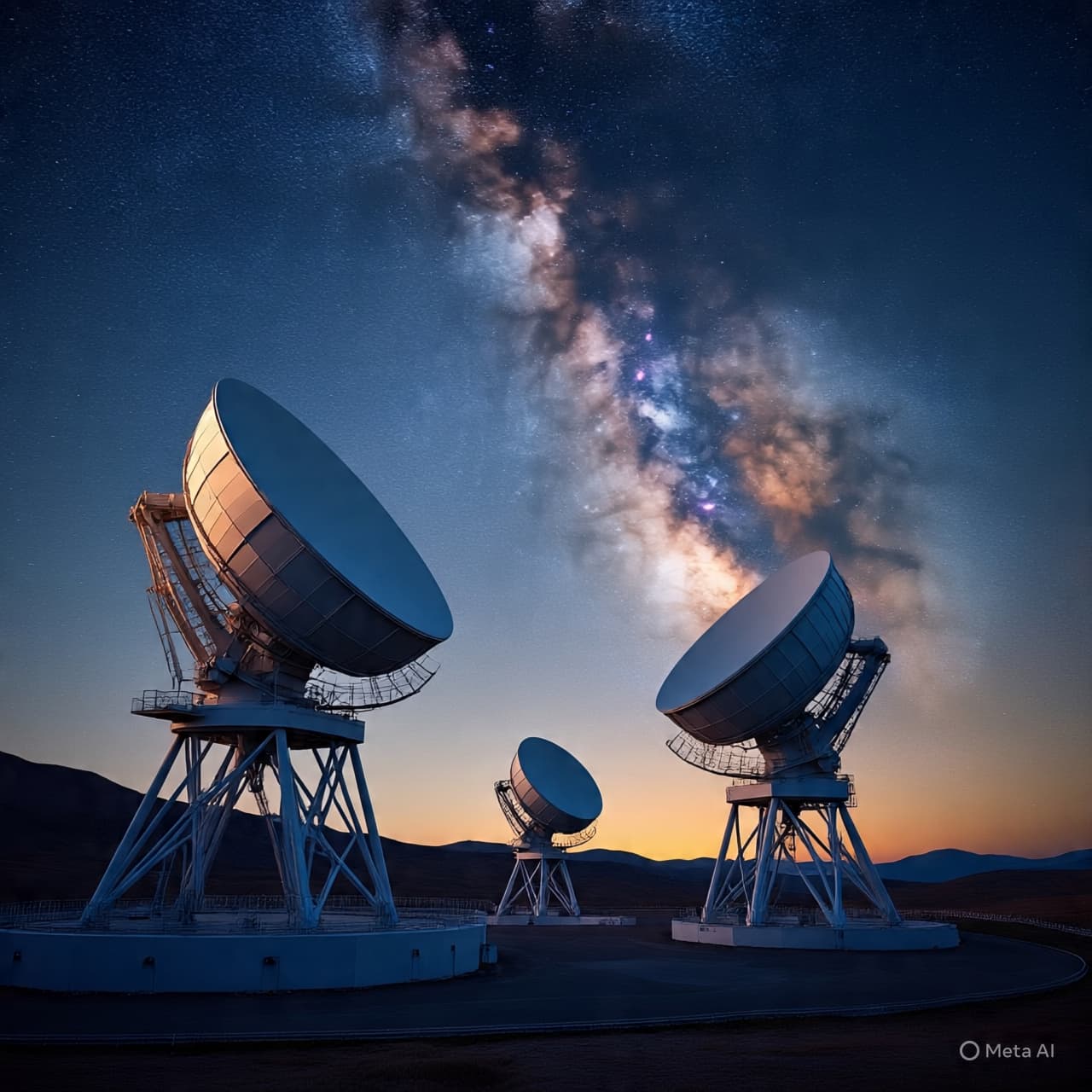
Night after night, the world’s great radio telescopes turn their silent faces toward the sky. Their dishes listen to the quiet between stars, searching for the faintest hints that somewhere, across the immense distances of the Milky Way, another intelligence might be speaking.
For decades, the cosmos has answered with what seems like stillness. The instruments record the hum of natural radiation, the pulses of distant stars, the whispers of galaxies forming and fading. But the anticipated signal—the unmistakable pattern of deliberate transmission—has remained elusive. The silence has often been interpreted as absence.
Yet new research suggests the story may be more complicated than silence alone.
Scientists studying how radio signals travel through stellar environments have found that turbulent “space weather” around distant stars could distort transmissions before they ever leave their home systems. Solar storms, charged plasma winds, and eruptions known as coronal mass ejections can ripple through the space surrounding a star, altering radio waves as they pass through. What begins as a clean, narrow signal—precisely the kind researchers search for—may spread across a wider range of frequencies by the time it escapes its origin.
To radio telescopes on Earth, that transformation matters. Many long-running searches for extraterrestrial intelligence are optimized to detect extremely narrow signals—sharp spikes in frequency that natural astrophysical processes rarely produce. But when stellar turbulence stretches a signal’s frequency range, its power becomes diluted. Instead of appearing as a clear beacon, it may blend into the background noise of space.
“If a signal gets broadened by its own star’s environment, it can slip below our detection thresholds, even if it’s there,” said astronomer Vishal Gajjar of the SETI Institute, who led the new study with research assistant Grayce Brown.
The researchers reached this conclusion by examining something closer to home: radio transmissions from spacecraft traveling within our own solar system. By measuring how solar plasma can subtly reshape those signals, the team created models estimating how much distortion might occur around other stars. They then extended those calculations to the environments of distant planetary systems.
Their findings suggest that stellar activity—especially around highly active stars—could significantly smear narrowband radio signals. In some cases, a transmission intended as a razor-thin beam of information might spread out enough to become nearly invisible to existing detection methods.
The effect could be particularly pronounced around M-dwarf stars, the small and active red stars that make up roughly three-quarters of the Milky Way’s stellar population. Their turbulent stellar winds and frequent eruptions may create environments where radio signals struggle to escape cleanly.
For researchers listening to the sky, the implications are subtle but profound. The absence of detected signals may not necessarily mean that technological civilizations are rare or silent. Instead, the signals themselves may arrive altered—stretched, scattered, or weakened by cosmic weather before reaching Earth.
The study does not claim that extraterrestrial transmissions exist, nor that any have already passed unnoticed through telescopes. But it does suggest that the universe may not be as acoustically empty as it sometimes appears. Instead, it may resemble a distant conversation carried across stormy seas—voices traveling far, but softened and distorted by the winds along the way.
In response, scientists say future searches may need to adapt. Instead of looking only for perfectly narrow radio beacons, new strategies could scan for signals with broader shapes or unexpected patterns, reflecting how they might truly arrive after crossing turbulent stellar environments.
For now, the great listening continues. Across observatories and arrays of antennas, instruments remain tuned to the sky, patient and precise. Somewhere beyond the reach of sunlight, another world may yet be speaking—its message drifting through the storms of its own star, waiting to be heard.
Published by Banx Network. This article is part of the Banx decentralized media programme, powered by the BXE token on the XRP Ledger.