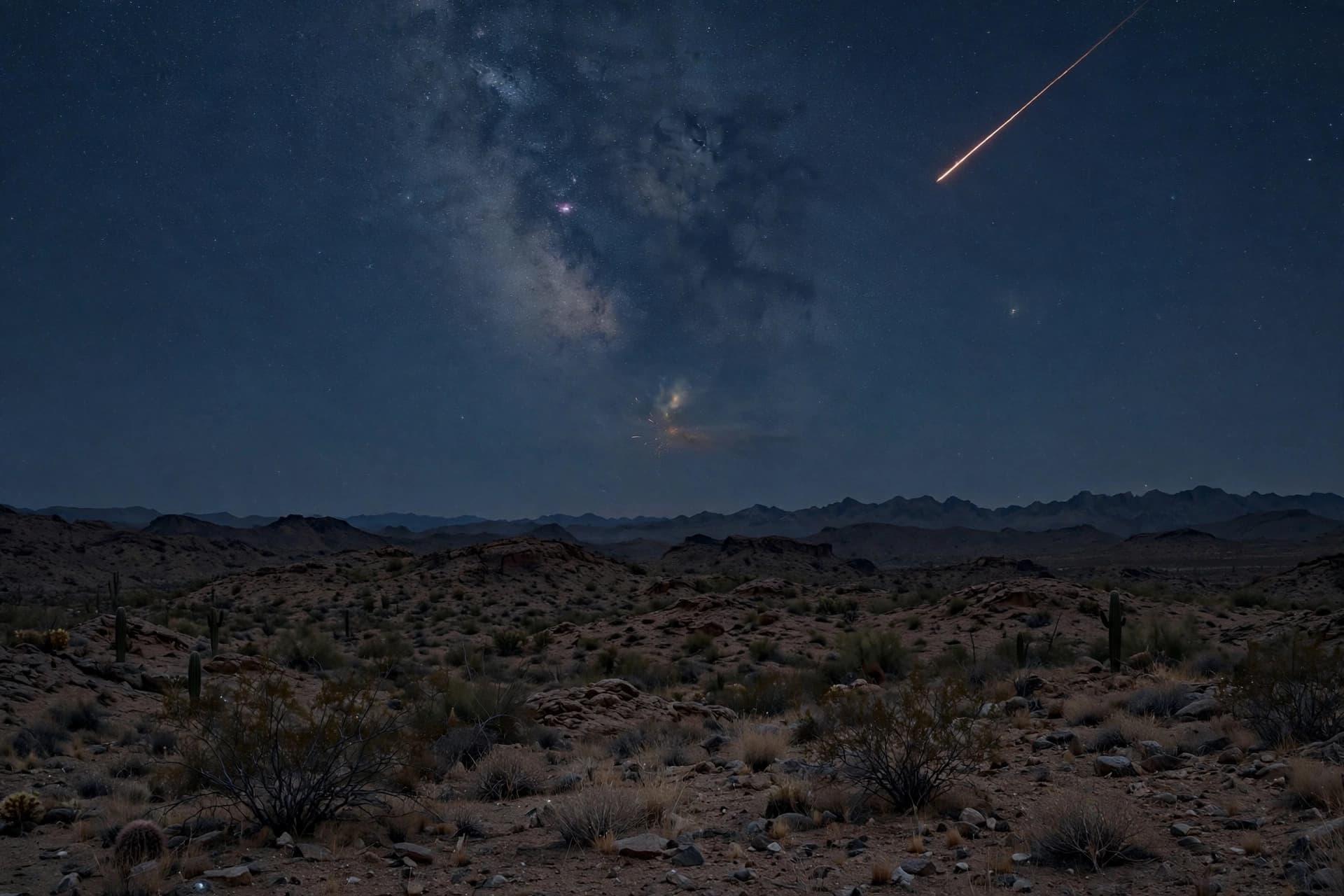
Long before it was given a name, the object now known as 3I/ATLAS crossed the solar system quietly, indifferent to the boundaries humans draw between stars. Its path did not curve like a comet born with the Sun, nor did it linger like an asteroid shaped by familiar gravity. It arrived already in motion, already elsewhere in origin, carrying with it the unmistakable signature of interstellar travel.
The detection of objects like 3I/ATLAS marks a subtle shift in astronomy, one less about spectacle than about readiness. These visitors do not announce themselves in advance. They appear suddenly, moving fast, often faint, offering only a brief window for study before they vanish back into interstellar darkness. Catching them requires more than a single telescope or a lucky observation. It demands a network—distributed, coordinated, and always watching.
Such a system is gradually taking shape. Wide-field survey telescopes scan the sky night after night, designed not to dwell on individual stars but to notice motion itself: a point of light behaving differently from the rest. Automated alert systems flag anomalies within hours, passing them to observatories around the world. Follow-up telescopes, operating across optical, infrared, and radio wavelengths, begin the work of characterization—measuring size, composition, rotation, and trajectory while time still allows.
Interstellar objects challenge established categories. They blur the line between comet and asteroid, between familiar chemistry and alien formation histories. Their surfaces may bear the marks of radiation exposure lasting millions of years. Their interiors may preserve conditions from star systems long dispersed. Each one is less a destination than a message, written in velocity and composition rather than language.
The challenge is not only detection, but interpretation. Data must move as quickly as the objects themselves. Spectra gathered in one hemisphere are compared with thermal readings from another. Orbital calculations are refined in real time. Machine-learning models help distinguish true interstellar paths from statistical noise. What emerges is not a single discovery, but a collaborative process, one that treats the sky as a shared laboratory.
Unlike planned missions, this work unfolds reactively, shaped by chance arrivals and fleeting encounters. Yet the scientific payoff is disproportionate. Interstellar objects offer direct samples of other planetary systems without the need to travel to them. They provide context for how common certain materials are in the galaxy, how planets form elsewhere, and how frequently stars exchange debris.
3I/ATLAS is unlikely to be the last such visitor. As detection methods improve, these crossings may become less rare, though no less profound. Each one reinforces a quiet realization: the solar system is not sealed. It is porous, open to the slow traffic of the galaxy.
A comprehensive network does not guarantee discovery, only preparedness. It ensures that when the next interstellar object passes through—silent, fast, and temporary—we will be ready not just to notice it, but to listen.
AI Image Disclaimer Visuals are AI-generated and serve as conceptual representations.
Sources NASA Minor Planet Center European Southern Observatory The Astrophysical Journal
Published by Banx Network. This article is part of the Banx decentralized media programme, powered by the BXE token on the XRP Ledger.