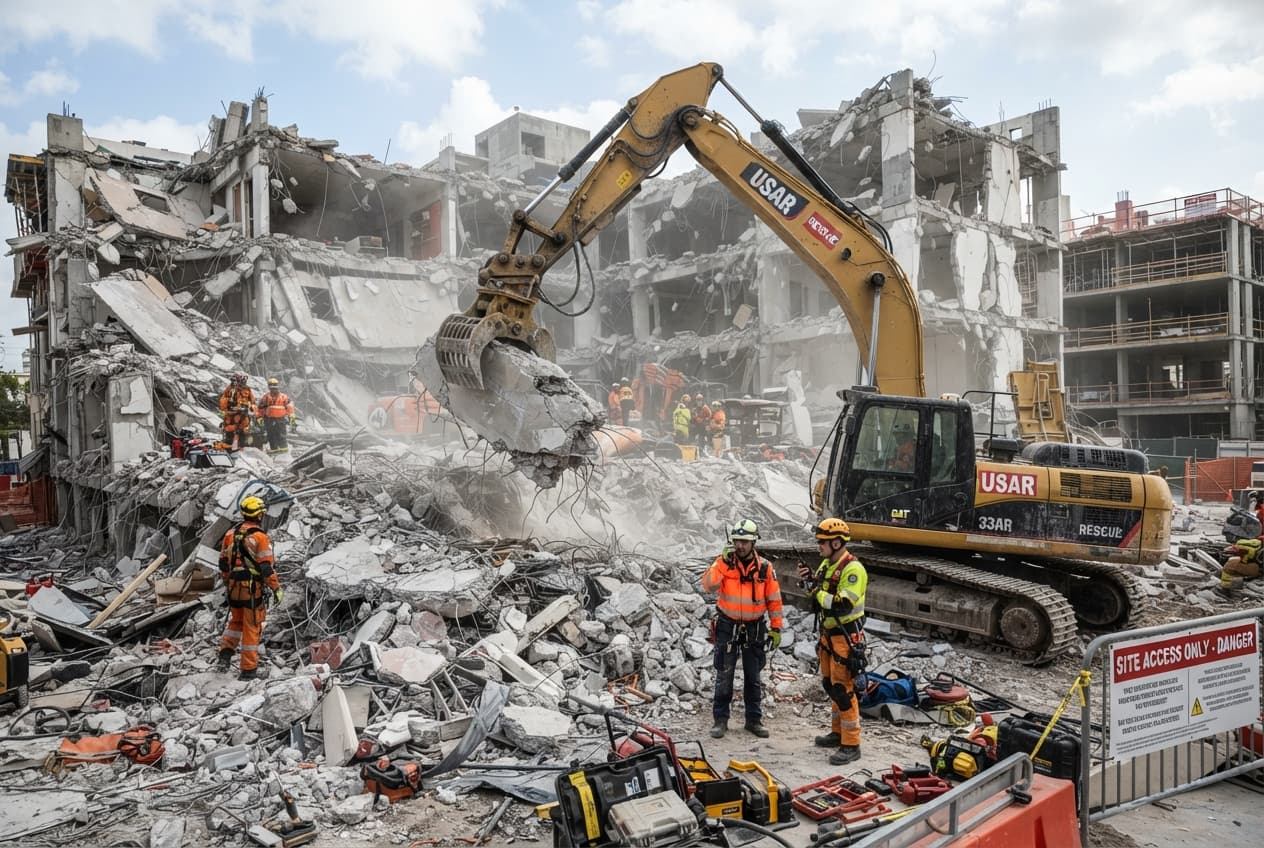
Sidoarjo, Indonesia—Heavy machinery cleared fractured concrete and twisted metal beams at the disaster zone in East Java province. Recovery personnel worked through structured grids to locate missing individuals trapped beneath stacked masonry. Regional authorities confirmed that the cumulative fatality count reached thirty-seven individuals.
The disaster unfolded when primary architectural sections of the facility gave way without prior warning. Initial emergency protocols relied on manual excavation methods to protect potential survivors hidden in void spaces. Specialized canine units swept the perimeter repeatedly during the first forty-eight hours following the collapse.
Engineers assessed adjacent wings to determine whether residual structural compromise threatened the active operational zones. Safety perimeters expanded outward by two hundred meters to keep unauthorized personnel away from unstable foundations. Investigators secured original architectural blueprints to analyze load-bearing tolerances.
Local civil protection teams coordinated logistics alongside military engineering detachments dispatched from regional headquarters. Floodlights illuminated the debris field as night operations maintained momentum without interruption. Medical triage tents remained fully staffed at the perimeter boundary to receive recovered individuals.
National disaster mitigation representatives briefed families gathered at the designated community center near the access road. Officials emphasized that structural instability limited how quickly heavy cranes could move displaced segments safely. Specialized cutting tools sliced through reinforcing steel rods blocking access to lower-level classrooms.
"Our hope is that by tomorrow everything will be levelled and we can determine the approximate number of victims who are in the rubble," a national disaster agency official stated at the site.
Engineers monitored ground sensors designed to detect micro-shifts in the standing walls surrounding the main impact crater. Dust suppression systems sprayed continuous water streams over the pulverized debris to manage airborne particulate hazards. Environmental health inspectors tested local water mains running beneath the compound for potential contamination risks.
Transport ministries restricted heavy vehicle traffic on regional approach roads to ensure unhindered passage for emergency ambulances. Procurators gathered maintenance logs from municipal authorities responsible for routine facility inspections.
Work crews continue clearing the lower basement levels as structural engineers evaluate the integrity of the remaining partition walls.
Published by Banx Network. This article is part of the Banx decentralized media programme, powered by the BXE token on the XRP Ledger.