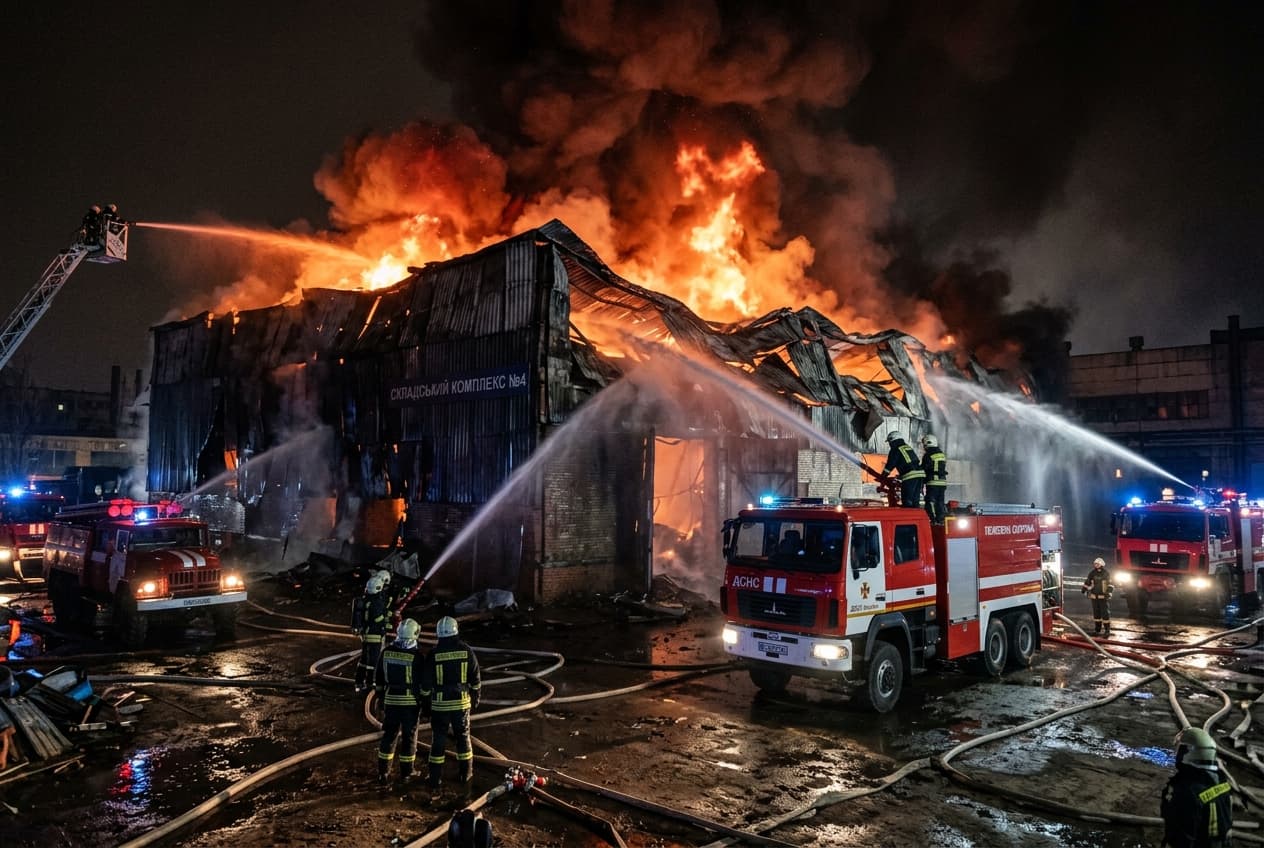
Kyiv, Ukraine—Artillery shelling struck a major commercial logistics hub in Kyiv during the early hours of September 3, 2026, igniting a massive fire that rapidly consumed adjacent storage facilities. Emergency dispatchers received emergency calls shortly after 03:00 local time as flames spread across the commercial district. Shockwaves shattered storefront windows and damaged nearby commercial buildings for several blocks.
Firefighting crews arrived to find the main logistics warehouse engulfed in flames. Secondary explosions detonated inside the facility as fuel stores and pressurized commercial inventory ignited under intense heat. Rescue teams pulled several night-shift security workers from the burning structure to provide immediate medical aid.
The strike hit a critical distribution node that handles civilian retail supply chains for the capital region. Logistics managers confirmed that several tons of consumer goods and food supplies were completely destroyed in the blaze. Surrounding commercial facilities suspended morning operations due to thick smoke and structural safety concerns.
Municipal authorities deployed high-capacity water tenders and specialized foam units to contain the fire. Power grid operators disconnected local sub-stations to prevent electrical short-circuits as water flooded street gutters. Police cordoned off major avenues to clear access routes for emergency transport vehicles.
Military administration officials stated that air defense units intercepted several incoming rounds, but surviving fragments struck the facility's main roof. Local administrators condemned the strike, emphasizing that the target was entirely civilian infrastructure with no military presence. State investigators documented shrapnel patterns to catalog evidence of civilian infrastructure targeting.
Local business owners gathered outside the perimeter perimeter as fire crews worked to prevent the flames from jumping to adjacent retail blocks. Supply chain directors warned of localized distribution delays across northern retail markets following the loss of the central hub. Insurance assessors began preliminary damage calculations from outside the safety perimeter.
Emergency management teams established a temporary command post to coordinate debris clearing and utility stabilization. Municipal water tankers continuously refilled fire apparatus as crews battled hot spots hidden beneath collapsed roofing sections. Neighboring commercial centers were evacuated while structural engineers assessed wall integrity.
Fire crews maintained heavy water streams over smoldering structural beams late into the afternoon. Emergency teams began clearing charred metal framing to allow forensic teams access to the impact crater.
Published by Banx Network. This article is part of the Banx decentralized media programme, powered by the BXE token on the XRP Ledger.