There is a particular hope that parents carry when they bring their children to the places that made them—a hope that the landscape will speak, that the food will tell a story, that the past will somehow become legible to a new generation. When the writer stepped out of Penang International Airport with her three children and her Australian husband, the humidity hit like "peering into a just-opened rice cooker." She had not been back in thirteen years . She wanted her children to feel something. What they felt, mostly, was the heat.
She had planned the trip as an immersion in the places of their grandparents' stories. Her father, who lives in Perth but travels to Penang frequently, booked his flight the night she floated the idea . She wanted them to understand that Gong Gong's only toy had been a discarded bicycle tyre, that he had shared one apple with five siblings. But the children smiled indulgently at those stories, as if he were exaggerating .
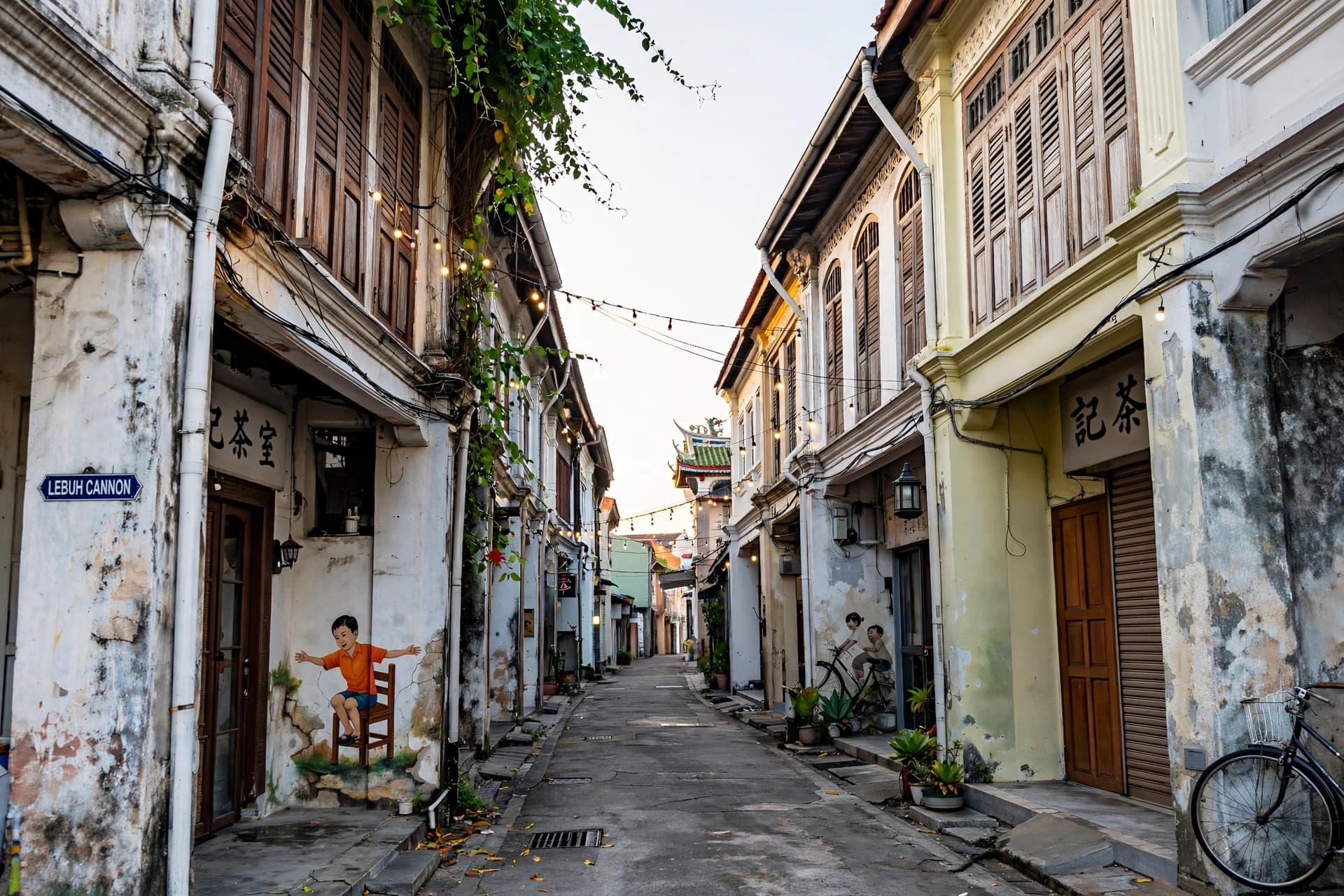
The first morning, her father met them at their hotel—the Eastern & Oriental, a gleaming marble establishment where he said he never dared set foot as a young man because only rich Europeans stayed there. Now they were the rich tourists, a fact that made her feel "guilty and grateful" . They began gently, letting the children luxuriate in air conditioning before venturing into George Town's Unesco World Heritage streets. But the heat was intense, and the children's interest in colonial architecture evaporated in the afternoon sun .
In the evenings, her father led them through alleyways in search of dinner, shepherding them off the road when motorbikes rumbled past. They found a place serving barbecued pork on springy egg noodles, and they fell upon the food in a frenzy. Later, they walked along the esplanade, watching a sunset that lit the clouds "like smears of mandarin sorbet" . These were the moments she had hoped for—not grand epiphanies, but small ones.
Toward the end of the trip, they drove to her father's childhood home in Tanjung Bungah. The children scowled from the backseat. Her ten-year-old hissed: "When can we go shopping?" The toddler pleaded to return to the hotel's infinity pool . At a roadside stall, her father bought a coconut, and the vendor hacked it open with a machete and stuck a straw in it. Her son spilled it on his lap. They continued down a narrow dirt road to a small weatherboard house with a red tin roof—empty, neglected, but her father still had the key .
What the writer discovered, in the end, was that the epiphanies she had hoped for were not the ones that arrived. Her children did not learn to love the history she loved. But they learned to swim in the warm waters of Penang, to laugh with their grandfather, to eat noodles with sticky soy sauce on their fingers. The trip became a bridge between generations, built not on lectures about heritage, but on shared meals and afternoons by the sea . Sometimes the roots we want to plant take hold in ways we cannot predict.
A writer returned to her birthplace of Penang, Malaysia, after thirteen years, hoping to immerse her three children in their Chinese heritage. Instead of grand cultural epiphanies, the trip became a series of small moments—shared meals, a visit to her father's childhood home, and afternoons at the beach. She learned that connection does not always require formal lessons.
AI Image Disclaimer: Visuals in this article are produced by artificial intelligence for illustrative purposes only.
Sources: The Guardian
Published by Banx Network. This article is part of the Banx decentralized media programme, powered by the BXE token on the XRP Ledger.