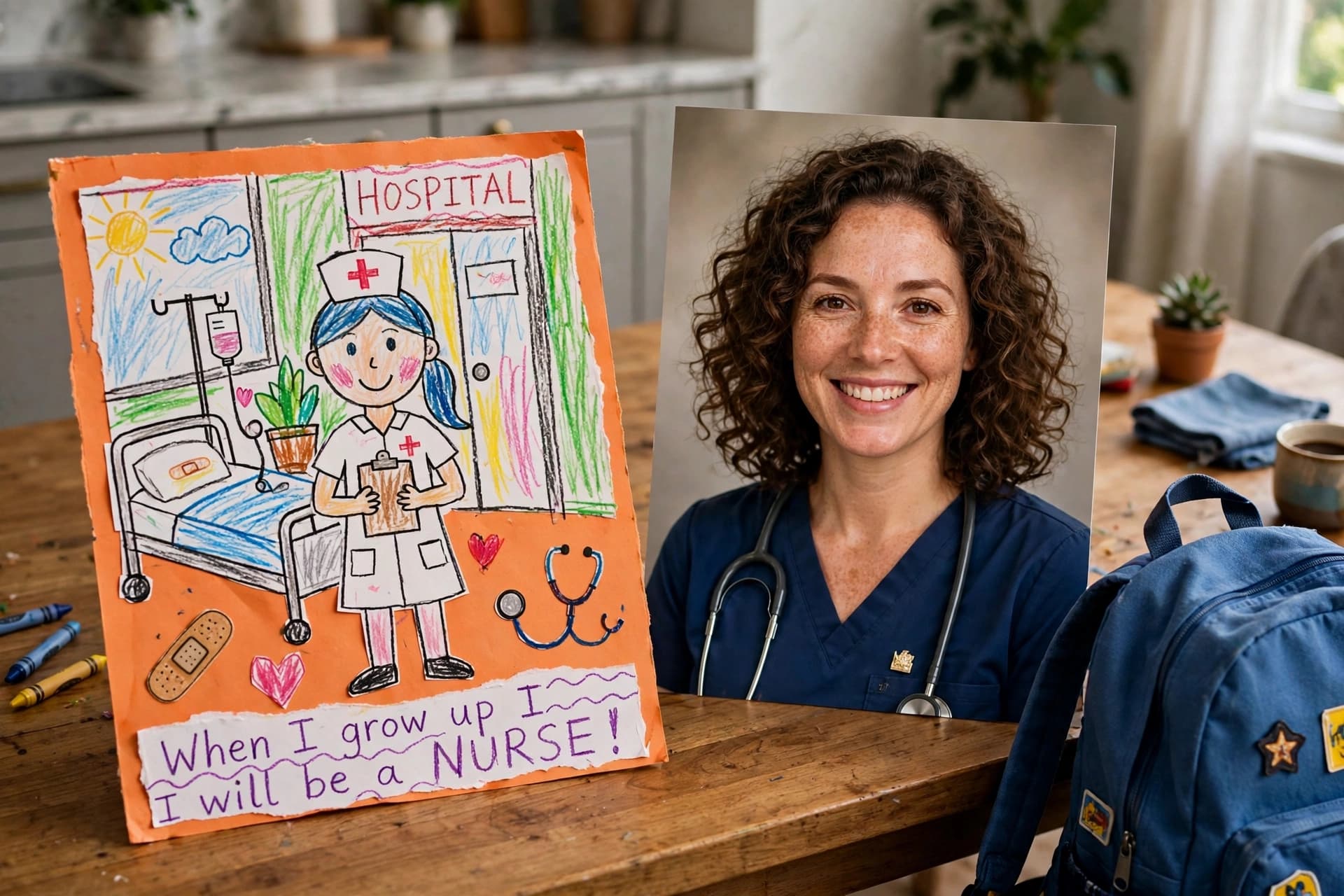
There is a particular kind of unease that arrives when a child brings home something from school that the parent did not expect, a quiet alarm that asks who decided this was appropriate and why no one asked. In South Carolina, Nikki Anderson opened her six-year-old daughter's backpack and found two images. One was a construction-paper drawing Harper had made herself, a nurse in a hospital, every shape cut and placed by her own hands. The other was an AI-generated photograph of Harper as a twenty-five-year-old, her face aged and smoothed into a smiling professional in scrubs .
Anderson's reaction was immediate and visceral. "Am I allowed to be grossed out about this? I am grossed out about this," she recalled thinking. "Did a teacher really upload my daughter's photo somewhere to make this, knowing what we know about AI?" The school, she said, had not sought her consent before using her daughter's likeness in a generative AI system. She did not know which platform was used, whether the images were retained, or whether they were used to train models .
The pedagogical intention, as Anderson understands it, was to show students what they might look like in their future careers. Harper wants to be a nurse. The AI image depicted her as one. But the mother's objection was not to the aspiration. It was to the replacement of the child's own imagination with an algorithm's interpretation of what a successful adult woman should look like—"young, thin, conventionally attractive," with long hair and clear skin . Harper had already imagined that future, Anderson wrote, and made something incredible to represent it. "What part of that needed to be finished by a computer?"
There is a privacy dimension that extends beyond one classroom. Parents across the country have raised concerns about how schools are adopting AI tools without clear policies on data handling, consent, and the retention of children's biometric and photographic data . Anderson's questions were specific: Which company received the photographs? Were the images retained, logged, shared with subprocessors, or used for model improvement? Does the school have a contract that restricts how a vendor handles children's data? She has yet to receive answers from the principal or school board, she said .
The response online was divided. Some parents were horrified by the privacy implications. Others thought Anderson was overreacting to a harmless classroom activity . She has been careful not to frame the incident as an attack on educators, noting that teachers are already asked to do extraordinary amounts with limited resources and should not bear sole responsibility for navigating a new technological landscape. What she wants, she said, is a meaningful step forward—safeguards that prevent this from happening again without demonizing the people who teach children .
For now, the image remains on Anderson's phone, a strange artifact of a moment when a six-year-old's future was outsourced to a machine. Harper, for her part, loved the picture. She told her mother she hoped she would be that beautiful when she grew up, though she understood it was only a guess . The child was delighted. The mother was left with questions that no one has yet answered.
AI Image Disclaimer: The visuals in this article are generated by artificial intelligence and are intended for illustrative purposes only.
Sources: People, Daily Mail, Yahoo News
Published by Banx Network. This article is part of the Banx decentralized media programme, powered by the BXE token on the XRP Ledger.