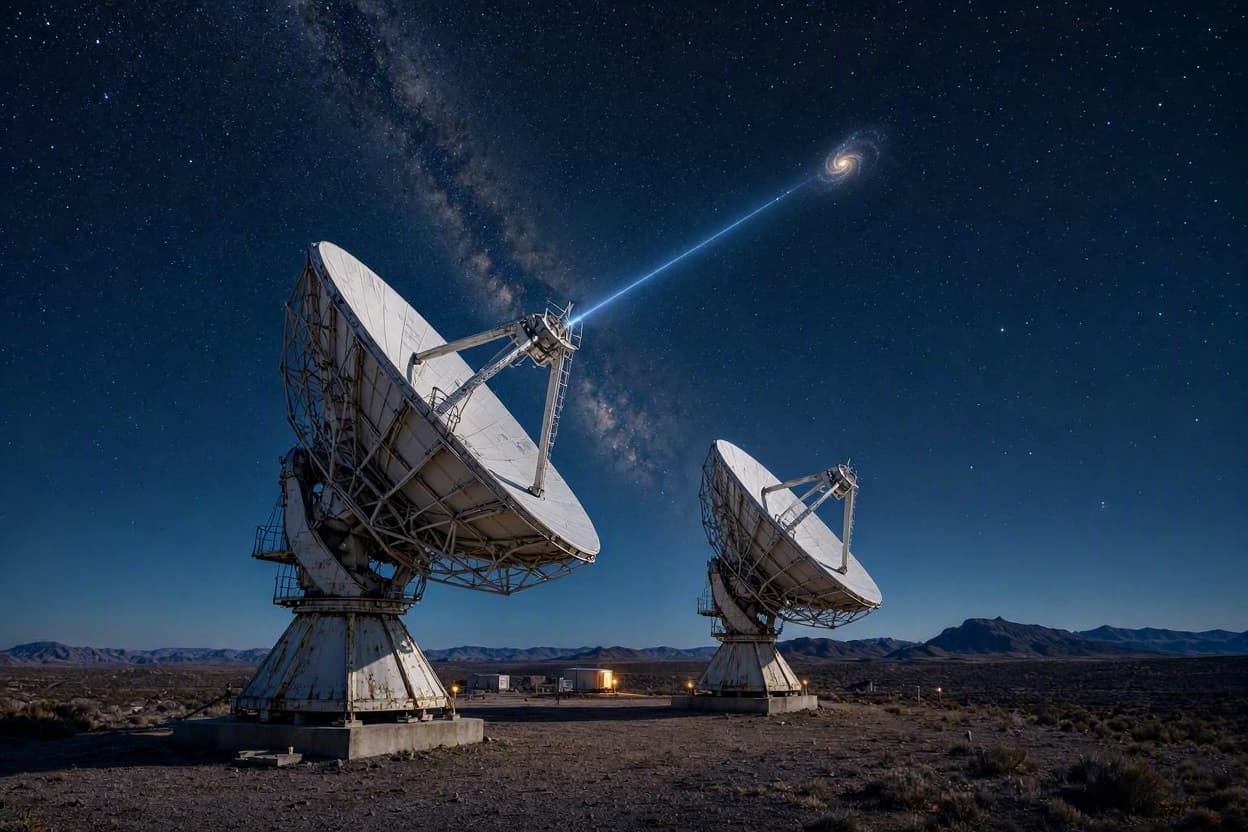
In the vast, silent theater of the cosmos, light travels as a messenger from the distant past, carrying secrets of energetic events that occurred billions of years ago. Recently, two powerful eyes on Earth—the Large-Sized Telescope prototype (LST-1) and the MAGIC telescopes—have captured a faint but significant signal from a source so remote it challenges our understanding of high-energy physics. The detection of very high-energy gamma rays from the blazar OP 313, located approximately 8 billion light-years away, marks a new frontier in astronomical observation, shattering previous distance records for such emissions.
Blazars are a specific type of active galactic nucleus, powered by supermassive black holes at the centers of galaxies. They emit jets of particles moving at nearly the speed of light, directed almost straight toward Earth. When these jets interact with surrounding matter or magnetic fields, they produce high-energy radiation, including gamma rays. Detecting this radiation from such immense distances is extraordinarily difficult, as the photons lose energy and scatter as they traverse the intergalactic medium.
The breakthrough came during a period of intense activity for OP 313. In late 2023, the blazar underwent a significant flare, emitting a burst of very high-energy (VHE) gamma rays. The LST-1, part of the upcoming Cherenkov Telescope Array Observatory (CTAO), and the established MAGIC telescopes in La Palma, Canary Islands, coordinated their observations to capture this fleeting event. Their combined sensitivity allowed them to detect photons with energies exceeding 100 GeV, a feat previously thought impossible for sources at such cosmological distances.
This discovery is not just a matter of breaking a record; it provides crucial insights into the nature of the universe’s transparency to high-energy light. Gamma rays traveling through space interact with the extragalactic background light (EBL), a diffuse glow of starlight and dust emission accumulated over cosmic history. By measuring how much of the gamma-ray signal survived the journey, astronomers can better map the density and evolution of the EBL, offering a window into the history of star formation.
The success of LST-1 in this detection also validates the design and capabilities of the next generation of gamma-ray observatories. As the first prototype of the CTAO’s large-sized telescopes, LST-1 demonstrated its ability to detect faint, transient sources with unprecedented precision. This achievement bodes well for the full array, which will consist of dozens of such telescopes working in concert to explore the high-energy universe.
For physicists, the detection raises intriguing questions about the mechanisms accelerating particles to such extreme energies within the blazar’s jet. How does OP 313 maintain such power over billions of years? What conditions allow it to produce gamma rays that can survive the long journey to Earth? These questions drive further theoretical modeling and observational campaigns, pushing the boundaries of astrophysics.
The collaboration between international teams, including researchers from the Institute of Astrophysics of the Canary Islands (IAC) and the Max Planck Institute for Physics, highlights the global nature of modern science. Sharing data and resources allows for more robust analysis and faster discovery, turning individual instruments into a unified network of exploration.
The detection of VHE gamma rays from OP 313 is a testament to human ingenuity and technological advancement. It reminds us that even from the deepest reaches of space, light can find its way to us, revealing the dynamic and violent processes that shape the universe.
AI Image Disclaimer: Please note that any accompanying illustrations for this piece are AI-generated representations intended to evoke the mood of the described events.
Sources: Institute of Astrophysics of the Canary Islands (IAC), Phys.org, Astronomy & Astrophysics, Max Planck Institute for Physics
Published by Banx Network. This article is part of the Banx decentralized media programme, powered by the BXE token on the XRP Ledger.