In the cold, dark reaches of the outer solar system, Neptune holds a secret written in the orbits of its moons. Recent observations from the James Webb Space Telescope suggest that the planet’s current satellite system is the aftermath of a violent cosmic event. Billions of years ago, the capture of Triton, Neptune’s largest moon, may have triggered a catastrophic collision that shattered its original moons, turning them inside out and scattering their remains across the sky.
Triton is an anomaly among large moons, orbiting Neptune in the opposite direction of the planet’s rotation. This retrograde motion strongly suggests that it was not formed with Neptune but was instead captured from the Kuiper Belt. As Triton was pulled into Neptune’s gravity, its massive presence would have destabilized any existing moons, causing chaotic interactions and high-speed collisions. The energy released in these impacts would have been immense, reshaping the entire system.
Data from Webb reveals that Neptune’s inner moons, such as Naiad and Thalassa, have compositions that differ from what might be expected if they had formed peacefully. Instead, they appear to be made of material from the interiors of larger, destroyed bodies. The "inside out" description refers to the way these collisions would have stripped away outer layers of ice and rock, exposing the denser core materials that now make up the smaller moons.
Nereid, another of Neptune’s moons, may be the sole survivor of this ancient destruction. Its irregular orbit and unique composition suggest it endured the chaos that wiped out its siblings. Studying Nereid provides a window into the pre-capture era, offering clues about the original population of icy worlds that once circled the blue giant. It is a relic of a lost era, preserved in the gravitational dance of the present.
This theory helps explain the unusual architecture of Neptune’s ring system as well. The debris from the shattered moons would have spread out to form the faint, dusty rings that encircle the planet today. Unlike Saturn’s bright, icy rings, Neptune’s are dark and tenuous, consistent with the processed material from violent collisions. The rings serve as a graveyard for the moons that came before.
Understanding this history is crucial for comparative planetology. It suggests that giant planet systems are not static but dynamic, shaped by captures and collisions over billions of years. Neptune’s story may be mirrored in other exoplanetary systems, where similar events could be occurring unseen. The solar system, it seems, is a place of constant change and renewal.
The lunar massacre at Neptune is a reminder of the violence inherent in planetary formation. Through the lens of modern telescopes, we can piece together this ancient drama, gaining insight into the forces that shape our cosmic neighborhood. The moons of Neptune are not just rocks in space; they are witnesses to a turbulent past.
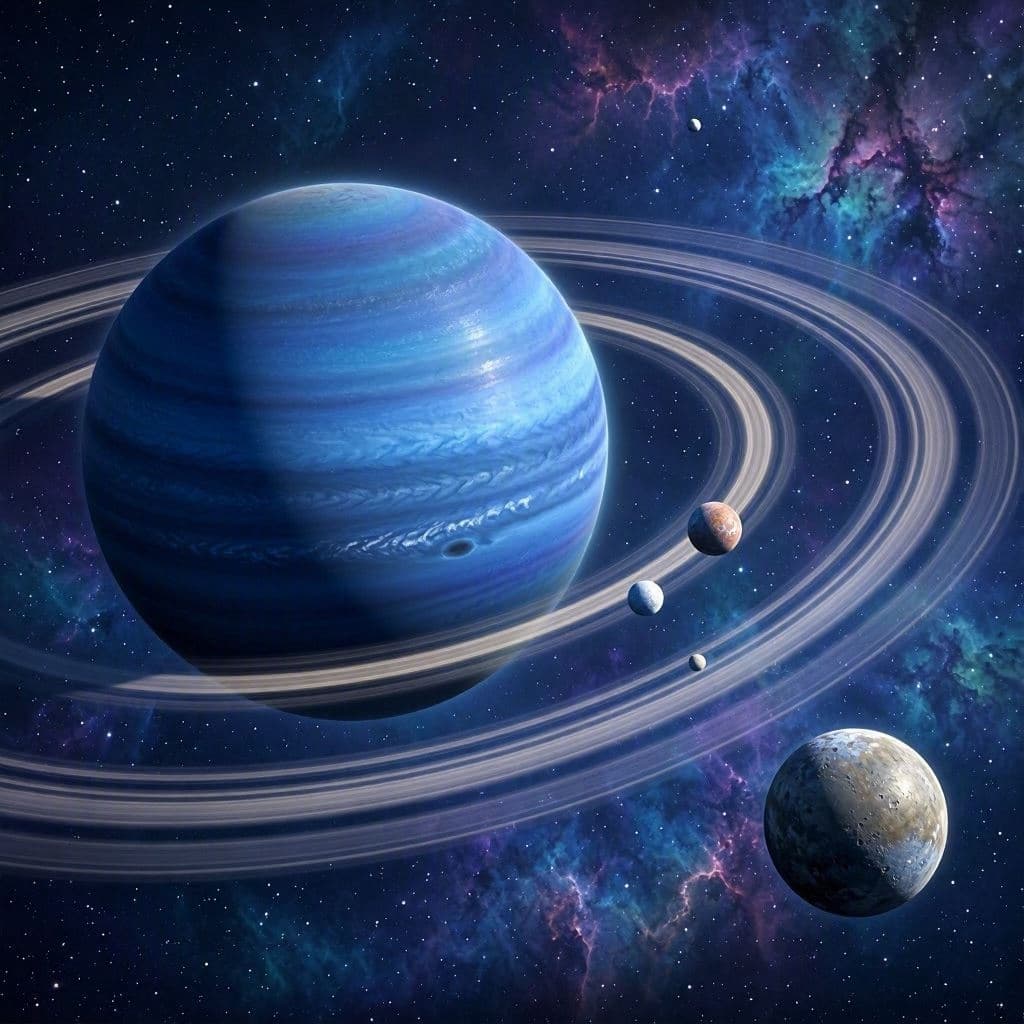
AI Image Disclaimer: The images provided are AI-generated to visually represent the astronomical and historical aspects of the story.
Sources: Caltech Reuters EarthSky
Published by Banx Network. This article is part of the Banx decentralized media programme, powered by the BXE token on the XRP Ledger.