

Key Highlights
- Earthquake Magnitude:A 6.7-magnitude quake struck Central Sulawesi, Indonesia.
- Time of Occurrence:The quake hit at 11:27 AM local time on June 16, 2026.
- Aftershocks:A strong 5.2-magnitude aftershock followed just three minutes later.
A powerful and shallow 6.7-magnitude earthquake struck Indonesia’s Central Sulawesi province on Tuesday morning, June 16, 2026, triggering widespread panic and sending terrified residents rushing into the streets for safety. The United States Geological Survey (USGS) and Indonesia's Meteorology, Climatology, and Geophysics Agency (BMKG) confirmed that the quake struck at 11:27 AM local time, with the epicenter located approximately 42 to 46 kilometers east-southeast of Palu, the provincial capital.
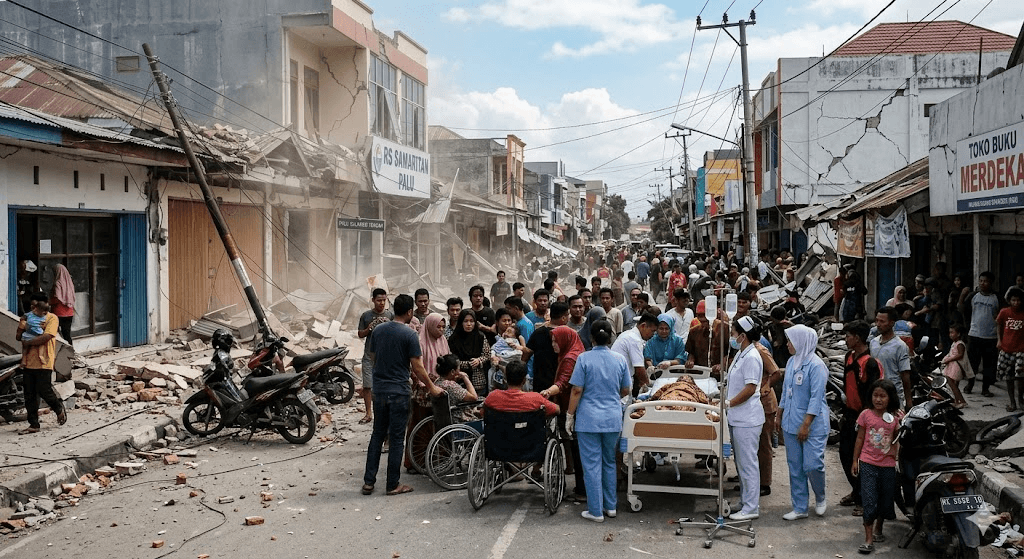
The earthquake occurred at a very shallow depth of just 10 kilometers, which is significant because shallow earthquakes tend to cause much more intense ground shaking at the surface compared to deeper ones. The severe shaking lasted for over a minute across the region, leading to chaos in the city of Palu, which is home to around 400,000 residents. At Samaritan Hospital, patients and visitors scrambled frantically to reach open ground as the building shook. Medical staff were forced to evacuate vulnerable patients outdoors—some still attached to IV drips or in wheelchairs—leaving them lined up in hospital beds on the streets.
Local hotels also emptied rapidly. Effendi Natali, the general manager of a four-star hotel in Palu, reported that all guests panicked and fled their rooms, though everyone ultimately made it to safety with the building sustaining only minor damage. Initial images emerging from the impact zone revealed scattered structural damage, with several buildings suffering shattered walls, partially collapsed roofs, and piles of debris littering the city streets.
Officials confirmed that the seismic activity did not trigger a tsunami threat. However, the area remains highly volatile, as just three minutes after the main tremor, the USGS detected a strong 5.2-magnitude aftershock at the same shallow depth. The BMKG has urged residents to remain calm but alert, advising everyone to stay clear of cracked or compromised structures.
The panic in Palu is compounded by deep historical trauma. In September 2018, the city was devastated by a massive earthquake that triggered a catastrophic tsunami and soil liquefaction, killing more than 4,000 people. While the National Disaster Management Agency is still gathering information on potential casualties, no deaths have been immediately reported. Indonesia sits squarely on the Pacific "Ring of Fire," an area of high seismic activity where multiple tectonic plates collide.
As the situation develops, authorities continue to monitor the region for further seismic activity and provide updates to the public regarding safety measures and potential evacuations.
Published by Banx Network. This article is part of the Banx decentralized media programme, powered by the BXE token on the XRP Ledger.




