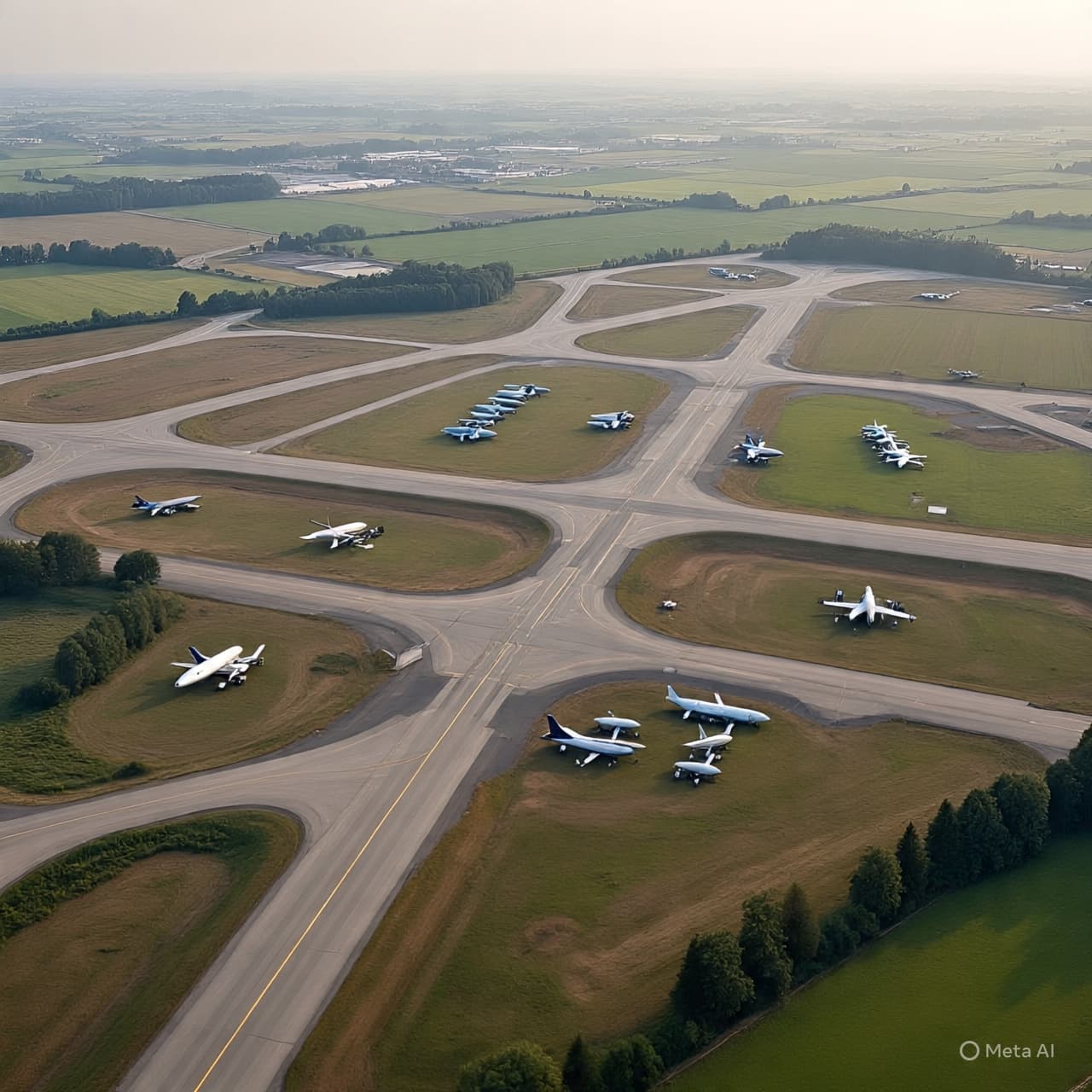
Over the flat expanse of northern France, the morning sun glints off hangars and runways, catching the contours of sleek aircraft that stand silently under pale light. Inside briefing rooms and offices, engineers and strategists trace lines on maps, compare prototypes, and weigh the future of a program that has captured the imagination of Europe’s aviation industry: the Future Combat Air System (FCAS). Airbus, the program’s industrial anchor, now signals a subtle shift—a willingness to consider a two-fighter option, a compromise to keep the ambitious vision airborne despite political, technical, and financial turbulence.
The FCAS program, envisioned as a next-generation fighter and unmanned system network capable of integrating across European air forces, has long symbolized both ambition and challenge. Collaborative by design, it spans multiple countries, industries, and research teams, each with their own priorities and timelines. Yet delays, cost overruns, and evolving defense requirements have prompted intense debate: should the program pursue a full complement of advanced manned fighters, or adapt to a smaller fleet paired with unmanned platforms to ensure continued development and delivery?
Airbus’s openness to a two-fighter approach reflects both pragmatism and strategy. By scaling the immediate fighter component, the program can continue to advance key technologies—sensor fusion, networked drones, stealth materials—without pausing the entire effort. Defense ministries in France, Germany, and Spain have expressed cautious interest, recognizing that a modular approach could preserve industrial momentum while managing budgetary constraints and political pressures. Analysts note that this compromise may allow Europe to maintain sovereignty over critical defense technology while remaining responsive to changing security dynamics in the region.
Beyond technical specifications, the choice carries symbolic weight. FCAS represents European collaboration in an era of global competition, where air superiority and innovation intersect with strategic autonomy. Shrinking the fighter component may be seen as a concession, yet it may also preserve a broader ecosystem of expertise, supply chains, and research networks. For engineers in Toulouse, Munich, and Madrid, each prototype tested, each software module integrated, embodies a commitment to capability, innovation, and the long arc of European aerospace ambition.
Industry observers emphasize that even a scaled approach entails considerable complexity. Integrating two manned fighters with multiple unmanned systems requires new command structures, sophisticated communications, and rigorous testing to ensure operational reliability. Funding must be sustained, and international coordination maintained across national priorities and procurement processes. In this delicate dance of diplomacy, technology, and industrial strategy, Airbus and its partners navigate not just design challenges, but the broader currents of defense policy, public scrutiny, and the pressures of international competition.
As dusk settles over the hangars and test strips, the aircraft cast long shadows across the tarmac, reflecting both the promise and the uncertainty of the endeavor. In offices and labs, engineers refine simulations, pilots review flight parameters, and policymakers weigh commitments, all bound by the shared hope that FCAS will endure. The two-fighter option is not a retreat—it is a pivot, a deliberate adjustment to ensure that the vision of a connected, next-generation air system remains alive, evolving, and within reach.
AI Image Disclaimer Visuals are AI-generated and intended as conceptual representations.
Sources Airbus Press Releases Defense News FlightGlobal Reuters Jane’s Defence Weekly
Published by Banx Network. This article is part of the Banx decentralized media programme, powered by the BXE token on the XRP Ledger.