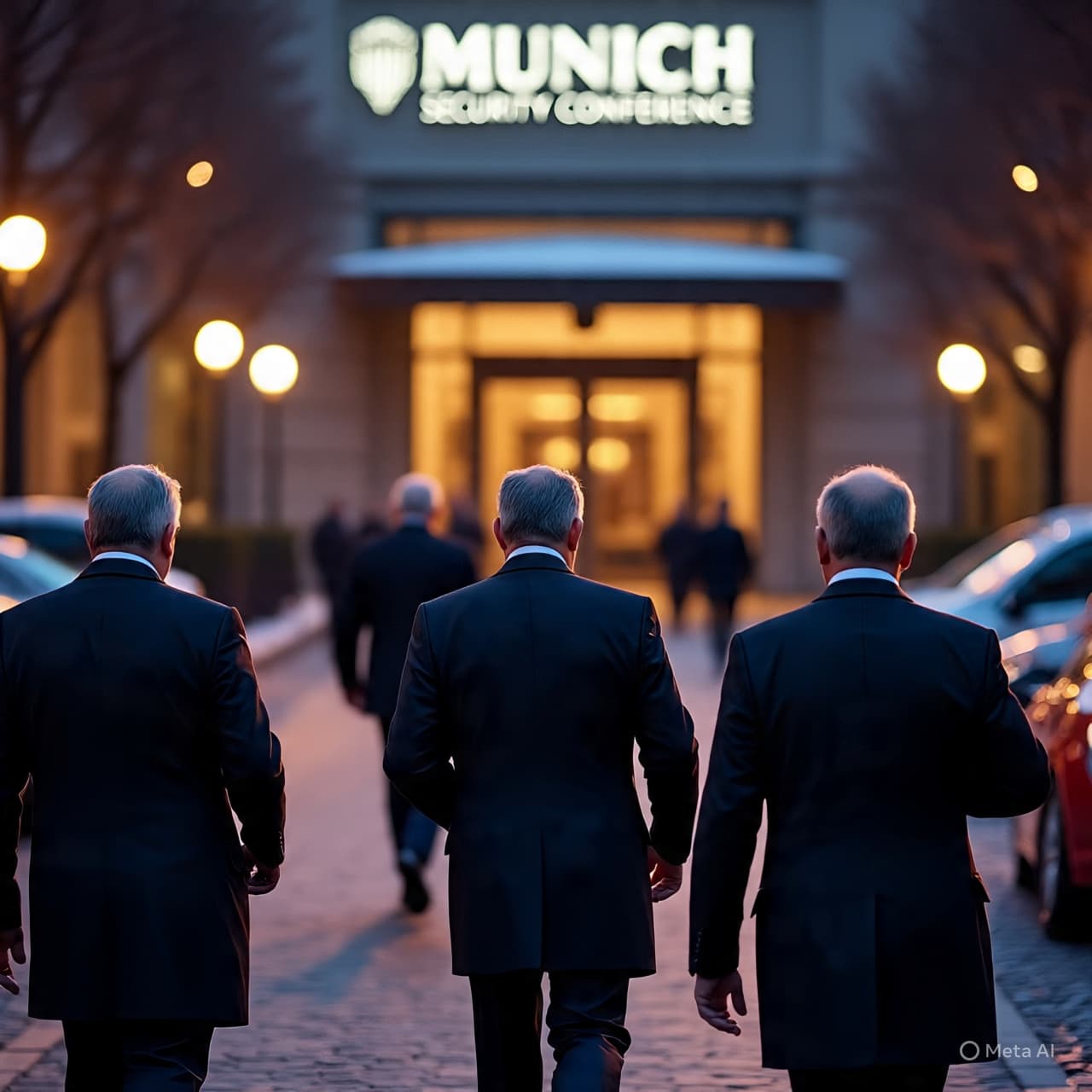
Late winter light drapes Munich in soft gold as the city’s ancient spires and cobblestone avenues meet another season of global gathering. Delegates and ministers drift between historic cafés and the grand halls where leaders once defined the shape of peace. February here can feel like a quiet breath between the cold’s grip and the first hint of spring’s promise — a fitting backdrop for conversations that seek to balance history with the uncertain horizon ahead.
At the Munich Security Conference, that quiet breathed into something more deliberate, echoing through rooms where words carry the weight of distant borders, alliances, and long‑held convictions. German Chancellor Friedrich Merz rose to speak with a voice steady yet reflective, tracing the arcs of Europe’s past security and the contours of its future. His thoughts did not burst onto the stage like sudden thunder; they settled like dust motes in a slanted late‑afternoon sun, bringing into focus the subtle interplay of reliance and autonomy that has defined a continent’s defense for generations.
Merz’s address unfolded against a world that has, by many measures, been shifting beneath the feet of old assumptions. The uneasy calm that followed the Cold War has given way to a mosaic of friction and unpredictability — from prolonged conflict in Eastern Europe to tensions that ripple across Atlantic corridors. Here in Munich, inviting both reflection and resolve, Merz spoke of urgent necessity without acrimony. He underscored Europe’s deep ties with the United States, the alliance that once seemed unshakable, but he also hinted at a landscape where those ties are being re‑examined in light of new global dynamics.
In soft yet unwavering tones, he revealed that Berlin and Paris have begun confidential discussions about a European nuclear deterrent, a concept long treated as theoretical and distant. The idea of a continental shield — cast in collaboration with France, the only nuclear‑armed state in the European Union — hummed at the edges of Merz’s remarks like a distant tide approaching shore. It was offered not as a break from tradition, but as a complementary pillar within the existing framework of NATO’s nuclear sharing, a way to ensure that the continent’s security doesn’t fracture into disparate zones of risk and reassurance.
For those listening, the image of nuclear deterrence is not one of spectacle but of gravity: the weight of responsibility that comes with defending peace in an era where unilateral action seems both less reliable and more fraught with consequence. “Even the United States,” Merz said, “will not be powerful enough to go it alone,” words that moved like a breath across the room, inviting reflection rather than alarm. His appeal to “repair and revive trust” with Washington wove through his speech like a river threading a landscape, acknowledging both the necessity of collaboration and the desire for European strength that stands on its own.
Outside the conference walls, Munich’s winter streets carry an unspoken rhythm — locals ambling past shuttered boutiques, cafe windows glowing in the dusk. The city absorbs the distant static of world events and returns to its quiet cadence, as if to remind that history is lived moment by moment, not just declared in grand halls. In the soft gathering dusk, where light blends into the promise of coming evening, the conversation about alliances, deterrence, and shared futures feels less like an edict and more like a dialogue. It is, for now, part of a larger story of how nations seek balance in a world that is constantly redefining itself.
AI image disclaimer Illustrations were created using AI tools and are not real photographs.
Sources Reuters Associated Press BBC News The Guardian PBS News Hour
Published by Banx Network. This article is part of the Banx decentralized media programme, powered by the BXE token on the XRP Ledger.