Villa Tunari, Bolivia—A wall of brown water and tropical debris tore through a low-lying rural community near Villa Tunari early Thursday after continuous rainfall forced a major regional river over its banks. Local municipal authorities confirmed that the sudden inundation swept away dozens of wooden homes and inundated agricultural plots within a matter of minutes. Families scrambled to higher ground as raging currents cut off the only access bridge connecting the settlement to the regional highway network.
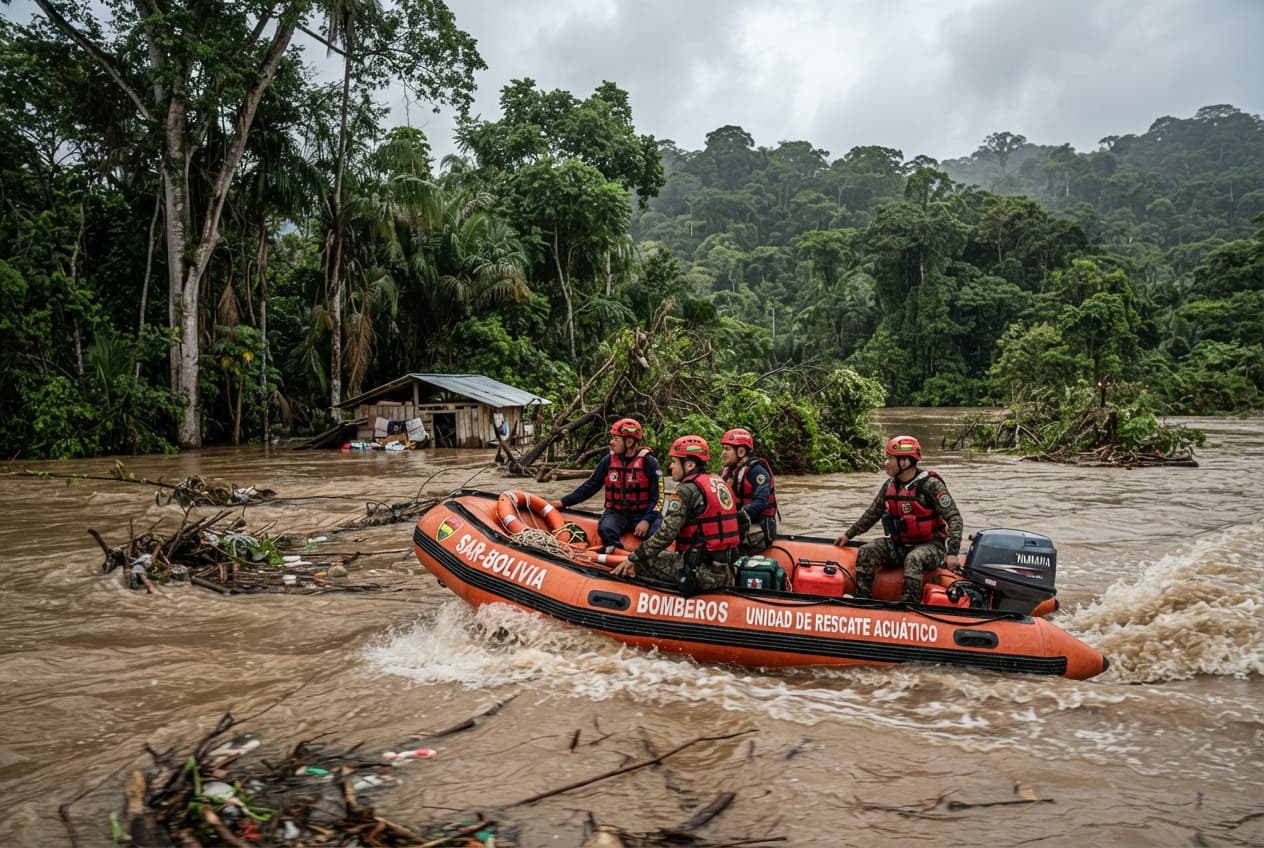
Heavy downpours throughout the tropical Chapare basin swelled upstream tributaries far beyond normal dry-season capacities. Civil defense representatives stated that deforestation along the riverbanks severely accelerated the force and velocity of the incoming floodwaters. Rescue boats dispatched from municipal headquarters struggled against ferocious currents trying to reach residents stranded on rooftops.
Local farmers watched helplessly from jungle ridges as banana crops, citrus orchards, and fish farming ponds vanished beneath the surging brown expanse. Community leaders reported that electrical transformers short-circuited during the initial surge, plunging the entire valley into total darkness. Drinking water wells were thoroughly contaminated by silt and sewage overflow, raising immediate public health concerns.
National naval personnel mobilized inflatable rescue watercraft and amphibious transport vehicles toward the flooded municipal district. Officials warned that navigating the debris-choked river channels puts rescue crews at severe risk of capsizing against hidden tree trunks. Medical posts in the town center activated emergency protocols to receive patients suffering from hypothermia and waterborne illnesses.
Provincial highway police established total traffic blockades along the main thoroughfare to prevent vehicles from entering flooded low-level sections. Engineers noted that saturated river embankments continue to erode rapidly under ongoing precipitation, threatening neighboring agricultural hamlets. Power utility crews await receding water levels before attempting to repair downed electrical distribution lines.
Temporary relief camps are being set up in local school buildings situated on elevated terrain above the flood plain. Municipal social workers are distributing bottled water, mosquito nets, and dry rations to displaced families crowded into classrooms. Regional coordinators emphasized that airborne supply drops will be mandatory if secondary bridges fail overnight.
Agricultural cooperatives estimate catastrophic financial losses as staples and livestock pastures were completely obliterated by the raging current. Farmers face severe economic ruin with no immediate state subsidies available to offset total asset destruction. Local commercial networks remain paralyzed as primary transit links stay completely severed.
Government ministers convened an emergency session in La Paz to evaluate damage reports submitted by regional tropical authorities. Emergency procurement funds were unlocked to dispatch heavy dredging machinery once water levels drop sufficiently. Search teams continue scouring downstream riverbanks for any sign of missing villagers reported by local agricultural syndicates.
Published by Banx Network. This article is part of the Banx decentralized media programme, powered by the BXE token on the XRP Ledger.