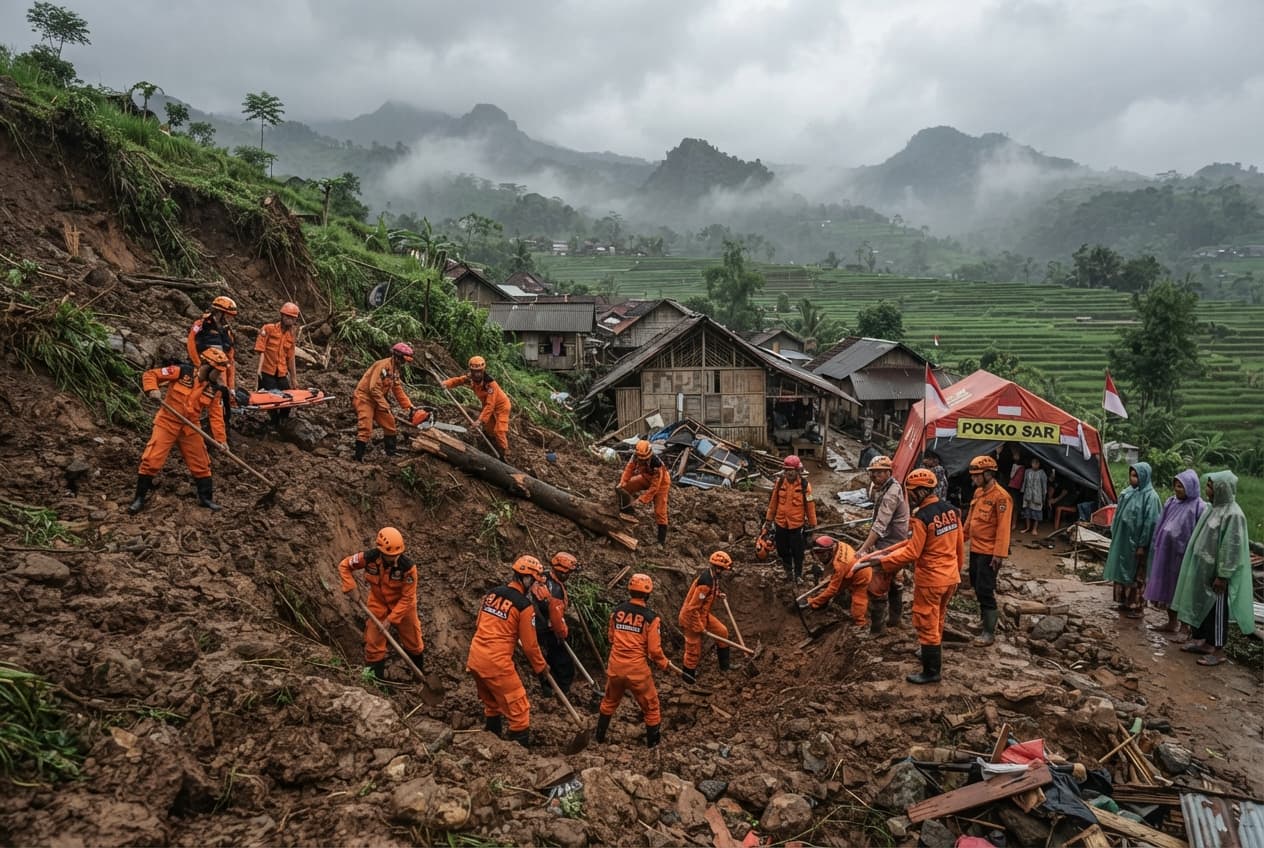
Bandung, Indonesia—A massive hillside collapse triggered by torrential rainfall buried a rural village in West Java earlier today, leaving four people dead and dozens missing under tons of mud and organic debris. Emergency search teams, local volunteers, and military personnel rushed to the affected hillside district following urgent calls from surrounding community members. Rescuers arrived to find several homes completely submerged under thick sludge, with access roads completely severed by earth movements.
The disaster struck during early morning hours after heavy downpours saturated the steep agricultural slopes above the settlement. The hillside gave way without warning, sending a wall of mud, boulders, and uprooted trees roaring down into the residential zone below. The sudden force swept away wooden structures, livestock, and vehicles, trapping sleeping residents inside their homes before they could evacuate.
Disaster response workers extracted four bodies from the mud layers within hours of initiating search operations. Paramedics confirmed the victims died from asphyxiation and severe crush trauma suffered during the slide. Medical teams set up temporary triage centers on higher ground to treat survivors suffering from hypothermia, deep lacerations, and broken bones.
Heavy machinery struggled to reach the core impact area due to blocked access routes and unstable soil conditions across the valley floor. First responders and local villagers were forced to use shovels, hoes, and their bare hands to clear mud and feel for trapped survivors. Search dogs and acoustic sensing equipment were deployed along the debris perimeter to locate air pockets beneath buried rooftops.
Regional authorities established emergency evacuation shelters in nearby schools and municipal buildings to house displaced families. Hundreds of residents living along neighboring slope lines were ordered to evacuate immediately as geologists warned of potential secondary slides following ongoing rainfall. Relief agencies began distributing clean water, thermal blankets, and food rations to families taking refuge in the shelters.
Local community leaders noted that deforestation and agricultural terracing on the upper slopes had long heightened soil instability during monsoon seasons. Environmental advocates called for immediate reviews of land-use policies across vulnerable hilly zones in West Java to prevent recurring disaster events. Government officials acknowledged that warnings regarding slope erosion had been issued earlier in the rainy season.
Disaster management officials expanded the search perimeter late in the afternoon as additional rescue squads arrived with specialized trenching tools and water pumps. Teams worked under challenging weather conditions as intermittent rains threatened to trigger further earth movements along the exposed ridge. Operations were structured into rotating shifts to ensure continuous search efforts throughout the night.
Forensic identification teams from the regional police department established a processing center near the shelter complex to identify the deceased and manage family inquiries. Social workers began providing psychological support to families waiting for news of missing relatives near the perimeter lines.
Search and rescue authorities confirmed that operations will continue until all missing individuals are accounted for. The local regency administration declared a fourteen-day emergency response period to mobilize regional emergency funding and logistics. The affected sector remains strictly off-limits to unauthorized personnel due to high landslide risks.
Published by Banx Network. This article is part of the Banx decentralized media programme, powered by the BXE token on the XRP Ledger.