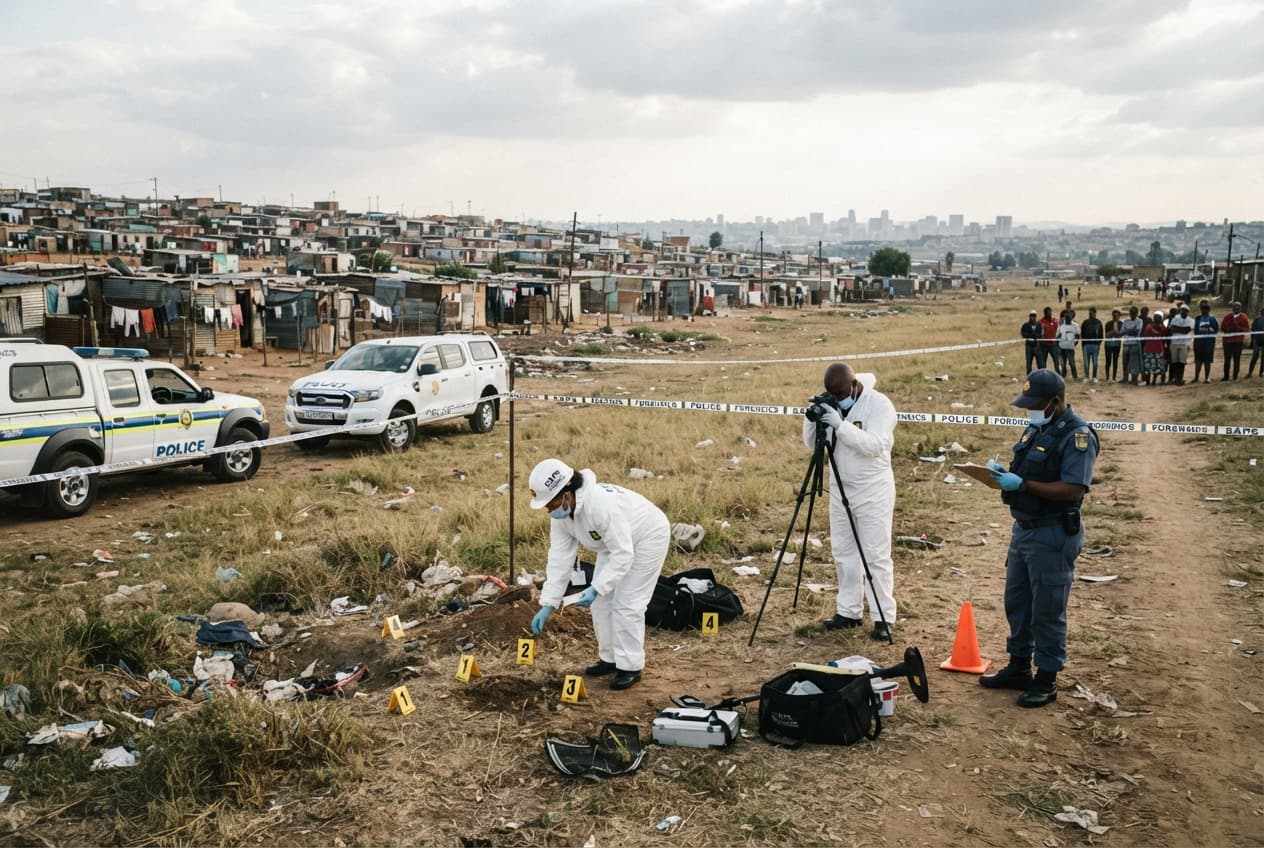
Johannesburg, South Africa—Local authorities confirmed the recovery of a young woman's body near an active construction site on the eastern edge of the metropolitan district. Forensic pathology teams cordoned off the dusty perimeter as investigators examined visible trauma wounds on the victim. This grim discovery marked the ninth time police have retrieved a female corpse from the same municipal region over a span of two months. Regional police commissioners rushed to the scene as word spread through nearby residential townships, drawing angry crowds of local residents.
Provincial security chiefs addressed journalists behind police tape, admitting that operational similarities across multiple crime scenes pointed toward a coordinated pattern of violence. Specialized multi-disciplinary detective units were deployed across several townships including Kempton Park, Dawn Park, and Clayville to trace the movements of potential suspects. Community members expressed mounting fury over institutional failures to protect women from escalating predatory attacks. Civil rights organizations and religious coalitions scheduled emergency protest marches toward local police stations to demand immediate protection measures
Family members of missing individuals gathered outside municipal community centers holding photographs and demanding answers from indifferent bureaucratic agencies. Support networks for missing persons issued urgent advisories urging citizens to report disappearances without delay rather than waiting out arbitrary holding periods. Local running clubs organized solidarity marathons and evening prayer vigils to honor victims who vanished during routine daily activities. Political leaders faced sharp criticism from opposition legislators who accused security ministries of dragging their feet on gender-based violence initiatives.
Provincial government officials arrived at the latest discovery site to pledge additional financial resources and specialized forensic tracking equipment for the investigative task force. Investigators warned citizens against circulating unverified graphic images or rumors across social media platforms, noting that disinformation hampered active police work. Forensic pathologists continued conducting detailed post-mortem examinations to establish exact timelines and chemical markers for each recovered victim. Intelligence officers combed through digital communications and local surveillance archives for viable clues linking the separate dumping grounds.
Community policing forums established voluntary neighborhood patrols to escort women commuting through isolated industrial corridors during early morning and late evening hours. Local business owners shuttered storefronts early in solidarity with public demonstrations demanding accountability from national security ministers. Religious leaders faced direct censure from activist groups demanding that pulpits address domestic and systemic violence openly rather than maintaining silence. Law enforcement agencies maintained strict checkpoints along arterial roads leading out of the municipality to intercept fleeing suspects.
Federal prosecutors announced they would review all past unsolved abduction cases across the greater Gauteng region to identify potential connections to the current spree. Forensic technicians processed soil and fiber samples recovered from the latest site in an effort to match microscopic evidence across the case files. Detective teams worked through the night inside temporary command vehicles, analyzing incoming telephone tips from informants. High-ranking police commanders reiterated their commitment to apprehending the perpetrators before further lives were lost.
Published by Banx Network. This article is part of the Banx decentralized media programme, powered by the BXE token on the XRP Ledger.