
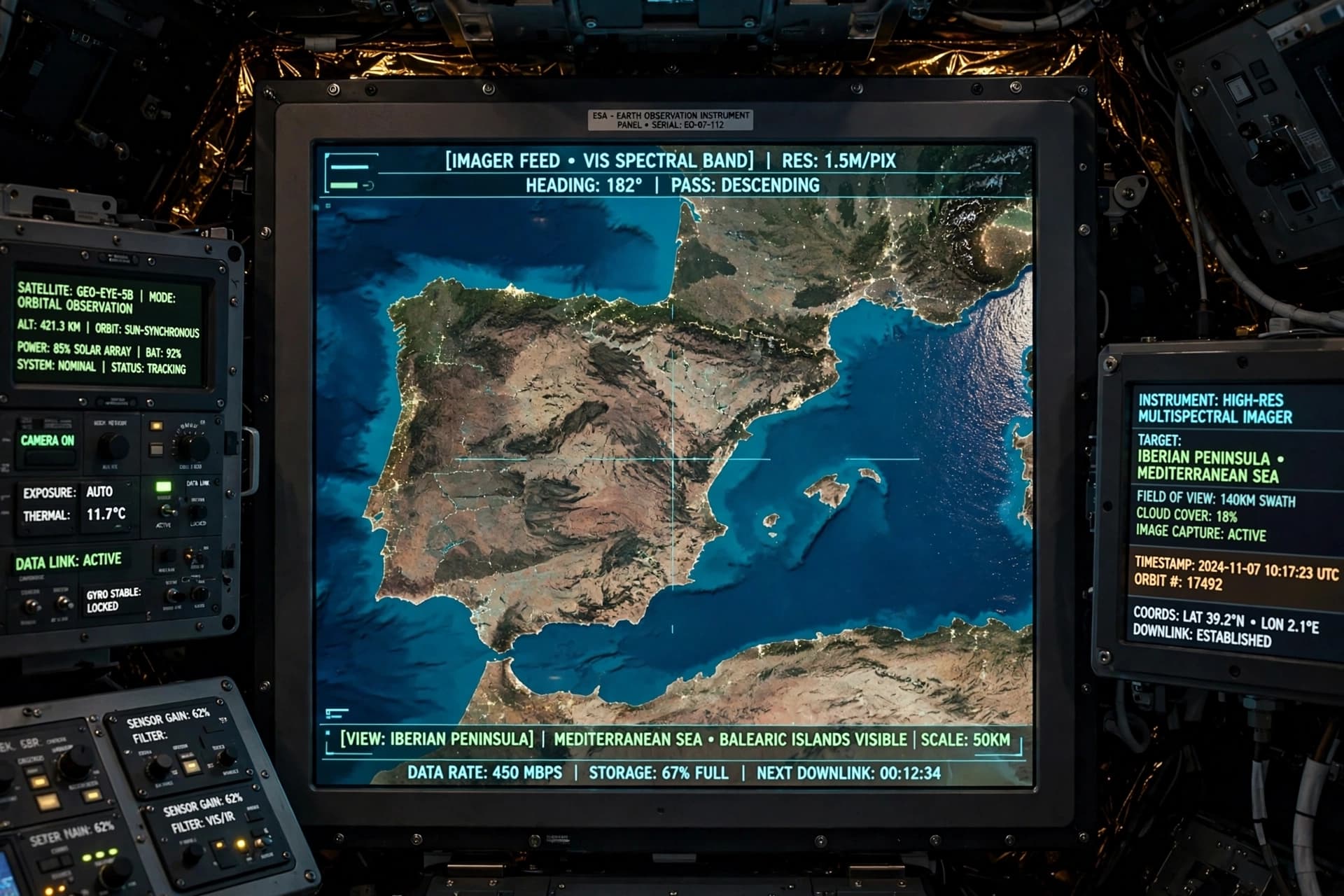
There is a particular promise in a first image—a promise made not in words but in the data that flows from a satellite's instruments, the colors and patterns that reveal whether the years of design and testing have produced something that works, and works well. On Tuesday, the European Space Agency released the first views of Earth from Sentinel-3C, the latest satellite in the Copernicus program, which was launched in September. The images show the planet in remarkable detail: the deep blue of the ocean, the green of the land, the intricate patterns of clouds and coastlines. They are the first of many, and they mark the beginning of a mission that will monitor the health of the planet for years to come.
Sentinel-3C is part of the Sentinel-3 family, a series of satellites designed to measure sea surface temperature, ocean color, sea level, and land surface temperature. The satellites carry instruments including the Ocean and Land Colour Instrument (OLCI), the Sea and Land Surface Temperature Radiometer (SLSTR), and the Synthetic Aperture Radar Altimeter (SRAL). Together, these instruments provide a comprehensive picture of the Earth's surface and its changes over time. The data they produce is used for a wide range of applications: monitoring the health of fisheries, tracking the effects of climate change, managing water resources, and responding to disasters.
The first images from Sentinel-3C demonstrate that the instruments are functioning as intended. One image shows the Iberian Peninsula and the Balearic Islands, with the Mediterranean Sea appearing in shades of blue and the land in tones of green and brown. Another shows the coast of Western Australia, with the Indian Ocean stretching toward the horizon. The images are not just beautiful—they are scientifically valuable, providing a baseline against which future changes can be measured.
What makes the Sentinel-3 mission particularly important is its continuity. The first Sentinel-3 satellite, Sentinel-3A, was launched in 2016; Sentinel-3B followed in 2018. The satellites have been collecting data for years, and their combined observations have become a critical resource for scientists and policymakers. Sentinel-3C will extend that record, ensuring that the measurements continue without interruption. The mission is part of Copernicus, the European Union's Earth observation program, which provides free and open access to data for anyone who needs it.
The first images are a milestone, but they are also a beginning. The satellite will now undergo a period of commissioning, during which its instruments will be calibrated and its data validated. Once that process is complete, the data will be released to the public, and the satellite will take its place alongside its predecessors, adding to a record of the planet that grows richer with each passing year. The views are the first of many. The work has just begun.
AI Image Disclaimer: The visual elements in this article were created using AI generation tools and are intended for illustrative purposes only.
Sources: European Space Agency, Copernicus Programme, Eumetsat
Published by Banx Network. This article is part of the Banx decentralized media programme, powered by the BXE token on the XRP Ledger.

.jpg&w=3840&q=75 "September 2026 Was the Second-Warmest on Record, With Global Temperatures Above 1.5°C for a Second Month")