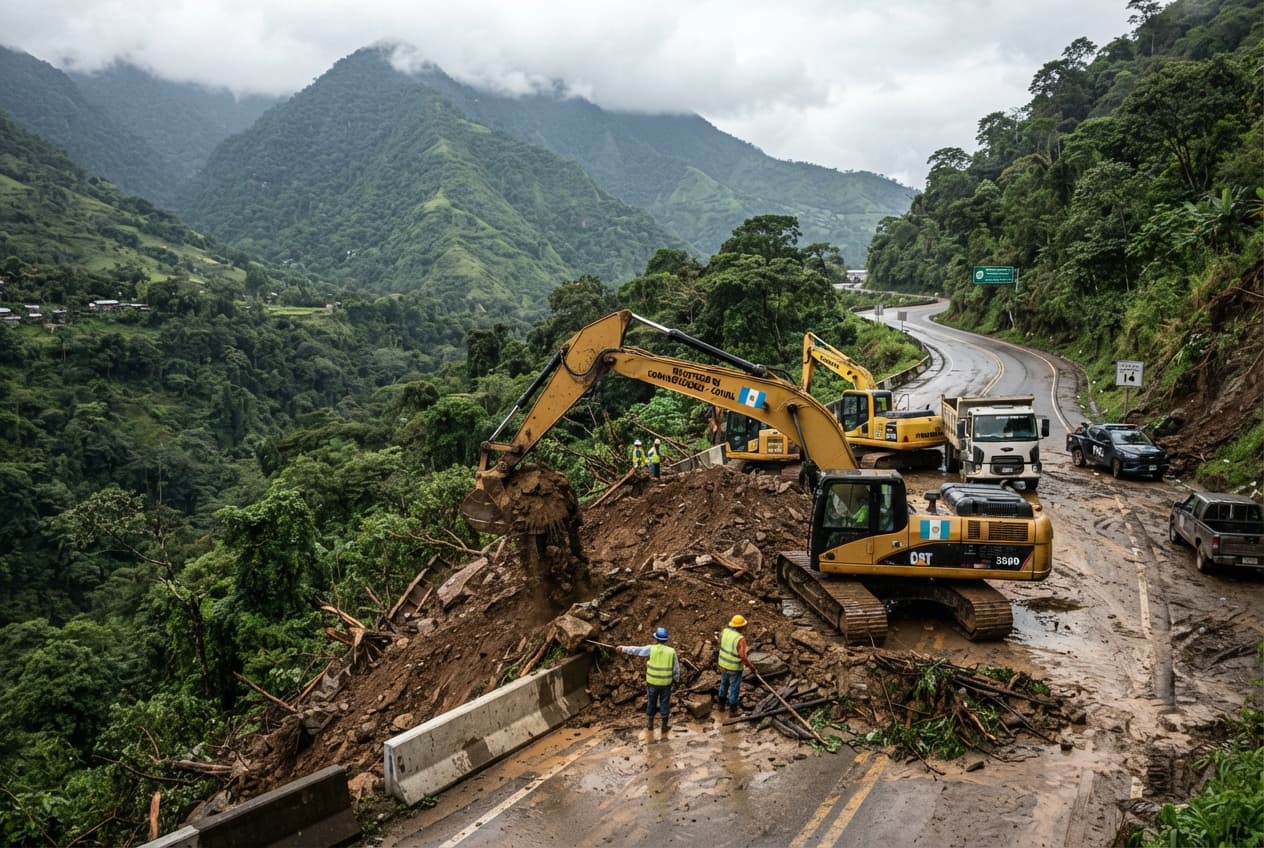
Guatemala City, Guatemala—A massive wall of mud and stone detached from a saturated hillside early Friday morning, burying a passenger vehicle on a vital rural highway. Continuous seasonal downpours had softened volcanic soil strata across the mountain pass over preceding weeks, pushing regional geology past stability limits. National civil protection authorities confirmed that five travelers inside the trapped vehicle perished before rescue units could breach the dense debris field. Heavy construction equipment mobilized by the transport ministry worked to clear hundreds of cubic meters of earth choking the mountain corridor. Traffic police closed access to the affected route at major junctions miles away, turning commercial trucks and buses around.
Emergency medical technicians and firefighters established an operational base near the slide edge to manage heavy extraction tools. Specialized search dogs combed the perimeter of the buried automobile to ensure no other pedestrians were caught in the secondary slide zone. Geological survey experts warned that persistent rainfall continued to threaten neighboring escarpments with sudden, unpredictable slope collapses. Regional transport officials issued mandatory travel restrictions for heavy freight carriers traversing mountain passes during active precipitation windows. Local municipal leaders provided logistical support to stranded motorists waiting out the highway closure at nearby roadside rest stops.
Families of the victims arrived at the municipal morgue escort convoy as recovery teams transferred the remains from the disaster site. International humanitarian organizations offered emergency engineering support to help clear blocked arterial transport arteries across the highlands. Agricultural workers watched from safe distances as muddy torrents swept across adjacent coffee plantations, flattening ripening crop rows. Government ministers announced a temporary allocation of emergency infrastructure funds to reinforce vulnerable roadside retaining structures. Meteorological monitors predicted that seasonal storm patterns would persist across the central highlands through the end of the month.
Cleanup operations slowed down significantly as evening fog rolled over the mountain pass and fresh rain showers began falling. Heavy machinery operators parked their equipment on stable ground until dawn to protect crews from nocturnal slide hazards. Traffic management bureaus broadcast alternate routing directions over national radio networks to guide stranded long-haul transport drivers. Civil protection agencies maintained red alert status across mountainous departments prone to high-velocity mudflows and flash inundations. Emergency command posts continued monitoring radar feeds while rescue units stood by for potential overnight deployments.
Published by Banx Network. This article is part of the Banx decentralized media programme, powered by the BXE token on the XRP Ledger.