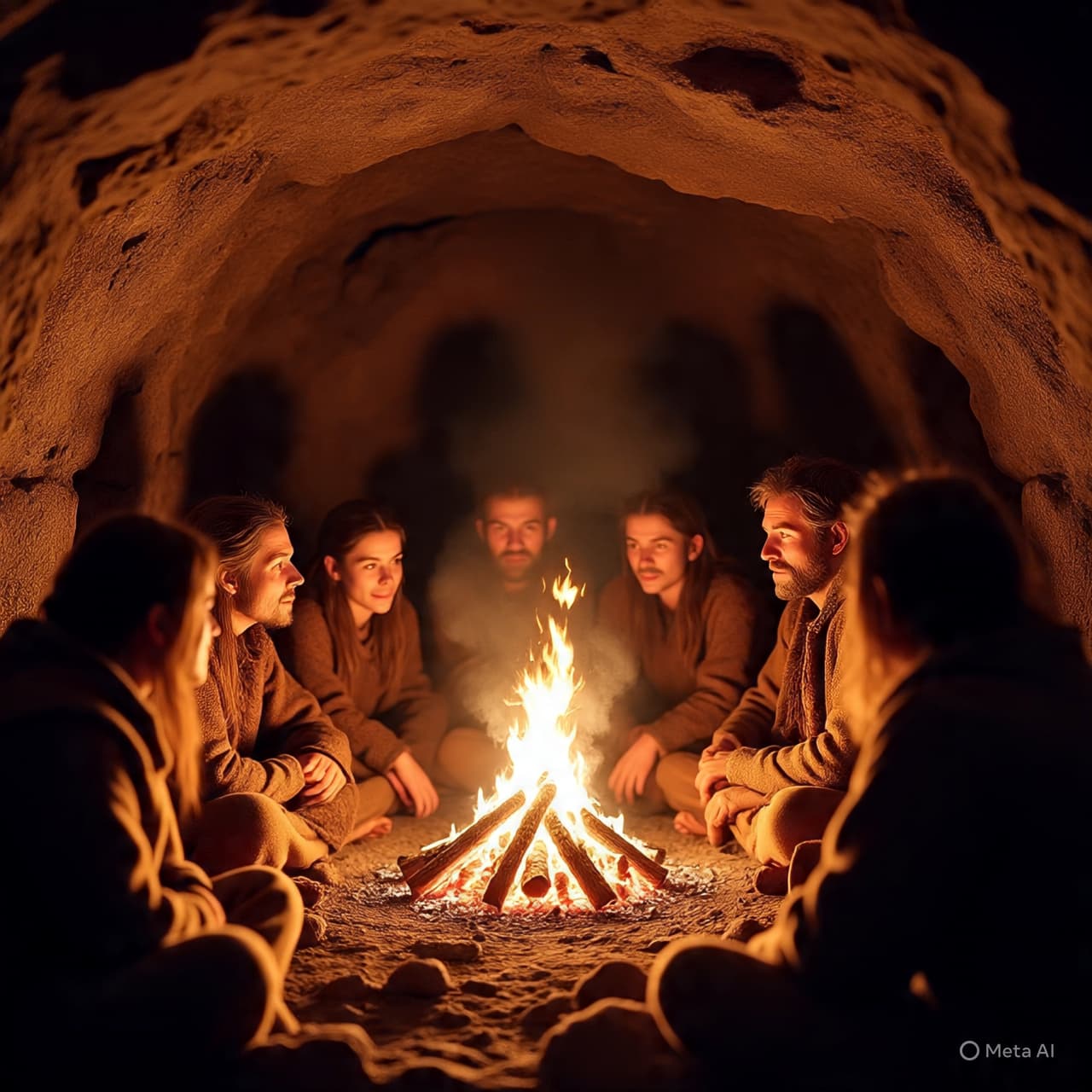
Long before language settled into shape, before tools became precise or shelters permanent, fire entered human life as both gift and threat. It warmed cold nights and softened food, but it also burned skin, scarred bodies, and demanded adaptation. A new study suggests that these injuries — often overlooked in the story of human progress — may have quietly shaped how our species evolved.
Burns were not rare accidents in early human environments. Open flames were unstable, unpredictable, and close at hand. Unlike claws or teeth, fire left injuries that healed slowly and incompletely. Survival depended not only on avoiding flames, but on enduring their consequences. Over generations, this pressure favored bodies better able to repair damaged skin, resist infection, and tolerate pain without losing function.
Researchers point to genetic adaptations related to wound healing and inflammation that appear unusually advanced in humans compared to other primates. Skin regeneration, immune response, and scar formation show signs of selection, suggesting repeated exposure to injury played a role in refining these systems. Burns, in particular, would have tested the limits of early physiology, exposing weaknesses quickly and often fatally.
The study also reframes social behavior as part of biological survival. Severe burns reduce mobility and hunting ability, making solitary recovery unlikely. Individuals who survived likely did so within groups capable of providing care, protection, and shared food. In this way, injury may have reinforced cooperation, favoring communities that could absorb temporary weakness without collapse.
Fire reshaped bodies indirectly as well. Cooking altered diet, improving nutrition and energy availability, which in turn supported faster healing and immune resilience. The ability to process richer food may have offset the risks of fire exposure, creating a feedback loop in which injury and adaptation evolved together.
Rather than a clean ascent toward mastery, the relationship between humans and fire appears uneven and costly. Progress left marks on the body. Burn injuries did not merely accompany evolution; they may have guided it, selecting for resilience over fragility, care over isolation, and patience over speed.
In the quiet record written into skin and genes, fire is not only a symbol of civilization. It is also a reminder that becoming human involved learning how to survive what we ourselves unleashed.
AI Image Disclaimer Visuals are AI-generated and intended as conceptual representations.
Sources Nature Ecology & Evolution Proceedings of the Royal Society B Harvard University Department of Human Evolutionary Biology
Published by Banx Network. This article is part of the Banx decentralized media programme, powered by the BXE token on the XRP Ledger.