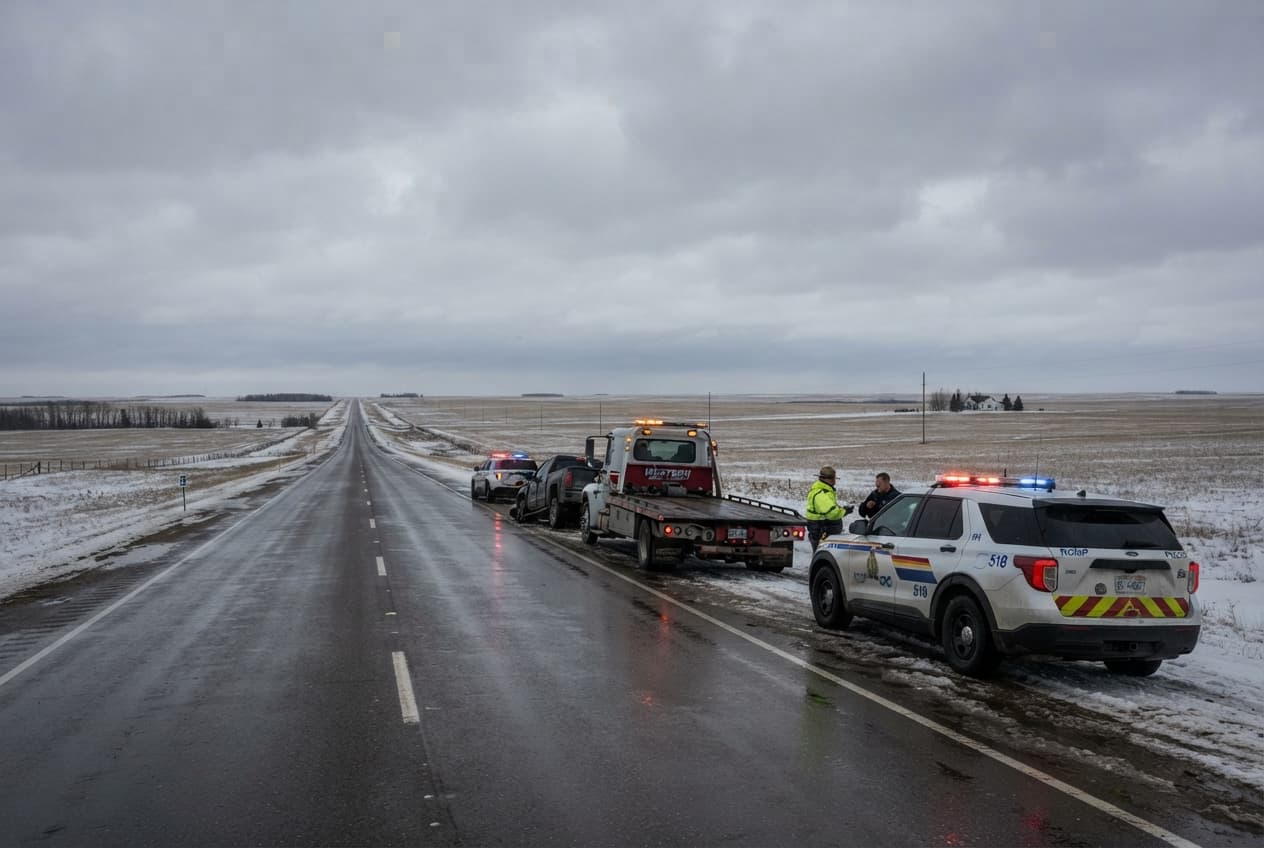
Regina, Canada—Debris glittered across the open prairie asphalt as emergency flashing lights cut through the grey morning drizzle. A devastating Saskatchewan highway crash claimed the lives of a family of four, sending shockwaves across the provincial interior. Royal Canadian Mounted Police detachments rushed to the remote stretch of two-lane highway following reports of a head-on collision. First responders found a heavily damaged passenger sedan and a commercial transport truck locked together in the ditch.
Paramedics confirmed that all four occupants of the passenger vehicle succumbed to their injuries before transport could be initiated. The driver of the semi-trailer sustained non-life-threatening injuries and was treated at a nearby regional health facility. Traffic along the trans-provincial corridor was diverted for miles as collision reconstruction experts secured the zone. Heavy recovery equipment was brought in to separate the wrecked vehicles from the soggy roadside embankment.
Forensic traffic analysts walked the pavement line with measuring wheels, documenting skid marks and impact trajectories. Initial findings indicate poor visibility and wet road conditions may have contributed to the vehicle crossing the center line. Investigators interviewed commercial transport witnesses who described sudden braking maneuvers moments before the impact occurred. Transport safety inspectors examined the braking systems and electronic logging data of the semi-trailer truck.
Local community leaders in the nearby farming town expressed profound grief upon learning the identities of the deceased family members. School officials confirmed that two of the victims were young children enrolled in the local district elementary school. Neighbors gathered at community centers to drop off food and offer support to extended family members in the region. Municipal flags were lowered to half-mast in tribute to the lives lost in the catastrophic highway incident.
The crash renewed fierce public debate regarding infrastructure conditions and the lack of divided lanes on major rural highways. Advocacy groups pointed to historical accident data on the corridor, demanding accelerated twinning projects from provincial ministers. Transportation ministry representatives defended current budgetary allocations, citing competing priorities across vast provincial road networks. Opposition politicians called for an immediate legislative inquiry into rural highway safety measures and maintenance schedules.
Coroner investigators supervised the removal of the victims' remains from the crushed sedan under heavy tarping. Funeral homes in the regional center prepared for the solemn arrival of the convoy carrying the family members. Police family liaison officers worked closely with relatives to provide support and navigate administrative procedures. The highway remained closed to all through traffic while heavy cleanup crews cleared spilled cargo.
Municipal road maintenance crews spread sand across patches of slick asphalt where fluid leaks threatened secondary traction issues. Environmental protection officers monitored the ditch line to contain a minor diesel fuel spill leaking from the truck's ruptured saddle tank. Tow operators wrapped chains around the mangled chassis of the sedan to hoist it onto a flatbed trailer. The highway finally reopened to restricted traffic flow late in the evening.
Provincial police reiterated their ongoing appeal for motorists to adjust driving habits to match changing seasonal weather patterns. Investigators stated that a complete technical report detailing the causal factors of the crash will take several weeks to finalize. The prairie winds swept across the empty highway as the investigation transitioned from emergency response to forensic analysis. Communities across the province mourned the sudden and devastating loss of an entire family.
Published by Banx Network. This article is part of the Banx decentralized media programme, powered by the BXE token on the XRP Ledger.