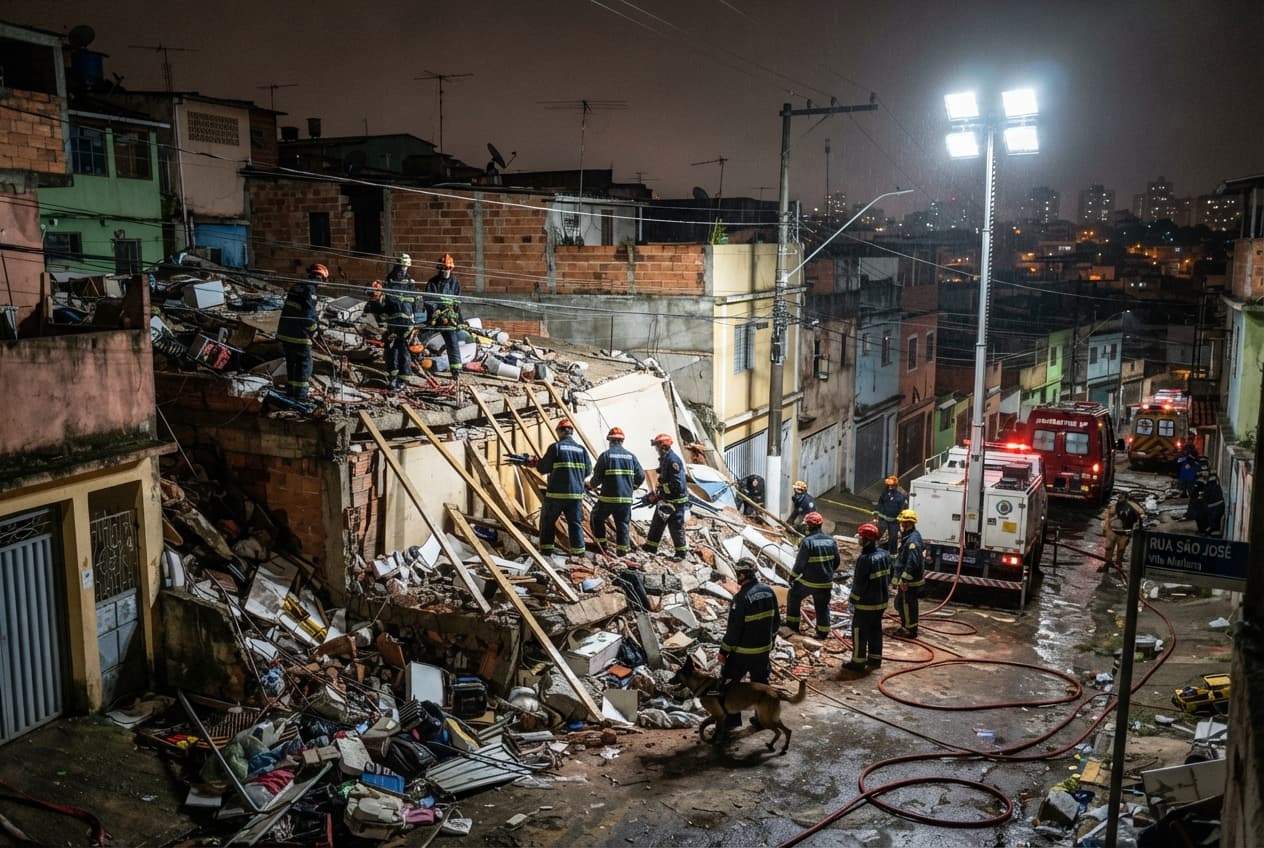
São Paulo, Brazil—Torrential downpours battered the metropolitan outskirts during the night, triggering a catastrophic structural collapse that crushed a residential family home. Municipal emergency services confirmed that two young children lost their lives beneath the falling masonry. The storm system dumped record volumes of rain across the urban basin, overwhelming local drainage systems and destabilizing saturated foundations. Fire rescue squads rushed to the densely populated neighborhood as neighbors began digging through the rubble with bare hands.
The sudden structural failure reduced the single-story dwelling to a tangled mass of broken concrete and twisted reinforcement bars. Family members inside the house were trapped when the roof slab gave way under the weight of accumulated water and mud. Emergency personnel deployed hydraulic lifting equipment and search-and-rescue canines to locate survivors amidst the unstable debris. Police officers cordoned off the surrounding blocks to keep curious onlookers away from adjacent buildings showing structural cracks.
Civil defense commanders noted that rapid, unmonitored urban growth across the municipal periphery consistently forces families into high-risk geological zones. Decades of neglected retaining walls and blocked municipal drainage channels compounded the vulnerability of the residential lot. Repeated safety warnings issued to local planning boards regarding hillside stability went unheeded prior to the storm. Those administrative oversights set the stage for the residential disaster.
Fire department spokesperson Lieutenant Marcos Almeida addressed reporters near the cordoned collapse zone. The weight of water and unstable earth proved too much for the boundary structures supporting the property, Almeida stated. Our extraction teams worked through extreme hazards to recover the victims from the interior space. Every available unit remains mobilized across the metropolitan region.
Paramedics treated several surviving family members for severe shock, lacerations, and acute trauma at a mobile triage post. Local hospitals activated emergency disaster protocols to receive pediatric casualties transferred from the site. Municipal social workers arrived to coordinate temporary shelter provisions for displaced neighbors whose homes face mandatory evacuation orders. Utility technicians cut electrical and gas lines across the block to prevent secondary explosions.
Structural engineers utilized laser measurement tools to monitor foundation shifts in three neighboring houses overlooking the crater. City inspectors posted red condemnation notices on vulnerable properties, ordering immediate clearance by occupants. Forensic investigators documented the wreckage layout to determine precise civil liability factors. Recovery operations concluded as heavy excavation machinery stabilized the perimeter.
Published by Banx Network. This article is part of the Banx decentralized media programme, powered by the BXE token on the XRP Ledger.