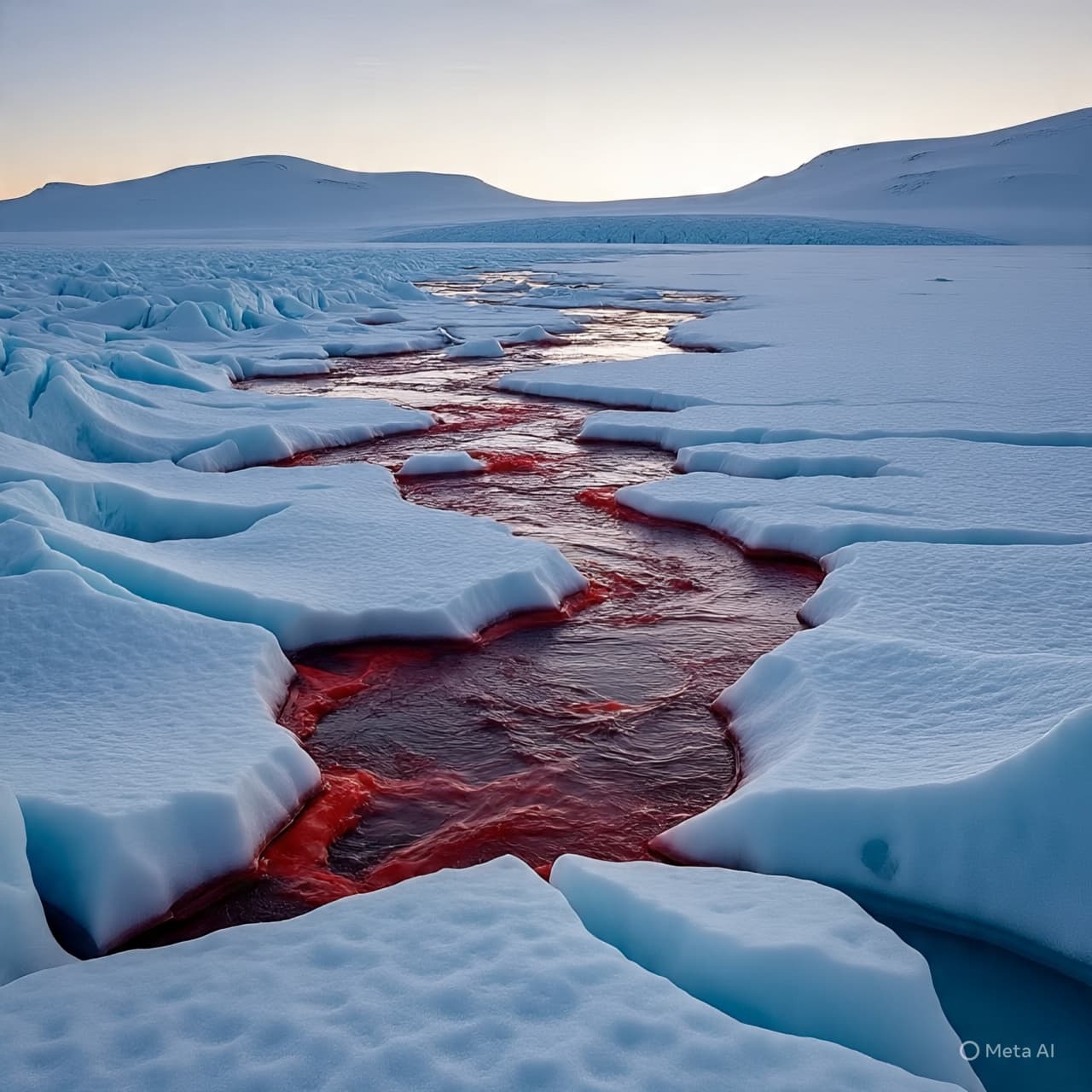
In the vast stillness of Antarctica, where wind sweeps across ice like a patient hand smoothing glass, there is a place where the white is interrupted by red. It spills from the face of a glacier in slow, rust-colored rivulets, staining the frozen surface below. Against the silence of the polar desert, the sight feels almost mythic — as though the continent itself had been wounded.
They call it Blood Falls.
The phenomenon emerges from the front of the Taylor Glacier in the McMurdo Dry Valleys, one of the coldest and driest regions on Earth. For more than a century, explorers and scientists have puzzled over its appearance: a crimson outflow streaming from an icy fissure, flowing intermittently onto the snow.
Early visitors speculated about algae or mysterious biological processes. But as research deepened, the explanation proved less dramatic — and more elegant.
Beneath the glacier lies an ancient pocket of hypersaline water, sealed off from the atmosphere for roughly two million years. This briny reservoir, trapped beneath thick ice, contains high concentrations of iron. When the subglacial water seeps to the surface through narrow fractures, it encounters oxygen for the first time in millennia. The iron reacts, oxidizing in a process similar to rust forming on metal. The result is the distinctive blood-red hue that streaks the glacier’s face.
Scientists from institutions including NASA and the National Science Foundation have studied the site not only for its visual drama but for what it reveals about life in extreme environments. The trapped brine remains liquid despite subzero temperatures because of its salt content, and it hosts microbial communities that survive without sunlight, sustained by chemical reactions involving iron and sulfur.
In that sense, Blood Falls is less a wound than a window — a glimpse into biochemical processes that operate beyond ordinary ecosystems. Its chemistry has drawn the interest of astrobiologists searching for analogues to icy worlds such as Mars or Jupiter’s moon Europa, where subsurface brines might also harbor life shielded from harsh surface conditions.
The McMurdo Dry Valleys themselves are often described as one of the closest terrestrial approximations of Mars: barren, windswept, and largely devoid of surface life. Yet even here, beneath layers of ice, ancient water circulates slowly through hidden channels. Radar imaging and geophysical surveys have mapped subglacial networks, revealing that Antarctica’s interior is less static than it appears.
The red plume does not flow constantly. It pulses irregularly, depending on pressure within the subglacial system and subtle shifts in the ice above. Each emergence leaves a fresh stain on the snow, a reminder that movement persists beneath what seems immovable.
There is something quietly reassuring in the explanation. What once looked ominous is simply chemistry meeting air. Iron, long isolated, reacting as iron does. The glacier does not bleed; it rusts.
And yet the image lingers — a bright slash across an otherwise pristine expanse. In a landscape defined by austerity, even a small change becomes monumental. Blood Falls reminds us that Antarctica, often imagined as frozen in time, holds dynamic systems beneath its surface. Ancient waters continue their slow circulation. Microbes endure in darkness. Iron waits for oxygen.
In the end, the mystery resolves not into spectacle but into process. The red waterfall is not a warning or an omen. It is the visible trace of invisible forces — geology, chemistry, and time converging at the edge of ice.
In Antarctica’s immense quiet, even rust can feel like revelation.
Published by Banx Network. This article is part of the Banx decentralized media programme, powered by the BXE token on the XRP Ledger.