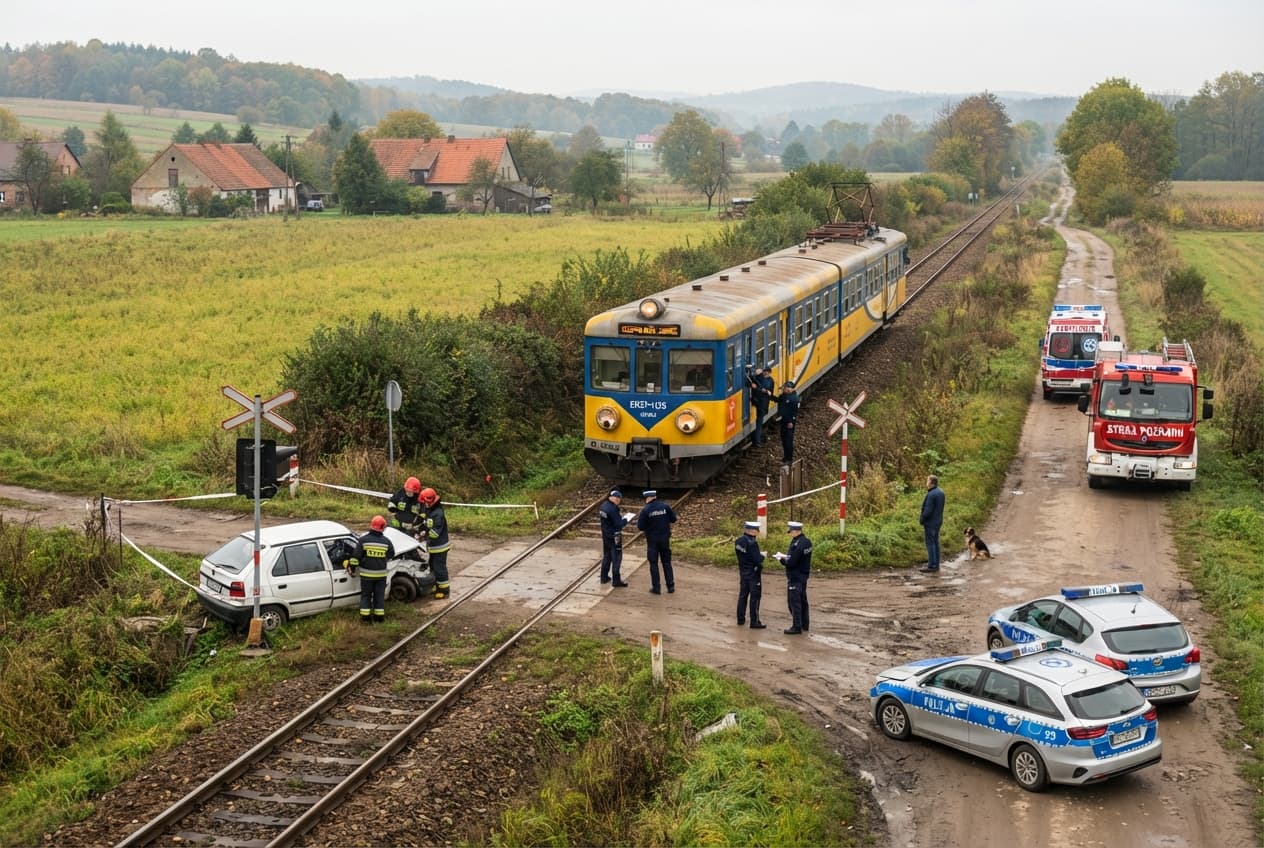
Lublin, Poland—A high-speed regional passenger train struck a passenger vehicle at an unsignaled railway crossing in a rural district of eastern Poland, resulting in the immediate death of two car occupants. The collision occurred as the locomotive crossed the unprotected intersection amid thick morning fog that severely limited visibility along the corridor. Train operators applied emergency brakes, but momentum carried the heavy passenger set nearly half a kilometer down the tracks before coming to a complete halt. Regional paramedics and state fire units rushed to the scene following frantic calls from onboard conductors.
First responders found the passenger automobile crushed and dragged beneath the front cowcatcher of the locomotive. Both occupants inside the car were pronounced dead at the scene by attending emergency physicians. None of the passengers or crew members aboard the train sustained physical injuries during the abrupt emergency stop. Railway technicians isolated overhead electrical catenary lines to allow safe extraction of the wreckage.
Local residents gathered near the tracks to protest the ongoing absence of automatic warning gates at the rural intersection. Municipal authorities confirmed that local councils have lobbied the national railway infrastructure manager for years to install active signaling. Regional prosecutors opened an immediate inquiry into whether mechanical fog warnings or speed restrictions were properly observed. The train driver underwent mandatory breathalyzer and toxicology screenings, which returned negative results.
National rail operators suspended all traffic along the single-track regional corridor while rescue crews cleared the wreckage. Replacement bus services were dispatched to transport stranded commuters between regional market towns. Railway safety inspectors began downloading event logs from the locomotive's onboard computer to verify transit speeds. The impacted crossing remains cordoned off with police tape as technical experts inspect track geometry.
Representatives from the state transport inspectorate arrived via rail inspection car to document sightline obstructions. Investigators noted that overgrown brush near the right-of-way potentially impaired the driver's peripheral vision. Local landowners denied responsibility for maintaining vegetation clearance buffers along the railway embankment. The bodies of the victims were transferred to the municipal forensic medicine department for formal autopsies.
Commuter services across the broader voivodeship experienced severe cascading delays throughout the afternoon peak. Railway dispatchers rerouted long-distance freight trains through alternative northern junctions to bypass the blocked segment. Passenger advocacy groups renewed calls for accelerated automation of hundreds of passive level crossings nationwide. Government infrastructure ministers promised an immediate funding review for rural rail safety upgrades.
Forensic photography teams completed their topographical mapping of the impact zone just before sunset. Heavy recovery cranes successfully hoisted the wrecked passenger car off the tracks and loaded it onto a flatbed trailer. Track engineers inspected the rails for structural distortion and confirmed the permanent way remained structurally sound. Normal rail operations on the corridor are tentatively scheduled to resume before the morning commute.
State authorities plan to release a comprehensive factual update once the black-box data analysis concludes. Local police appealed for any remaining witnesses with dashboard camera footage of the approach to come forward. Grief support specialists were dispatched to the local village where the victims maintained active community ties. Investigation teams wrapped up field operations at the crossing as darkness settled over the rural plains.
Published by Banx Network. This article is part of the Banx decentralized media programme, powered by the BXE token on the XRP Ledger.