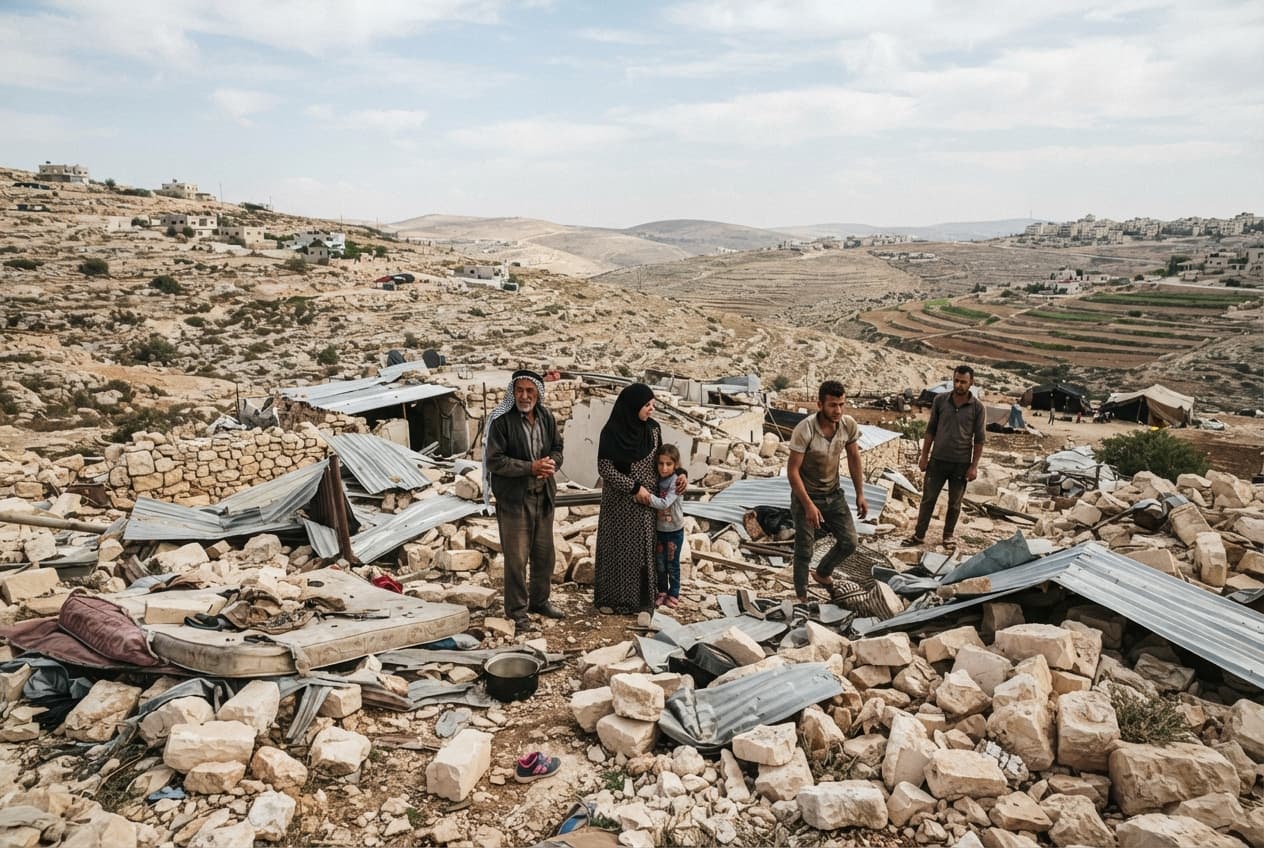
Hebron, West Bank—Israeli administrative forces backed by heavy engineering equipment executed a fresh wave of structural demolitions across multiple herding hamlets in the Masafer Yatta region, displacing dozens of Palestinian residents. The morning operations targeted remote rural communities situated within designated firing zones, leaving families homeless and stripping vulnerable agrarian settlements of essential water storage and livestock infrastructure.
Civil Administration bulldozers accompanied by military units entered the hillside community of Khirbet al-Fakhit before dawn, cordoning off residential perimeters prior to dismantling homes and agricultural outbuildings. Local village councils reported that several residential structures, animal shelters, solar panel arrays, and subterranean water cisterns were systematically flattened during the sweep.
Community leaders noted that families had occupied these ancestral lands for generations, depending entirely on seasonal grazing and small-scale livestock rearing for economic survival. "They are systematically erasing the basic infrastructure required to sustain human life in this arid landscape," stated local field researcher Nasser Nawajaa while inspecting the rubble of a demolished dwelling.
Humanitarian monitors on the ground documented the destruction of multiple external latrines, chicken coops, and vital rainwater harvesting tanks crucial for summer survival in the water-scarce southern hills. Displaced herders scrambled to salvage corrugated metal sheets and wooden beams from the wreckage while trying to herd distressed sheep away from collapsing masonry walls.
Legal aid organizations operating in the West Bank filed urgent injunctions attempting to halt the administrative enforcement actions, arguing that mass displacement violates fundamental international protections governing occupied territories. Courts, however, routinely reject preliminary appeals concerning structures built without permits—permits that Palestinian residents state are practically impossible to secure from military planning committees.
International diplomatic missions issued periodic statements expressing deep concern over the accelerated pace of administrative demolitions and coercive displacement pressures exerted on rural herding populations. Representatives from European Union delegations visited the affected hamlets to assess humanitarian needs and document property losses inflicted by the heavy machinery operations.
Displaced families hastily pitched makeshift canvas tents and plastic sheeting over stone foundations, facing an immediate future devoid of electricity, running water, and basic sanitation facilities. Local community committees worked alongside volunteer groups to deliver emergency food parcels and temporary shelter materials before nightfall descended across the rocky hillsides.
As military vehicles withdrew toward nearby settlement outposts, residents gathered around small campfires amidst the ruins of their homes, contemplating long-term survival strategies under escalating expulsion pressures. The threat of subsequent demolition waves hangs heavy over neighboring hamlets bracing for similar enforcement notices in the coming weeks.
Published by Banx Network. This article is part of the Banx decentralized media programme, powered by the BXE token on the XRP Ledger.